EN
EN  DE
DE  RU
RU  PT
PT  JA
JA  ES
ES  IT
IT 
Impact Barriers
Impact barriers are a crucial safety and protective measure in various industries. They are designed to mitigate and reduce the impact of collisions, providing safety for both personnel and equipment. In this comprehensive product description, we will explore the features, benefits, and applications of impact barriers.
What Are Impact Barriers?
Impact barriers, also known as crash barriers or safety barriers, are specialized structures designed to absorb and redirect the force of impacts, such as those caused by vehicles or heavy machinery. These barriers are commonly used in industrial facilities, construction sites, warehouses, and roadways to prevent accidents and protect assets.
Key Features of Impact Barriers
Impact barriers come with a range of features that make them an essential safety component:
- High-Quality Materials: Our impact barriers are constructed using durable and high-strength materials, ensuring their ability to withstand significant forces.
- Modular Design: The modular design of impact barriers allows for easy installation, customization, and expansion to fit various environments and requirements.
- Energy Absorption: These barriers are designed to absorb and dissipate kinetic energy, minimizing damage during collisions.
- Corrosion Resistance: To ensure long-lasting performance, our impact barriers are treated with anti-corrosion coatings, making them suitable for outdoor use.
- Visibility Enhancements: Some models feature reflective elements for increased visibility, especially in low-light conditions.
How Impact Barriers Work
The functionality of impact barriers is based on the principle of energy absorption and redirection. When a collision occurs, these barriers absorb the energy of the impact and redirect it along the barrier’s length, preventing the colliding object from penetrating further into a protected area.
Applications of Impact Barriers
Impact barriers find wide-ranging applications in multiple industries:
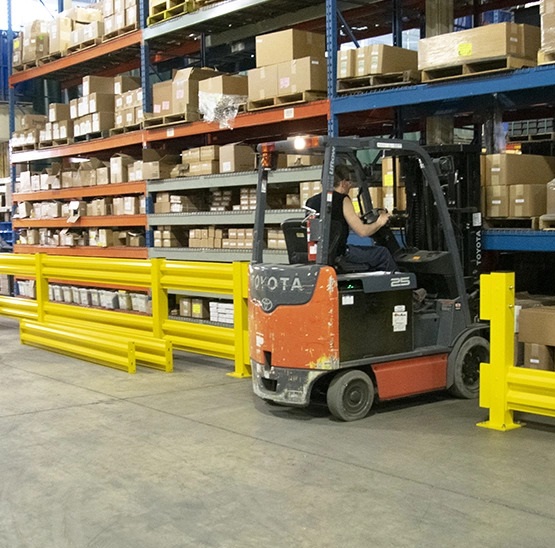
- Industrial Safety: Impact barriers are used in manufacturing plants and warehouses to protect workers, equipment, and structures from vehicle collisions.
- Construction Sites: They provide safety for construction workers and prevent unauthorized access to potentially hazardous areas.
- Roadway Safety: Impact barriers are essential on highways and roads to mitigate accidents and minimize vehicle damage during collisions.
- Storage Facilities: Warehouses and storage yards use impact barriers to safeguard inventory and storage structures.
Why Choose Our Impact Barriers?
When it comes to safety and protection, our impact barriers stand out for several reasons:
Durability and Reliability
Our impact barriers are built to last, ensuring they provide long-term protection for your assets and personnel. With corrosion-resistant coatings and high-quality materials, you can trust their reliability.
Customization Options
We offer customization options to tailor our impact barriers to your specific needs. Whether you require a certain size, color, or additional features, we can accommodate your requirements.
Easy Installation
Our modular design makes installation a breeze. Save time and resources with straightforward assembly and minimal downtime.
Compliance with Safety Standards
All our impact barriers adhere to industry safety standards, ensuring that you receive a product that meets or exceeds safety regulations.
Enhance Safety with Impact Barriers
Investing in impact barriers is an investment in safety and protection. Whether you need to secure your industrial facility, construction site, or roadway, our impact barriers offer a reliable solution. Contact us today to learn more about how our impact barriers can benefit your organization.
Interlock Switch Mounting Without Drilling: Why Alfence T-Slot Posts End Phantom Stops
Bolting an interlock switch bracket through a powder-coated steel post drills the coating, drops swarf into the cell and leaves a rust line — and when the hinged leaf sags, the tongue misaligns and the PLC reports a phantom guard fault. Alfence mounts sensors, e-stops and conduit in the T-slot groove of a 40×40 mm or 45×45 mm aluminum post, with door hardware sized to keep the safety switch aligned.
Phantom Safe Torque Off Stops: T-Slot Guarding Fence Posts Mount Interlocks Without Drilling
Painted steel guarding posts force maintenance to drill for interlock switches, dropping swarf in the cell and breaking the coating where rust starts. Sagging hinge doors then misalign the interlock tongue and the PLC trips Safe Torque Off while the gate is closed. Alfence industrial safety fence mounts sensors, e-stops and cable routing into the T-slot aluminum profile post without drilling, and uses hinged, folding or sliding door frames that keep interlock geometry stable - protecting OEE through phantom stops and line changes.
Automotive Plant Industrial Safety Fence: Keep the Robot Cell Close to the Hazard
Automotive plants cannot afford to lose production floor to an oversized machine guarding perimeter. Alfence combines 20×100 mm mesh with slim 40×40 mm or 45×45 mm aluminum posts for a compact, reconfigurable industrial safety fence layout, with final clearance confirmed by the project risk assessment.