EN
EN  DE
DE  RU
RU  PT
PT  JA
JA  ES
ES  IT
IT In the foundational planning stages of any critical facility, a fundamental decision must be made: what will form the first line of defense? The choice often boils down to two classic options: a solid wall or a high-security fence. Traditionally, the wall has been seen as the default choice for maximum security, an imposing symbol of impenetrability. However, in the modern security landscape, this long-held assumption deserves rigorous scrutiny.
This is not a simple choice between materials; it is a strategic decision with profound, long-term implications for your security effectiveness, operational efficiency, and overall budget. This analysis will provide a multi-dimensional comparison to help you determine which solution truly aligns with the needs of a modern, technology-driven facility.

The Security Dimension: Re-evaluating “Impenetrability”
The primary purpose of a perimeter is, of course, security. But we must ask: what does “security” truly mean in the 21st century?
The Case for the Wall: A concrete or brick wall offers immense resistance to brute-force attacks. Its sheer mass is a powerful psychological and physical deterrent to unsophisticated threats.
The Critical Flaw of the Wall: Its greatest strength is also its most fatal weakness: it is opaque. A solid wall creates a total information blackout. You have zero visibility of the area immediately outside your perimeter. This means you cannot detect threats as they approach, survey the area, or prepare a response. In an era of advanced surveillance, a wall renders your expensive CCTV and AI analytics systems blind at the most critical boundary.
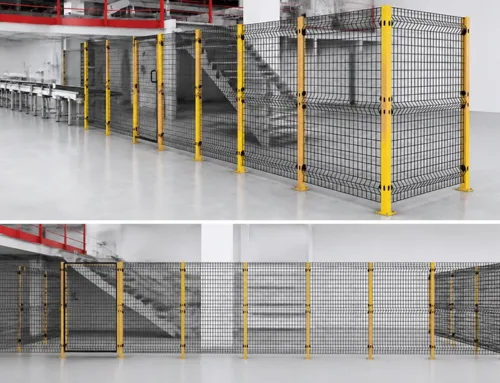
The Case for the Modern Fence: A high-performance security fence provides a more intelligent, layered approach to security.
- Proactive Awareness through Visibility: The defining advantage of a fence is its transparency. It allows your surveillance systems and human patrols an unobstructed view, enabling them to detect and assess potential threats long before they reach the perimeter.
- Active, Engineered Denial: Modern high-security fencing is not the easily defeated chain-link of the past. Systems engineered with a high-density, anti-climb mesh—often with apertures like 3″ x 0.5″—are designed to be virtually impossible to scale, as they offer no hand or foot holds. When considering anti climb fences, this is a crucial feature.
A wall provides brute-force blocking. A modern high-security fence provides an integrated defense, combining active physical denial with the crucial element of total situational awareness.
The Cost Dimension: A Total Cost of Ownership (TCO) Comparison
A facility’s perimeter is a multi-decade investment. Analyzing cost requires looking far beyond the initial quote.
- Initial Investment: A solid wall almost always carries a significantly higher upfront cost due to extensive foundational work, greater material requirements, and more intensive labor. A modular fence system is typically faster and less resource-intensive to install.
- Long-Term Maintenance: While a wall is immune to rust, it is susceptible to cracking and costly to repair. A premium fence system treated with a hot-dip galvanized base and a subsequent powder coating is engineered for extreme durability and near-zero maintenance.
- Future Adaptability: Modifying a concrete wall is a major, disruptive, and expensive construction project. A modular fence system, by contrast, is designed for adaptability. A panel can be replaced or a new gate integrated with relative ease and minimal operational downtime.
The Operational & Environmental Dimension
The perimeter’s impact extends beyond security and finance into the daily life of the facility.
- Environmental Integration: A solid wall blocks airflow and natural light, creating a harsh micro-environment. A transparent fence allows for natural ventilation and light.
- Emergency Response: In an emergency, a fence allows first responders to see into the site and assess the situation before entering, potentially saving critical time and lives. A wall completely obstructs this vital initial assessment.
- Aesthetics & Atmosphere: A wall creates an imposing, often oppressive “fortress” atmosphere. A modern fence, while secure, feels more open and can be customized with a full range of RAL colors to align with corporate branding and architecture.
Final Analysis: The Strategic Choice for a Modern Facility
The choice is clear. While the brute force of a solid wall has a certain appeal, it is a relic of a past security paradigm. It is inflexible, costly, and fundamentally incompatible with the principles of modern, technology-driven, proactive security.
The modern high-security fence offers a more intelligent solution. It delivers a formidable, engineered physical barrier while simultaneously enhancing the surveillance and operational capabilities of your facility. It is the strategically superior choice for any organization that values awareness, flexibility, and long-term financial prudence.