EN
EN  DE
DE  RU
RU  PT
PT  JA
JA  ES
ES  IT
IT 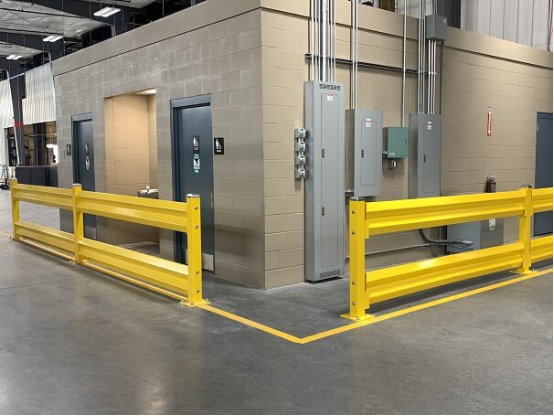
Let’s talk about Mark. Mark is not a real person, but his story is one that plays out in warehouses, distribution centers, and manufacturing plants every single day. He’s a forklift operator, and a very good one. With over a decade of experience, he can navigate a narrow aisle with a level of precision that is genuinely impressive. He’s passed every safety training course, he knows the rules, and he respects the bright yellow lines painted on the polished concrete floor. He is, by every measure, a model employee.
His Tuesday starts like any other. The morning rush is over, and the facility has settled into its steady operational rhythm. Mark is moving a pallet of finished goods from the production line to the staging area for shipment. It’s a route he has driven thousands of times. The route takes him past a key intersection—a blind corner where the main forklift thoroughfare meets a pedestrian walkway leading from the administrative offices to the factory floor. At that exact corner stands a bank of critical motor control centers (MCCs), the nerve center for the entire packaging line.
As Mark approaches the corner, he does what he’s been trained to do: he slows down and sounds his horn. At the very same moment, an engineer, focused on a tablet displaying urgent diagnostic data, steps out from the office hallway onto the pedestrian path. Hearing the horn, the engineer instinctively hesitates and takes a half-step back. Mark, seeing the briefest flash of movement, reflexively nudges his steering wheel to give the pedestrian a wider berth. It’s a tiny, almost imperceptible course correction. A subconscious act of courtesy.
But the laws of physics are not courteous. They are absolute. The slight change in direction shifts the momentum of the 4-ton vehicle and its 1-ton load. The massive hard-rubber tire on the outside of the turn catches the corner of the unprotected electrical cabinet with a dull, sickening thud. The impact itself isn’t dramatic. There is no crash, no flying debris. But inside the cabinet, the force fractures a series of busbar supports and sends a vibration through the sensitive programmable logic controllers (PLCs). A shower of sparks, a puff of acrid smoke, and the entire packaging line goes dark. Silence.
Analyzing the Anatomy of a “Harmless” Accident
In the post-incident review, what would we find? No one was reckless. No one broke the rules. Mark followed his training. The engineer was in a designated walkway. The painted lines on the floor were clear and compliant. By every administrative measure, this was a system that should have worked. But it failed. It failed because it relied on a chain of perfect human interactions that, in the real world, is fragile. It failed because it mistook a guideline for a physical barrier.
The true cause of this multi-thousand-dollar incident was not human error. It was a design error. It was the failure to account for the predictable physics of the environment and the equally predictable nuances of human nature. The reflexive swerve, the moment of hesitation—these are not failures; they are human instincts. A robust safety system does not try to train these instincts away. It anticipates them and builds a physical world where they cannot lead to a catastrophic outcome.
Designing for Reality, Not for Perfection
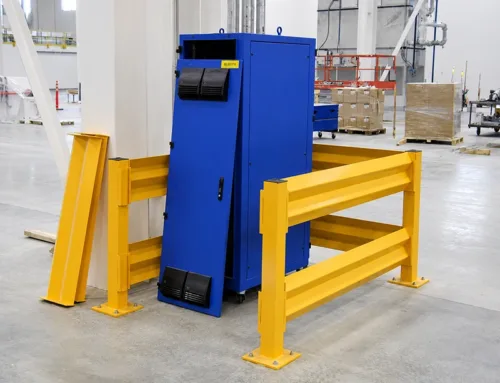
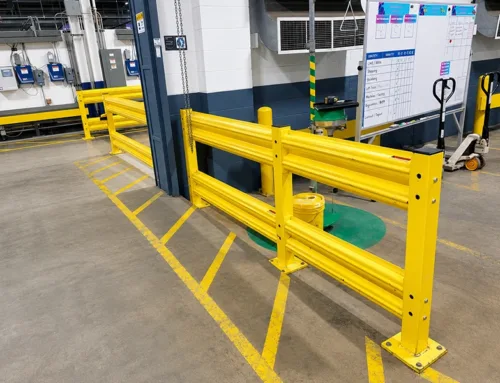
Imagine the same scenario, but with one difference: a section of heavy duty guardrail installed around that critical corner. Mark approaches. The engineer emerges. Mark instinctively swerves. This time, his wheel makes contact not with a fragile electrical cabinet, but with a 7mm-thick slab of W-beam steel, anchored to the concrete floor. The guardrail flexes, absorbing and distributing the kinetic energy exactly as its engineers intended. The forklift is stopped. The electrical cabinet remains untouched. The production line keeps running.
The event is downgraded from a “major incident” to a “minor operational note.” Mark might need to fill out a report, and a section of the heavy duty guardrail may need to be inspected (and perhaps replaced), but the cost is negligible compared to the alternative. This is the profound difference between a system designed for perfection and a system designed for reality. We cannot eliminate every blind corner or every moment of human distraction. But we can, and must, eliminate the possibility of that moment translating into a disaster.
Your facility is full of these blind corners and critical intersections. Walk your floor today, and don’t just look at the lines. Look at the physics, consider the human element, and decide if your most critical assets are protected by a suggestion, or by a certainty.