EN
EN  DE
DE  RU
RU  PT
PT  JA
JA  ES
ES  IT
IT 

|
For engineers and procurement managers, a vague specification like “heavy-duty” is a hidden cost. When choosing Industrial Safety Fencing, the true total cost of ownership (TCO) is determined by material transparency: the precise steel grade, the post dimensions, and the weld integrity. By standardizing on robust specifications, such as structural Q235 carbon steel and TUV-certified engineering, you gain a guarantee of long-term structural integrity that generic systems simply cannot offer, drastically reducing unexpected maintenance and replacement costs down the line. |
The Core Specification: Why 60x60mm Posts Matter
When comparing safety barriers, post size and material grade are the single most important indicators of impact resistance and rigidity. Many vendors offer slimmer or lesser-specified posts which may meet minimum safety distances but will fail structurally under the slightest impact. The core knowledge point is that **Structural Dimension and Material Grade are Non-Negotiable TCO Factors.**
A superior system standardizes on:
- **60x60mm Structural Posts:** This dimension provides a larger footprint and greater cross-sectional rigidity compared to the common 40x40mm offerings, ensuring the post resists deflection when struck by moving equipment.
- **Q235 Carbon Steel:** This grade is known for its excellent weldability and high strength. Coupled with a 2.0mm wall thickness, it provides the necessary foundation to manage and dissipate impact energy, thereby protecting both the safety perimeter and the machinery inside.
Choosing systems with transparent, heavy-duty specifications like these eliminates the need for expensive secondary floor protection and guarantees compliance with ISO 14120 safety requirements for decades.
Eliminating the Weak Link: The Full-Weld Advantage
The panel is the most visible part of the guard, but its integrity is determined by the joinery. If the mesh wire relies on crimping or minimal spot-welding to the frame, the panel will loosen, vibrate, and eventually lose its structural integrity after minimal stress. The operational change here is **Weld Integrity Guarantees Panel Longevity.**

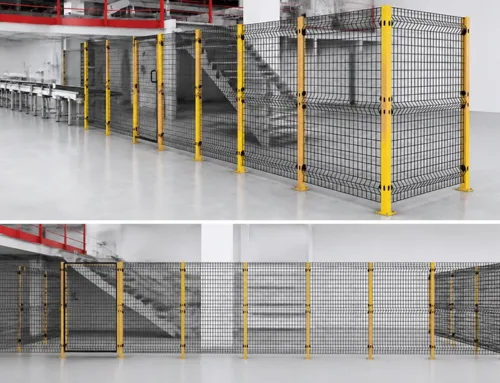
By employing **Flat Welding** where the mesh wire is fully and permanently fused to the 20x30mm panel frame, the system achieves a highly rigid, monolithic structure. This not only increases TUV-certified impact resistance but also provides a smooth, burr-free surface, which is safer for personnel handling the panels during installation and maintenance. This manufacturing detail prevents panel failure, translating directly into zero replacement costs due to weld fatigue.
Total Cost of Ownership: Corrosion Proofing and Reusability
Low upfront cost often ignores the reality of industrial corrosion and dynamic factory layouts. A fence that rusts within five years or must be scrapped during a line modification is a high-cost failure. The financial value delivered by engineered fencing is **Long-Term Capital Preservation.**
Every component is treated with a high-quality **Powder Coating** process, specifically tested to ISO 9227 (Salt Spray Corrosion) standards. This finish ensures the Q235 steel resists rust even in humid or chemically exposed environments, protecting the structural strength for decades. Combined with the complete modularity—allowing the heavy-duty posts and panels to be quickly unbolted, relocated, and reassembled using standardized fixing rings—the initial capital expenditure on the perimeter guard becomes a reusable, adaptable asset for every future factory layout.
Frequently Asked Questions (FAQ)
What makes Q235 carbon steel the superior choice for safety fencing?
Q235 carbon steel is a proven structural grade material known for its strength, durability, and reliable mechanical properties. Its explicit specification ensures that the fence’s core structure can handle repeated stress and impact better than materials with vague or non-specific designations, offering greater confidence in long-term safety compliance.
How is the powder coating tested for corrosion resistance?
The durability of the powder coating is verified by independent laboratory testing, specifically to ISO 9227 (Salt Spray Corrosion). This standard ensures the coating maintains its adhesion and protective qualities under accelerated environmental stress, guaranteeing protection against rust in typical industrial conditions.
Does the bolt-together system compromise TUV-certified impact resistance?
No. TUV certification validates the structural integrity of the material (Q235 steel) and the design (post and panel geometry). The bolt-together assembly uses heavy-duty M10 expansion bolts and rigid fixing rings, which maintain the certified strength and ensure the fence remains compliant without needing field welding.
How does the system ensure structural stability in non-standard corner configurations?
For complex layouts, the modular system allows for custom panel widths and uses the same robust 60x60mm posts at every corner. This ensures that whether the layout is 90 degrees or a non-standard angle, the structural rigidity and compliance are maintained precisely as engineered, unlike custom, site-fabricated welding solutions.
Can the structural posts be used with competitor panel systems?
While the posts provide universal structural strength, the fixing rings and mounting hardware are custom-designed to integrate seamlessly with the Mdfence framed panels. Using all components from the same vendor guarantees the TUV-certified alignment, compliance, and strength of the complete perimeter system.