EN
EN  DE
DE  RU
RU  PT
PT  JA
JA  ES
ES  IT
IT 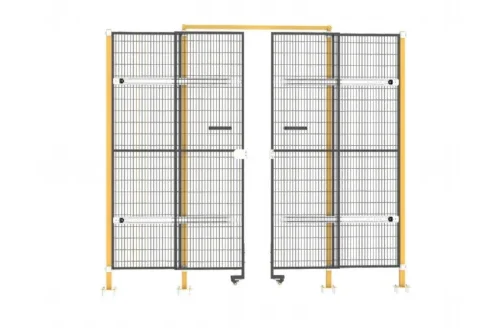

|
When engineering turnkey solutions for automated production lines, system integrators constantly hit a wall: should the robotics layout be enclosed in clear polycarbonate or steel wire mesh? Make the wrong choice, and you are either starving servo motors of airflow, blinding operators with scratched, coolant-stained panels, or failing ISO 13857 safety distance audits. Let’s break down the exact engineering logic for high-speed mechanical assembly and CNC environments. |
The Reality of Polycarbonate in Automotive & Machining Cells
The On-Site Pain (Before): You spec clear polycarbonate (PC) panels around a new CNC machining center or an automated testing cell, thinking it looks sleek and high-tech. Within three months, the reality of the factory floor sets in. Flying metal chips from milling operations and constant wipe-downs of atomized cutting fluids leave the PC severely scratched and cloudy. Operators can no longer monitor the tool path or the robotic welding station without opening the door—defeating the purpose of the guard. Worse, the fully enclosed PC traps heat, causing control equipment and servo drives to overheat during peak production shifts.
The Engineering Logic (Why it works): Polycarbonate is a highly specialized material. It excels at one thing: containment. It should be deployed exclusively as a localized shield where there is a direct, calculated risk of high-velocity fluid splash or laser/welding arc exposure. It is not a perimeter solution.
The Operational Yield (After): By restricting polycarbonate only to specific hazard zones and using wire mesh for the remaining 80% of the cell, you eliminate the “greenhouse effect” around your machinery. Your PLCs and drives stay cool, and you drastically reduce the MTTR (Mean Time To Repair) because maintenance crews aren’t constantly replacing degraded, opaque plastic panels.
Why Framed Mesh Dominates Robotics Layouts
The On-Site Pain (Before): If you opt for cheap, frameless wire mesh (often 2×2 inch / 50x50mm grids) for your robot safety fencing, you face two massive headaches. First, the mesh sags the moment an operator leans on it. Second, the large 2-inch gaps fail the ISO 13857 finger-safe standard unless you push the fence back at least 33.5 inches (850mm) from the hazard. In a facility where floor space costs a premium, this forced setback eats directly into your warehouse AGV paths and material handling areas.

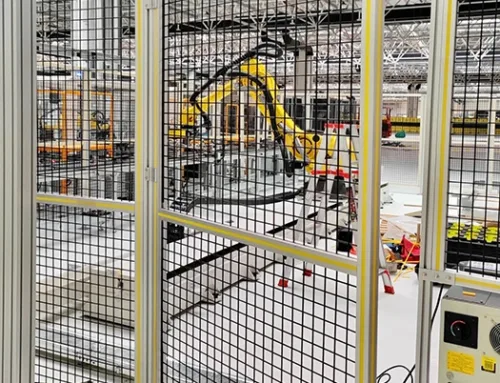
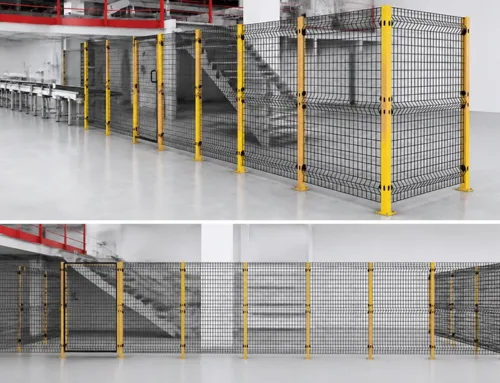
The Engineering Logic (Why it works): The Mdfence system utilizes a fully welded, framed panel architecture. The 20x30mm Q235 carbon steel tubular frame acts as a rigid load-bearing beam, preventing out-of-plane deformation. More importantly, the 0.78″ x 3.9″ (20x100mm) mesh slot restricts penetration to the fingertip only. This precise geometry legally allows you to install the industrial safety fencing just 4.7 inches (120mm) away from the moving robotic arm. Furthermore, the RAL 9005 black powder coating on the wire absorbs optical glare, creating a “see-through” effect that maximizes visibility for quality inspection.
The Operational Yield (After): You reclaim up to 7 square feet of high-value floor space per linear meter of fencing. Your automated high-speed manufacturing lines become incredibly compact, allowing you to fit more turnkey cells into the same facility footprint while maintaining a rigid, 1600-Joule impact-resistant perimeter.
The Unspoken Bottleneck: Interlock Integration on Doors
The On-Site Pain (Before): You’ve built the cell, but now the electrical engineers need to mount Omron D4NL or Pizzato safety interlocks. With standard T-slot aluminum or generic mesh, this means hours of hot work, drilling, and custom-tapping brackets on-site. The metal shavings cause rust, and because the door frame lacks structural rigidity, the hinges sag over time. The lock tongue misaligns by just 2mm, the PLC registers a fault, the Safety Torque Off (STO) circuit trips, and your multi-million-dollar assembly line halts for a “ghost error.”

The Engineering Logic (Why it works): Advanced machine guarding systems treat the physical fence as a node in the electrical safety circuit. Mdfence provides pre-engineered lock carriers (like the KKCK-LCK-B-D4NL-SET) specifically designed for industry-standard electronic switches. When paired with our framed sliding doors running on heavy-duty top bearing rails, the structural geometry remains perfectly square.
The Operational Yield (After): System integrators cut on-site mechanical assembly time by 30%. The interlock bolts on seamlessly with zero drilling. The sliding door glides smoothly year after year, ensuring the safety switch aligns perfectly every single time. False trips are eliminated, and your OEE (Overall Equipment Effectiveness) remains at peak levels.
Polycarbonate vs. Framed Mesh: The Integrator’s Verdict
| Performance Metric | Polycarbonate (PC) Panels | Mdfence Framed Steel Mesh |
|---|---|---|
| Primary Application | CNC coolant containment, welding arc shielding | Automated production lines, robotics layouts, perimeter guarding |
| Ventilation & Thermal | Zero airflow. Traps heat, risking servo drive faults. | Maximum airflow. Dissipates heat from control equipment. |
| Long-Term Visibility | Degrades quickly. Scratches and gets cloudy from oils. | Permanent visibility. Black mesh absorbs glare for clear inspection. |
| Impact Resistance | High, but prone to cracking under localized sharp impacts. | TUV Certified 1600 Joules. Absorbs forklift and payload impacts via plastic deformation. |
Frequently Asked Questions (Automotive & Automation Integration)
Yes. Mdfence’s modular design allows you to install polycarbonate panels specifically adjacent to machining zones where fluid splash is a risk, while using standard 20x100mm framed mesh for the rest of the perimeter to maintain critical airflow and visibility.
According to ISO 13857 standards for reach distances, the 20mm slot width prevents anything larger than a fingertip from penetrating. This allows the fencing to be installed as close as 120mm (4.7 inches) from the hazard zone, saving significant floor space compared to 50x50mm mesh.
No. We provide pre-engineered lock carriers (e.g., for Omron D4NL or Pizzato switches) that bolt directly onto the existing framework. This eliminates on-site drilling, prevents rust, and ensures perfectly aligned STO circuit triggers.
Absolutely. Our sliding doors utilize the same 20x30mm Q235 steel tubular frames as our static panels and run on heavy-duty top-hung bearing rails. This prevents the sagging commonly seen in aluminum profile doors, ensuring reliable switch engagement.
Yes, the system is 100% modular. Unlike welded-in-place barriers, the Mdfence system uses bolt-on fixing rings. You can unbolt the panels, relocate the posts, and reconfigure the entire robotics layout without any destructive cutting or grinding.