EN
EN  DE
DE  RU
RU  PT
PT  JA
JA  ES
ES  IT
IT 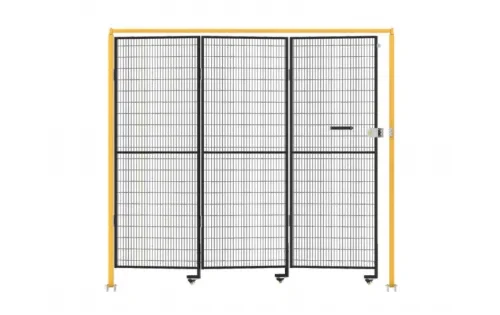
 |
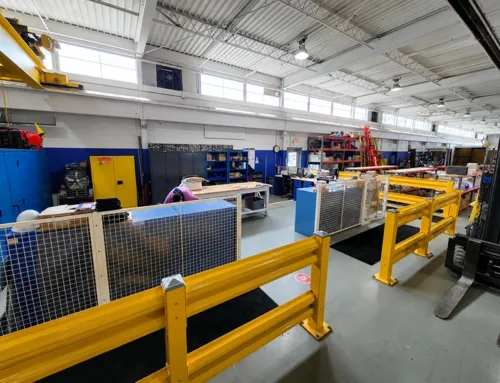
Your new robot cell layout is perfect on paper. But on the factory floor, standard safety fencing forces you so far back from the machine that your forklift aisle just disappeared. Every inch of wasted space is a hit to your production density and a permanent operational headache. There has to be a better way to calculate safety distance without compromising productivity. |
The Hidden Cost of “Standard” Robot Safety Fencing
As an automation engineer or EHS manager, you live by the standards. When it comes to robot safety fencing, ISO 13857 is the rulebook. It dictates the mandatory safety distance between a guard and a hazard, and its logic is simple: the larger the opening in your fence panel, the farther away it must be installed. This is where the real-world problems begin.
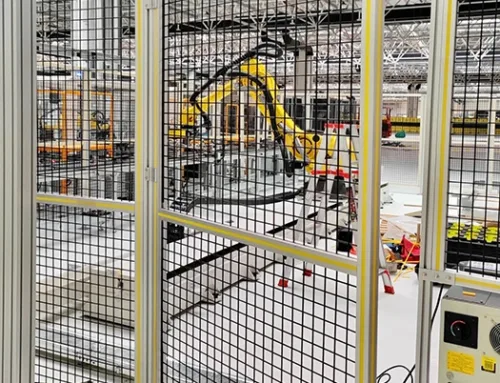
Many conventional machine guarding systems use a 50x50mm (approx. 2″x2″) mesh. According to ISO 13857, this size opening allows for potential hand or arm access, forcing a minimum safety distance of 200mm. If an arm can reach over or through, that distance can balloon to 850mm (nearly 3 feet). In a busy production environment, that’s not just a buffer zone—it’s a massive loss of valuable floor space that could have been used for another process, material staging, or a safe transit lane.
Rethinking the Equation: How Mesh Aperture Reclaims Your Floor Space
The minimum distance for your robot fencing isn’t a fixed number; it’s a variable you can control through intelligent system design. The critical factor is the mesh aperture (the size of the opening).
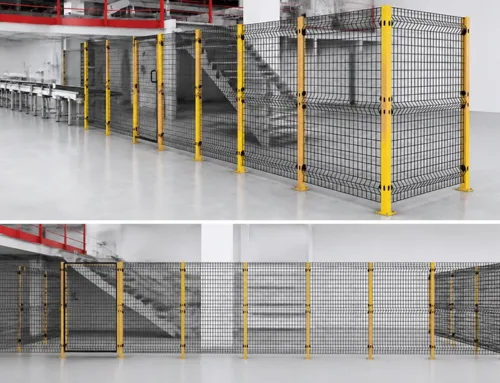
Our Mdfence system is engineered with a standard 20x100mm mesh. The 20mm (approx. 0.78″) vertical gap is the controlling dimension. It’s too narrow for fingers to pass through, effectively eliminating the “reach-through” risk defined by the standard. This physical limitation allows the safety distance to be legally and safely reduced to just 120mm (approx. 4.7 inches).
This isn’t just a minor adjustment. By switching from an 850mm to a 120mm safety distance, you reclaim 0.73 meters (over 28 inches) of space on every linear meter of fencing. For a typical 5m x 5m robotic work cell, this translates to reclaiming over 14 square meters (150 sq. ft.) of high-value production floor. Suddenly, your forklift aisle is viable again, and your layout works in reality, not just in CAD.
More Than Just Distance: A System Designed for Modern Automation
Achieving the minimum safety distance is critical, but a truly effective robot safety fence must also be robust and integrate seamlessly into your control architecture. A barrier that causes nuisance trips or complicates maintenance is a barrier to OEE (Overall Equipment Effectiveness).
Engineered for Impact and Integration
Unlike flimsy, frameless mesh, every Mdfence panel features a fully welded 20x30mm tubular steel frame. This architecture provides certified impact resistance of up to 1600 Joules—enough to stop a 100kg (220 lbs) object moving at 20 km/h (12.4 mph). This ensures the fence acts as a true physical safeguard against catastrophic failures, not just a visual deterrent.
Furthermore, we understand that modern machine guarding is an active part of your safety circuit. Our door systems are designed with pre-engineered mounting plates and carriers for industry-standard safety interlock switches, including the Omron D4NL and Pizzato series. This eliminates the need for on-site drilling and fabrication, ensuring a clean, compliant installation that integrates directly with your PLC’s safety logic (e.g., STO). The result is a faster, error-free setup and a system that passes your EHS audit the first time.

Frequently Asked Questions
1. What is the primary safety standard that dictates the distance for robot fencing?
The key international standard is ISO 13857: “Safety of machinery — Safety distances to prevent hazard zones being reached by upper and lower limbs.” It directly links the allowable opening size in a physical guard to the required minimum distance from the hazard.
2. Can your fencing system integrate with our plant’s standard safety interlocks, like those from Schmersal, Pilz, or Omron?
Yes. Our system is designed for seamless integration. We offer a range of pre-engineered mounting plates and lock carriers specifically for popular safety interlocks, including the Omron D4NL and Pizzato series. This ensures a robust, plug-and-play installation without the need for custom on-site fabrication.
3. What does a 1600 Joule impact rating mean in a practical, real-world scenario?
A 1600 Joule rating is equivalent to the kinetic energy of a 100 kg (220 lbs) object, such as a large casting or a robot end-effector, traveling at 20 km/h (12.4 mph). It means the fence is certified to withstand such an impact without penetration or structural failure, effectively containing a catastrophic event within the cell.
4. Our automation line has conveyors passing through the guarded area. How do you handle these openings?
We design and provide custom tunnel guards for conveyor openings. These guards are specifically shaped to allow materials to pass through while still complying with the strict opening-size and distance requirements of ISO 13857, ensuring personnel cannot access the hazard zone through the conveyor path.
5. We need to install the fencing over a weekend to avoid shutting down production. How does modular assembly help?
Our modular, bolt-together system is up to 70% faster to install than traditional welded fencing. It requires no on-site welding, cutting, or grinding, which means no “hot work” permits, fire hazards, or fume extraction. A two-person team can assemble large sections quickly using only standard hand tools, making it ideal for rapid deployment during planned maintenance windows.