EN
EN  DE
DE  RU
RU  PT
PT  JA
JA  ES
ES  IT
IT 
 |
Your robot cell is installed, but the safety guarding is causing headaches. On-site welding for interlock brackets has scorched the new powder coat, the gate already sags causing nuisance trips in the E-stop circuit, and the client’s EHS manager is raising concerns during the final walkthrough. Project delays are not an option. There is a bolt-on solution that prevents this from day one. |
From Blueprint to Power-On: Why Your Robot Cell’s Interlocks Demand a Smarter Fencing System
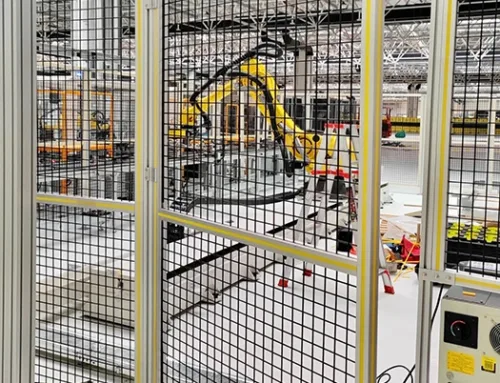
For an automation system integrator, the final 10% of a project can feel like 90% of the work. The multi-million-dollar KUKA or Fanuc robot arm is performing flawlessly, but the success of the entire cell hinges on the physical barrier that surrounds it: the Robot Safety Fencing. Too often, this critical component is an afterthought, leading to costly on-site fabrication, failed safety audits, and frustrating delays.
The problem isn’t the fence itself; it’s the failure to treat it as an integral part of the machine’s control system. A sagging gate, a misaligned interlock, or a weak panel isn’t just a physical flaw—it’s a point of failure in your safety circuit.
The Integrator’s Nightmare: When “Standard” Fencing Fails the EHS Audit
Imagine this scenario: you’ve opted for a generic, locally welded fence to save on initial costs. During the final commissioning, the client’s safety manager arrives.
- The Interlock Problem: Your team spent hours with a hand drill and angle grinder to mount the client-specified Omron D4NL or Pizzato safety interlock. The mounting is flimsy, the protective powder coat is compromised and will rust, and the alignment is already off by a few millimeters.
- The Gate Sag: The wide-span hinged gate, lacking structural integrity, has already started to droop. This slight misalignment is enough to cause intermittent “nuisance trips,” shutting down the entire line and leaving operators and engineers chasing phantom faults.
- The Compliance Failure: The large 50x50mm mesh, while cheap, forces you to install the entire fence much farther from the robot to meet ISO 13857 safety distance standards. This wastes valuable floor space the client was counting on for a future conveyor line.
Suddenly, your team is performing hot work on a finished cell, the project timeline is blown, and your firm’s reputation for quality is on the line.
The Mdfence Logic: A Safety Platform, Not Just a Perimeter
A modern Machine Guarding system must be designed for integration from the ground up. It’s not just a steel barrier; it’s a stable, predictable mounting platform for the critical safety components that interface with your PLC.
Engineered for Perfect Interlock Alignment, Every Time
The core of our system is designed to eliminate the variables that cause integration failures.
|
1. Structural Rigidity That Prevents Sag: Our panels aren’t just wire mesh; they are fully welded into a 20x30mm tubular steel frame. This framed architecture, supported by robust 60x60mm posts anchored to the floor, provides exceptional out-of-plane stiffness. For hinged and sliding doors, this means zero sag over the long term. Your safety interlock’s actuator and body remain perfectly aligned, eliminating false trips and ensuring your safety circuit is reliable. 2. Pre-Engineered Interlock Carriers: Forget the drill and angle grinder. We offer a “Safety Interlock Carrier”—a pre-fabricated, precision-cut mounting plate designed specifically for industry-standard switches like the Omron D4NL, Pizzato, or Schmersal series. This turns a custom fabrication task into a simple, repeatable bolt-on process, saving hours of installation time and preserving the integrity of the factory powder coat finish. |
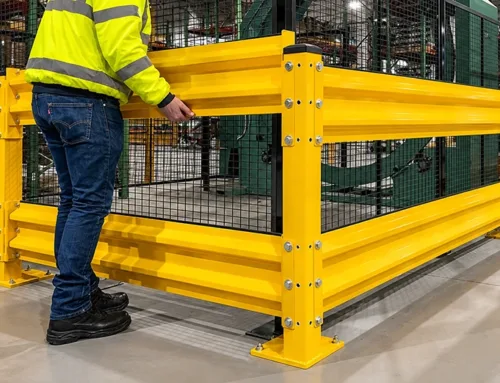
 Framed panels provide the structural integrity needed for stable doors. |

Designed for Rapid, Clean, and Flexible Deployment
System integration is a race against the clock. Our modular, no-weld design is built for speed and adaptability.
- Cold Assembly vs. Hot Work: The entire system assembles with high-strength steel clips and M8 bolts. There is no on-site cutting, welding, or grinding. This means no fire hazards, no smoke, no damaged floors, and no need for hot work permits. A two-person team can install over 150 feet of fencing in a single day.
- Future-Proof Modularity: When the production line is retooled or moved, a welded fence becomes scrap metal. Mdfence is a reusable asset. Panels, posts, and doors can be disassembled and reconfigured in a new layout with a 95% asset reuse rate.
- Space-Saving Design: The standard 20x100mm mesh aperture is “finger-safe” according to ISO 13857. This allows you to place the barrier as close as 120mm (approx. 4.7 inches) from the hazard. Compared to a 50x50mm mesh requiring up to 850mm (33.5 inches) of clearance, you can save square footage and give back valuable floor space to your client.

The Result: Pass the Audit, Impress the Client, Move to the Next Project
By integrating a purpose-built robot safety fencing system, the narrative changes completely. The installation is clean, fast, and predictable. The safety interlocks bolt on perfectly, functioning flawlessly from the first power-on. The EHS manager’s walkthrough becomes a formality—they see a professional, robust, and compliant system that reflects the quality of the automation within.
You not only deliver the project on time and on budget, but you also provide your client with a flexible, durable safety asset that will adapt with their business for years to come.
Frequently Asked Questions for Automation Integrators
1. How does your system integrate with safety interlocks you don’t list, like Schmersal or Allen-Bradley/Rockwell?
Our universal mounting plates are designed with flexible hole patterns to accommodate most major safety switch brands. For unique or new models, we can rapidly engineer and supply a custom “Safety Interlock Carrier” plate based on the component’s datasheet to ensure a seamless, bolt-on fit.
2. Can I get 3D CAD/STP files for your components to drop into my SolidWorks or AutoCAD robot cell design?
Absolutely. We provide a complete library of 3D STP files for all our standard components—posts, panels, doors, and mounting hardware. This allows your design engineers to accurately model the entire safety system, check for clearances, and generate a precise Bill of Materials (BOM) directly from your layout, eliminating guesswork and ordering errors.
3. What is the certified impact rating, and how does it relate to ANSI/RIA R15.06 standards?
Our heavy-duty system is certified to withstand an impact energy of 1600 Joules. This is a critical factor in the Risk Assessment required by ANSI/RIA R15.06. This rating—equivalent to stopping a 100 kg (220 lbs) object moving at 20 km/h (12.4 mph)—provides documented proof that the guarding can contain a catastrophic failure, such as a robot dropping a heavy payload or a part being ejected.
4. How exactly does the 20x100mm mesh save floor space compared to a standard 2″x2″ mesh?
Safety standards (ISO 13857) dictate that the smaller the opening in a guard, the closer it can be to the hazard. A 2″x2″ (approx. 50x50mm) mesh allows fingers and parts of the hand to pass through, requiring a safety distance of 200mm or more. Our 20mm narrow gap only allows fingertips to pass, legally reducing the required safety distance to just 120mm. For a 50-foot-long cell, this can save over 40 square feet of high-value production floor space.
5. We have a conveyor passing through the robot cell. Do you offer solutions for that?
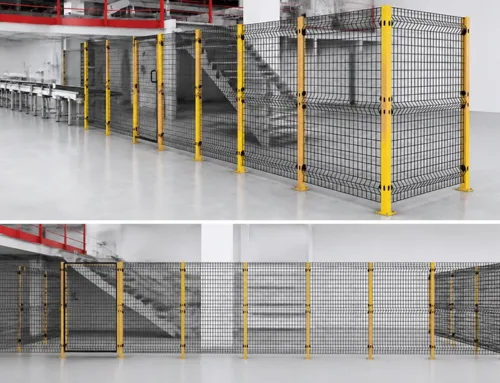
Yes, we provide custom-fabricated Tunnel Guards. These are cutouts in our standard framed panels, sized precisely for your conveyor system. The tunnel opening is designed to comply with ISO 13857, allowing products to pass through while preventing personnel from reaching into the hazardous area. This provides a clean, integrated, and fully compliant solution without compromising safety.