EN
EN  DE
DE  RU
RU  PT
PT  JA
JA  ES
ES  IT
IT WAREHOUSE SAFETY / PEDESTRIAN–MHE SEPARATION
Wave Beam Barrier for Forklift Zones: Build a Physical Line Between People and MHE
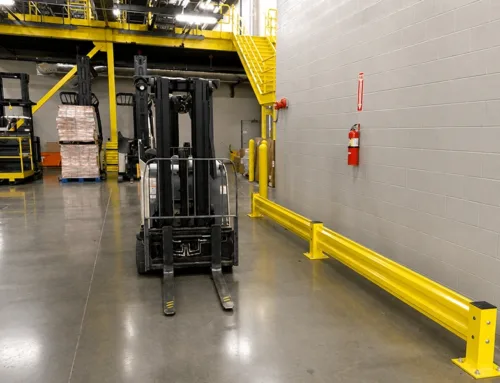
When pedestrians and forklifts share an aisle, a wave beam barrier turns an informal traffic rule into a visible, floor-mounted warehouse safety barrier. Hsafety combines corrugated steel rails, high-visibility yellow warning coating and optional reflective tape to create a passive separation layer that remains in place when training, attention or active monitoring fails.
Why Mixed Traffic Needs More Than Signs, Paint and Training
In a warehouse, distribution center or production line, a pedestrian can enter an MHE route in seconds. Floor markings and warning signs improve awareness, but they do not physically prevent a shortcut. Training also degrades as shifts change, new employees arrive and operating pressure increases. Cameras and sensors can identify a conflict and issue an alert, but an alert is not a barrier. Hsafety supplies the passive layer: a bolted guard rail system that separates the pedestrian route from the forklift area and protects people, racks, walls and fixed equipment from impact. It complements an Amazon-style active safety stack of sensors and cameras rather than trying to replace it.
| Design point | Hsafety wave beam barrier provision |
|---|---|
| Barrier construction | Q235 carbon steel guard rail using corrugated beams; available as 2-rib/W-beam or 3-rib/thrie-beam configurations subject to project selection. |
| Rail arrangement | Single rail or double rail layouts for pedestrian-vehicle separation, asset protection and machine guarding boundaries. |
| Typical dimensions | About 1,000 mm high; rail width about 300–310 mm; 3 or 4 mm thickness options; final drawing confirms the selected specification. |
| Posts and anchoring | Project 15176 design condition: 80×80×6 mm square posts, 160×160×16 mm base plates and floor anchoring to concrete; anchor details require final engineering confirmation. |
| Visibility and finish | Yellow safety coating as shown; powder coating, hot-dip galvanized finish and reflective tape are selectable options, not automatic inclusions. |
| Layout flexibility | Bolted modular sections support straight runs, corners and custom-length guardrail planning instead of forcing standard panels into every gap. |
How the Structure Converts a Traffic Rule into a Hard Boundary
Double corrugated rails define the pedestrian route
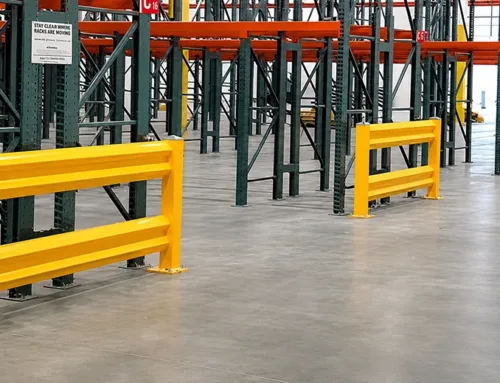
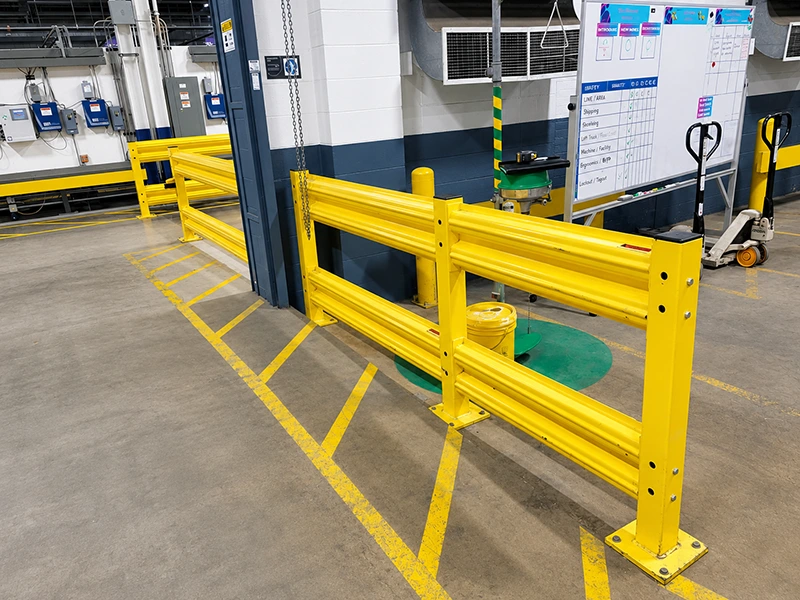
The rack-end application shows two horizontal wave beam barrier rails carried between square posts. The corrugation adds formed geometry to the steel beam, while the continuous run gives pedestrians and forklift operators an unmistakable boundary. For a warehouse guardrail, the objective is not to encourage people to remember a rule; it is to make the unsafe crossing physically difficult and visually obvious. The yellow coating reinforces the workplace safety barrier at aisle edges, loading dock approaches and equipment boundaries.
Floor-mounted posts protect rack ends and assets
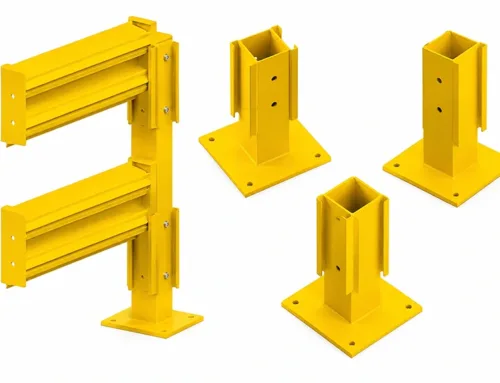
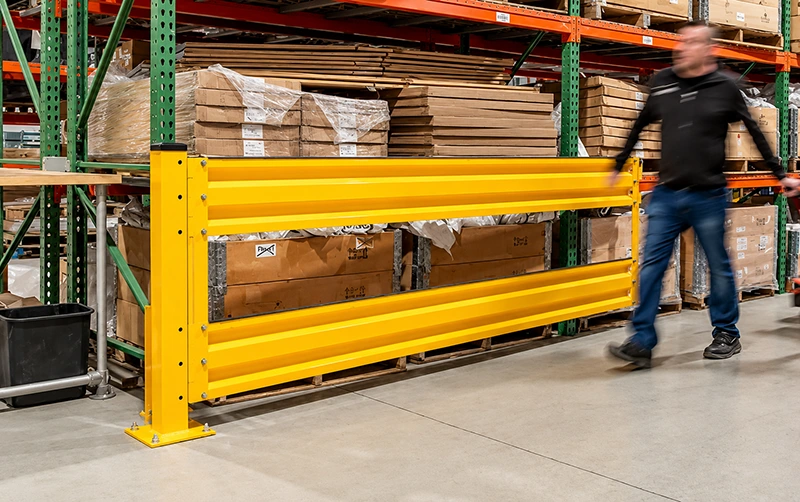
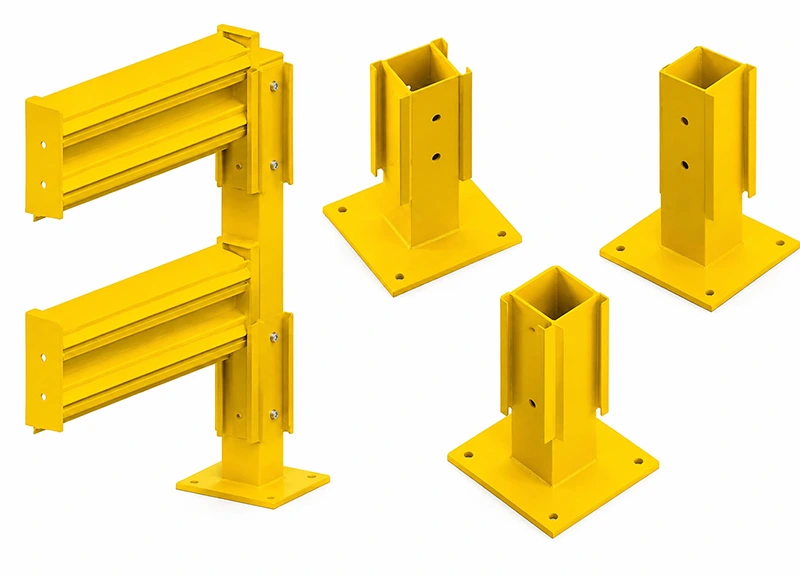
At rack uprights, the barrier needs to start before the collision point and remain tied to the concrete floor. This installation view shows the double-rail guardrail, square posts and base plates working as one modular system. In the recorded multi-zone design, a 1,500 mm post spacing and 1,000 mm barrier height were used as project conditions. Those figures are not a universal impact rating: the final spacing, anchor selection and collision assessment must follow the site risk review and approved drawing.
Continuous runs follow conveyors and crossing points
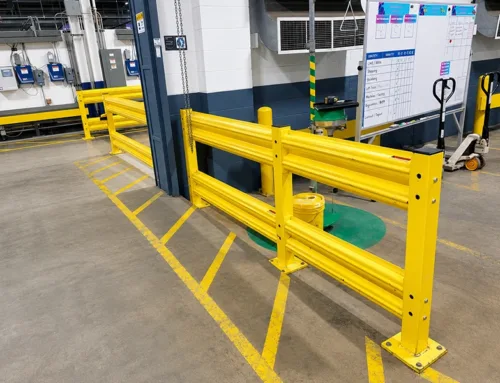
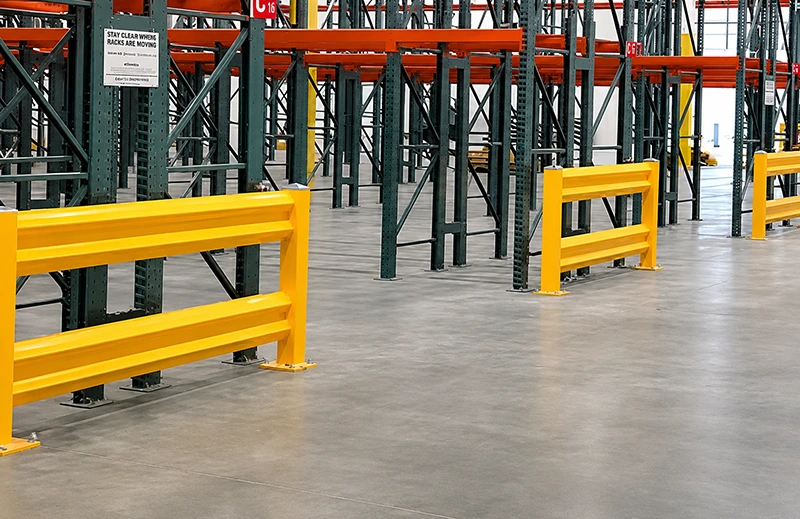
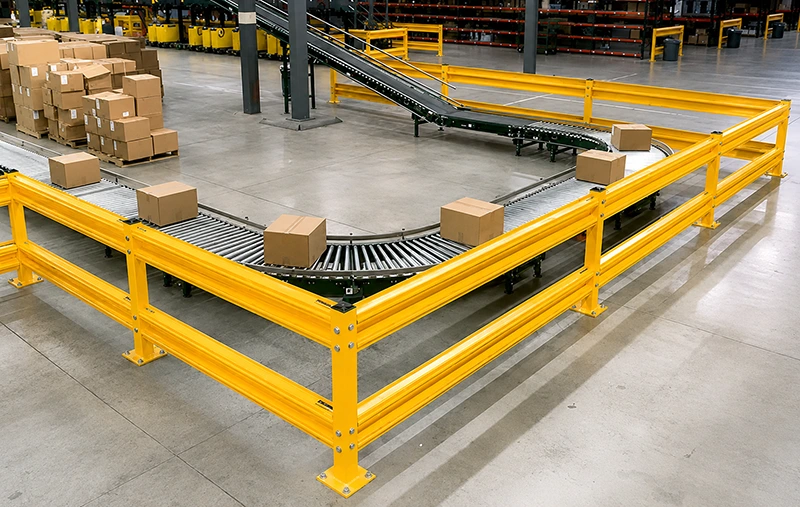
Mixed traffic rarely follows a perfect rectangle. Conveyor lines turn, intersect and create blind approach zones. The warehouse image shows a wave beam barrier continuing around straight sections and corners, with anchored base plates at each post. Hsafety sections are bolted together so the layout can be planned around conveyor guarding, aisle protection, equipment isolation and pedestrian safety separation. Optional reflective tape can add conspicuity where lighting is limited; it should be specified against the actual operating environment.
Where to Apply the Passive Separation Layer
- Forklift and MHE aisles: create pedestrian-vehicle separation where walking routes run beside powered equipment.
- Rack-end protection: shield pallet rack uprights and reduce the chance of forklift damage to stored assets.
- Conveyors and sorting zones: keep people, pallets and vehicles outside the operating envelope of fixed equipment.
- Loading dock protection: mark and defend the edge of vehicle movement areas where traffic intensity is high.
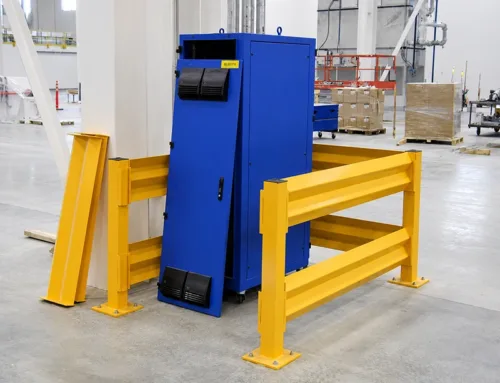
- Equipment and electrical rooms: protect cabinets, pipework, walls and service access points from collision protection risks.
For a multi-zone project, Hsafety can combine standard and special-length rails. Opportunity 15176 recorded four runs of 17,000 mm, 12,000 mm, 17,100 mm and 11,900 mm, all at 1,000 mm high. The design used 64 standard 1,500 mm rails plus eight special rails from 680 to 1,140 mm, with 42 posts in total. These are project records, not a default bill of materials; each site should be checked against traffic paths, concrete condition, turning radii and the required engineering load case.
Specify the Barrier Against the Actual Risk
Before ordering, confirm the MHE type and speed, impact direction, pedestrian route, rail height, single- or double-rail arrangement, 2-rib or 3-rib profile, post spacing, concrete condition and required finish. The recorded 3-ton forklift at 10 km/h and approximately 16,680 N load were a customer project design condition—not an independent certification claim. Hsafety is a warehouse guard rails system for engineered industrial applications, not a highway guardrail or an automatically compliant substitute for a site-specific risk assessment. A product drawing and installation review should establish the final configuration.
Make “Stay Out of the MHE Lane” a Physical Condition
Use cameras and sensors to warn, procedures to guide, and a Hsafety wave beam barrier to hold the line. A floor-mounted steel guard rail provides the bottom layer that does not depend on perfect memory, complete training or a fast human reaction. Send us your aisle plan, hazard points and required lengths for a warehouse safety barrier layout covering pedestrian separation, rack-end protection and forklift impact protection.