EN
EN  DE
DE  RU
RU  PT
PT  JA
JA  ES
ES  IT
IT WAREHOUSE AUTOMATION | AGV / AMR + FORKLIFT MIXED TRAFFIC
How a safety barrier system creates a physical boundary for AGV and forklift routes
When AGVs, AMRs, pedestrians, and manual forklifts share warehouse aisles, a safety barrier system turns digital route instructions into a visible, floor-mounted boundary—helping prevent vehicle and pedestrian crossover while protecting conveyors, racks, walls, and fixed equipment.
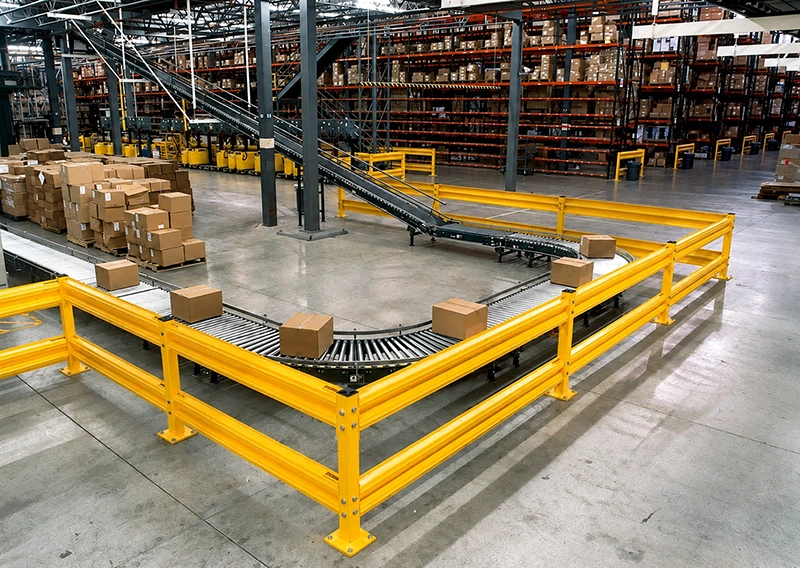
AGV and AMR navigation can define a preferred path, but software alone cannot stop a manual forklift from entering the same envelope. Hsafety warehouse guard rails add the missing physical layer for collision protection and pedestrian-vehicle separation.
From shared traffic to a defined warehouse safety barrier system
In a distribution center or automated production line, the risk is not limited to one vehicle type. An AMR may follow its digital map while a forklift cuts across an aisle, a pallet blocks a sensor, or a pedestrian uses the shortest route to a workstation. The result is more collision dimensions, uncertain right-of-way, rack-end damage, conveyor stoppage, and avoidable accident downtime.
Common temporary controls—painted lines, rope or strap barriers, wooden barriers, or isolated concrete bollards—mark an area but do not create a continuous impact guard. Site-welded steel pipe railing can be rigid, yet it often requires cutting, welding, and repainting whenever the route changes. These approaches leave gaps at conveyor corners and do not give the automation team a stable physical reference for route planning.
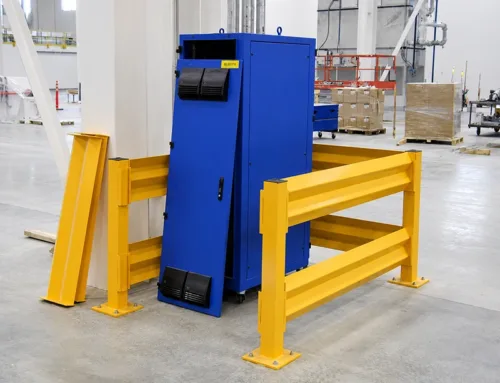
Hsafety is specified as a bolted guard rail system around the hazard envelope. The industrial guard rail can define an AGV lane, protect an aisle edge, separate a pedestrian walkway, or shield a robot cell and conveyor interface. It is an external asset-protection barrier; it should not be confused with a machine safety fence, which provides internal guarding around machinery.
| Design point | Hsafety warehouse guard rails |
|---|---|
| Primary role | Physical route boundary, forklift impact protection, equipment isolation barrier, and pedestrian-vehicle separation |
| Beam construction | Q235 carbon steel corrugated guard rail; 2-rib / W-beam or 3-rib / thrie-beam configurations can be discussed by risk zone |
| Beam dimensions | Approx. 310 mm rail width, 85 mm wave height, 3 mm or 4 mm thickness; confirm the final drawing before release |
| System geometry | Typical 1,000 mm guardrail height, modular double rail or single rail layouts, and custom length guardrail sections for straight runs and corners |
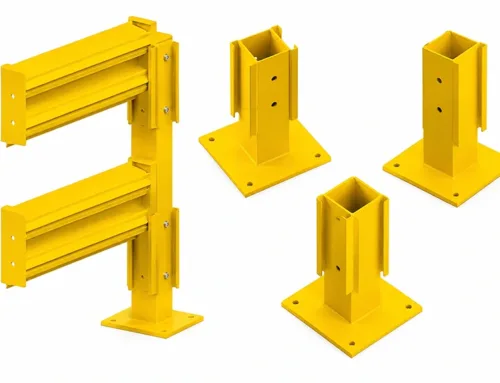
| Posts and anchoring | Project design example: 80 × 80 × 6 mm square posts with 160 × 160 × 16 mm base plates and expansion anchors into concrete |
| Finish and visibility | Powder coated guardrail in safety yellow; hot-dip galvanized finish, reflective tape guard rail, and other options require project confirmation |
These dimensions are engineering inputs, not a blanket collision certification. Anchor selection, concrete thickness, vehicle mass, speed, clearance, and impact direction must be checked against the actual site and applicable requirements, including any OSHA guardrail compliance review.
Why the safety barrier system fits mixed AGV and forklift operations
1. Corrugated steel provides a visible, continuous route reference
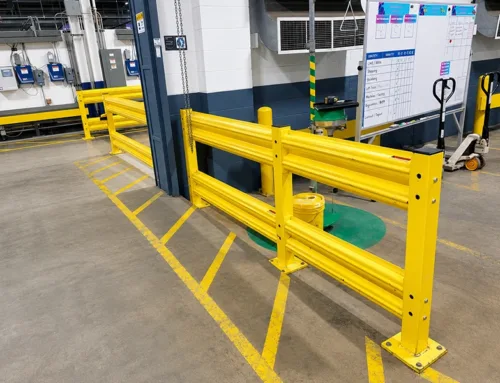
The wave profile adds formed stiffness to the Q235 steel beam, while the double-rail arrangement creates a clearly visible boundary at the edge of a vehicle lane. In a mixed-traffic warehouse, the barrier does not replace AGV sensors or dispatch logic. It complements them: the fleet management system defines the digital route, and the floor-mounted steel guard rail defines where vehicles and people must not cross. After an impact, the rail and anchors should be inspected under the site’s engineering procedure; local deformation does not justify assuming unlimited reuse.
2. Bolt-on modules support route changes without site welding
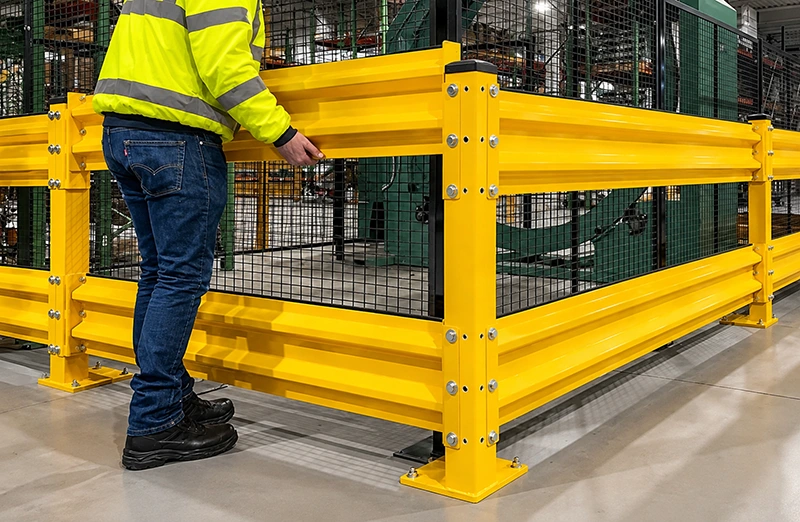
AGV projects often evolve after commissioning: a charging point moves, a conveyor is extended, or a pedestrian crossing is relocated. Hsafety uses bolted connections between corrugated panels and square posts, so sections can be arranged as a modular guardrail along a straight aisle or around a turn. The 1,500 mm module is a practical reference, while special panel lengths can close the final gap instead of leaving an unprotected opening. Lift-out or removable guard rail arrangements can be evaluated where controlled access is required.
3. Base-plate anchoring defines the boundary at the floor
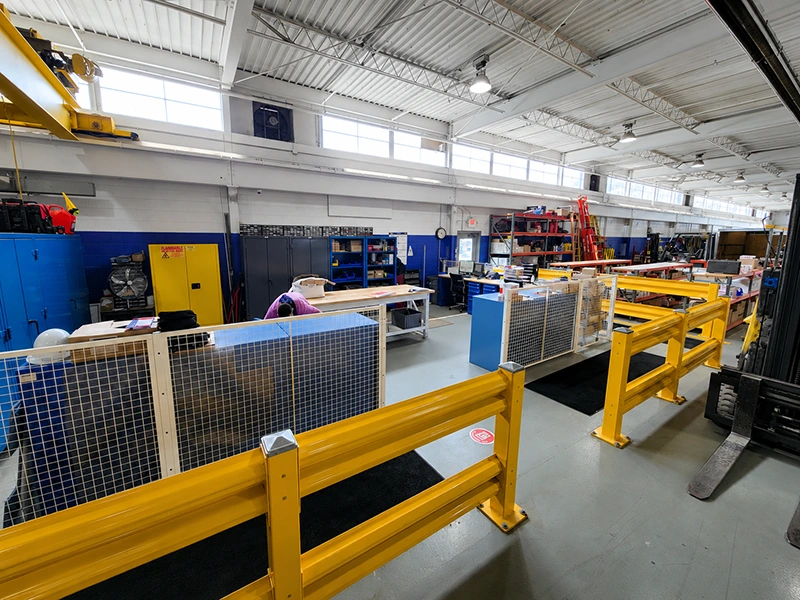
A guard rail only works as a route boundary when its position is fixed. The Hsafety floor mounted guardrail uses square posts, guardrail base plates, and anchor bolts installed into a suitable concrete floor, then connects the beam with brackets and fasteners. This gives the automation and EHS teams a physical line to coordinate with aisle markings, AGV maps, loading dock protection, rack end protection, and machine guarding zones. Site verification remains essential: the project brief’s concrete anchoring assumptions and final anchor specification must be confirmed before installation.
Where to apply the safety barrier system
- AGV and AMR lanes: define the outside edge of automated routes and reduce unauthorized crossover by manual vehicles.
- Conveyors and sortation: provide continuous conveyor guarding through straight sections, intersections, and turns.
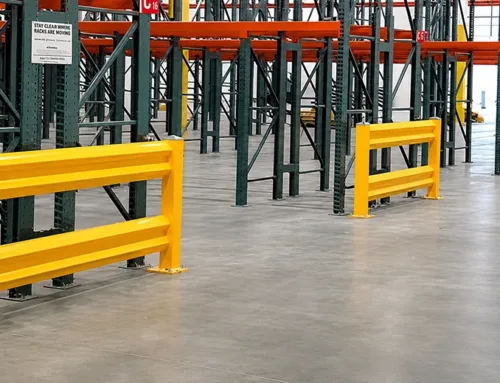
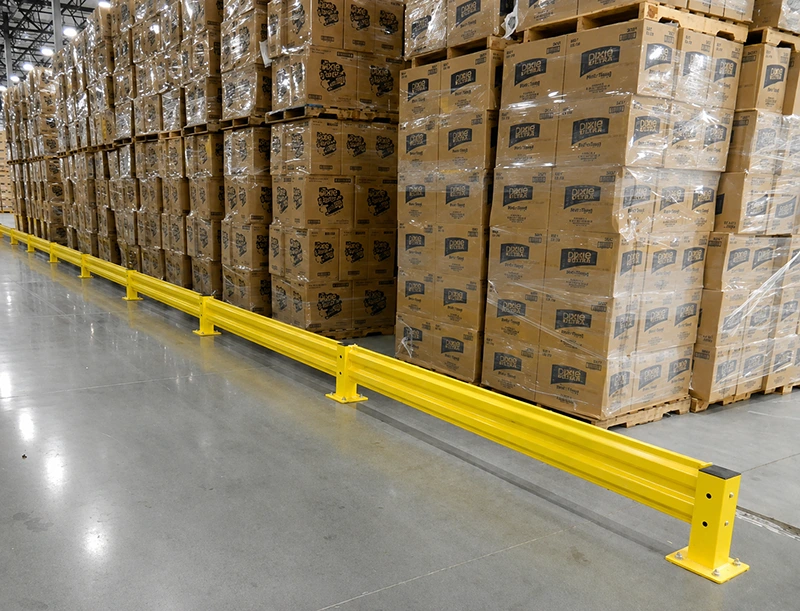
- Rack ends and storage aisles: add rack end protection where forklift impact could damage uprights, inventory, or walls.
- Pedestrian routes: create a workplace safety barrier for pedestrian safety separation at shared crossings and workstations.
- Robot cells and fixed assets: protect equipment cabinets, production line separation zones, pipework, and loading dock approaches.
For each zone, select the rail configuration, clearance, height, surface treatment, and anchoring details from the actual traffic pattern—not from the AGV map alone. Hsafety can be reviewed as an A-SAFE alternative or steel guard rail option when a project requires a rigid, modular, floor-anchored boundary, but the final selection must match the impact conditions and engineering calculation.
Specify the physical boundary with the digital route
Send the AGV/AMR route drawing, forklift type and operating speed, pedestrian crossings, protected assets, concrete floor information, required lengths, and preferred finish. SGF can then review whether a single rail or double rail, 2-rib or 3-rib guardrail, standard 1,500 mm modules, custom length sections, guardrail brackets, end caps, and access points suit the layout. The output should be a coordinated installation drawing—not a generic barrier count.
Build a two-layer control: digital dispatch plus physical protection
A mixed AGV, AMR, forklift, and pedestrian environment needs more than route logic. Hsafety warehouse safety barrier modules make the boundary visible, anchored, and maintainable, helping protect racks, conveyors, walls, and equipment while reducing the likelihood of collision-related downtime. Contact SGF to review your warehouse guard rails requirement.