EN
EN  DE
DE  RU
RU  PT
PT  JA
JA  ES
ES  IT
IT Welding cell guarding · Arc-flash isolation · Industrial safety fence
Welding Cell Arc-Flash Isolation with Alfence Modular Safety Fence
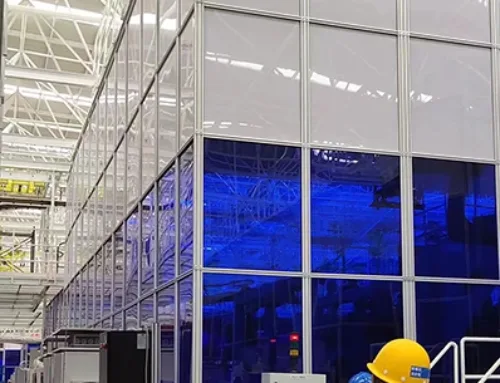
A thin mesh panel at a welding cell can be melted or distorted by hot spatter, while an open grid may leave nearby operators exposed to welding arc light. Alfence combines modular machine guarding with solid PC, polycarbonate, or acrylic panels in the welding zone, tinted or red options for arc-flash control, and reinforced welded mesh where impact resistance is the priority. The result is a reconfigurable safety guarding fence that separates the process without turning the entire production line into a welded, difficult-to-change enclosure.
Match the guarding material to the welding-zone hazard
The old approach is often a standard thin wire fence around every side of the cell. It can be economical for a general robot perimeter, but it is a poor fit when hot droplets repeatedly strike the panel or when arc light is visible from an adjacent walkway. Alfence lets the project team divide the boundary by function: solid panel at the welding unit, reinforced mesh in higher-impact areas, and standard mesh where visibility and general access control are sufficient.
| Design point | Alfence specification and project decision |
|---|---|
| Welding-zone barrier | Use a solid PC, polycarbonate, or acrylic panel instead of mesh to intercept spatter; plastic panel heat resistance is listed at no more than 60 °C, so process temperature and clearance must be confirmed. |
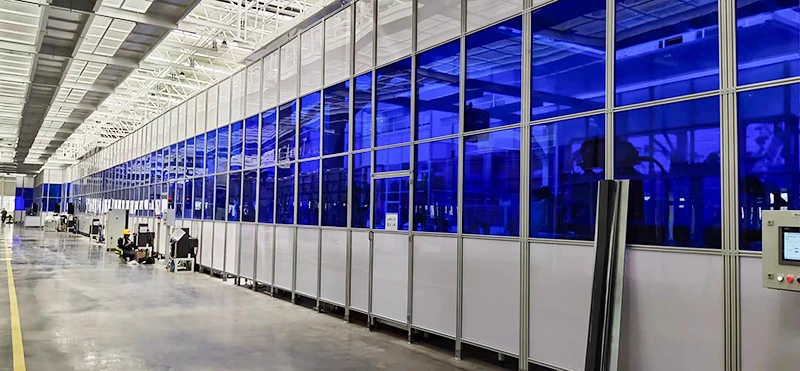
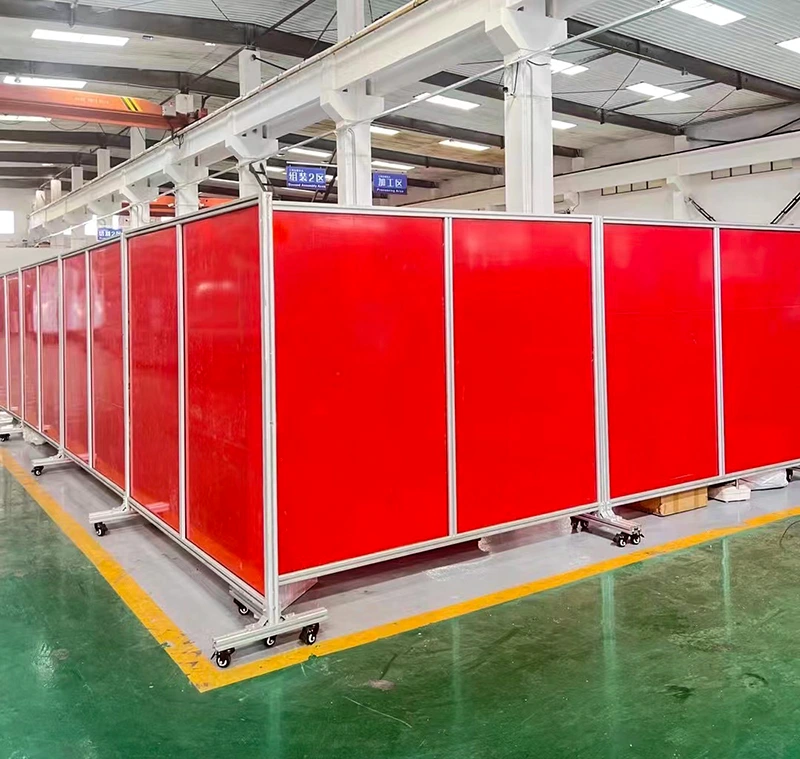
| Arc-flash visibility | Choose a tinted or red panel where the layout requires reduced welding arc-light exposure for people outside the cell; complete the final risk assessment for the process. |
| Standard mesh area | 20 × 20 mm outer frame with 3 mm wire for general machine guarding zones, with the project grid and safety distance checked against the equipment. |
| Higher-impact area | 20 × 30 mm outer frame with 3.5 mm wire as the reinforced option where the welding cell boundary has greater impact exposure. |
| Modular frame | 40 × 40 mm or 45 × 45 mm aluminum profile posts with bolt-free panel assembly, removable sections, and floor anchoring through foot connectors. |
| Access and control | Hinged, sliding, folding, or telescopic safety doors can be coordinated with an interlock switch or safety light curtain for maintenance and material flow. |
Why the hybrid Alfence layout fits welding cell guarding
Replace only the hot-zone mesh with a solid panel
A welding unit does not need the same infill on every side. A thin mesh placed directly in the spatter path can be locally damaged, lose its shape, or sag like a hammock after repeated heat exposure. Alfence allows the welding cell section to use a solid PC, polycarbonate, or acrylic panel while the surrounding machine guarding remains modular. Tinted and red panel choices address the arc-light exposure problem without requiring a full opaque enclosure. Because the listed panel heat limit is ≤60 °C, the panel position, shielding distance, and actual process temperature must be reviewed before release.
Use reinforced welded mesh where impact exposure is higher
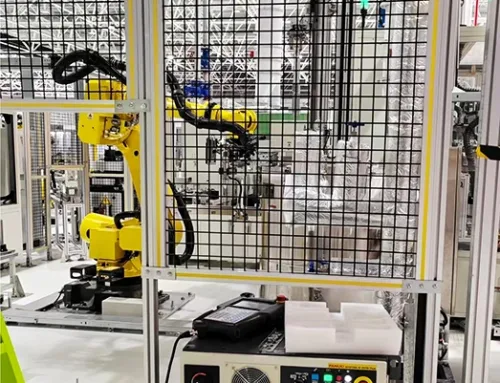
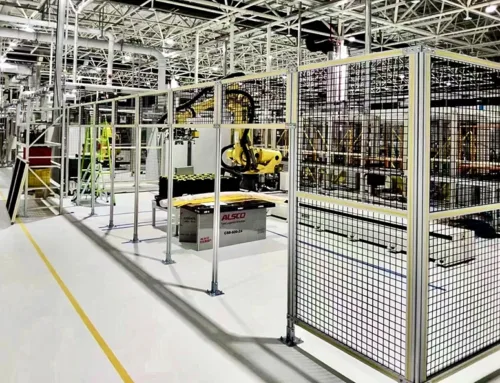
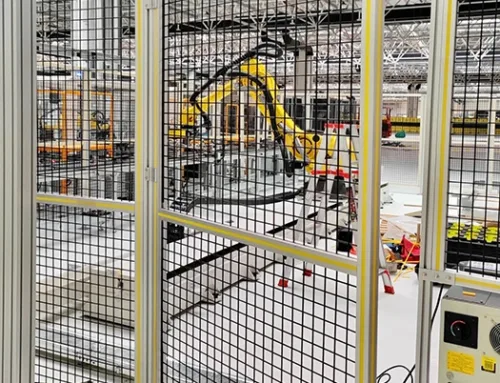
Outside the direct welding plume, a transparent mesh boundary can preserve visibility and ventilation around the robot cell. The standard 20 × 20 mm outer frame with 3 mm wire is suited to the general zone described in the brief. Where parts handling, maintenance traffic, or accidental contact raises the impact concern, specify the 20 × 30 mm outer frame with 3.5 mm wire. This is a targeted upgrade, not a claim that aluminum guarding replaces a high-impact steel barrier in every environment. The post-and-panel system remains removable and reconfigurable when the line changes.
Keep doors, interlocks, and maintenance access in the same boundary
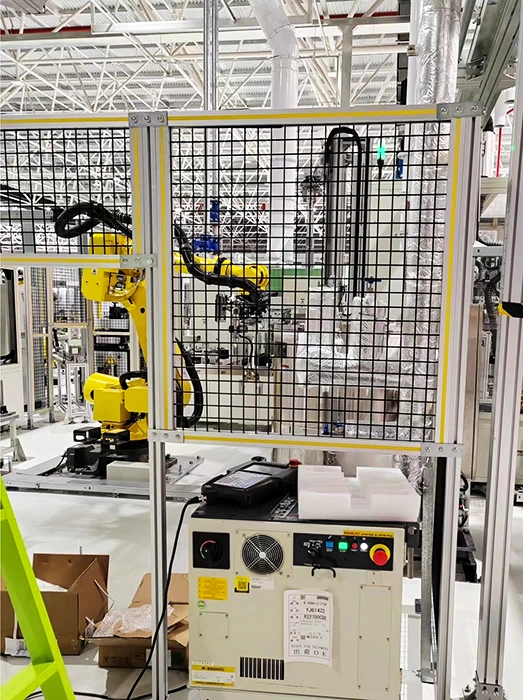
Arc-flash isolation is only one part of a usable robot cell. The fence must also guide people to a defined access point and keep maintenance actions visible in the layout. Alfence supports hinged, sliding, folding, and other modular door arrangements, with safety interlock switches and light curtains available for the access strategy. Aluminum profiles, connectors, foot plates, and expansion-bolt anchoring make the perimeter easier to adjust than a welded steel fence when a robot, conveyor, or control cabinet is relocated. The visual result is a clear safety guarding fence rather than a collection of improvised panels.
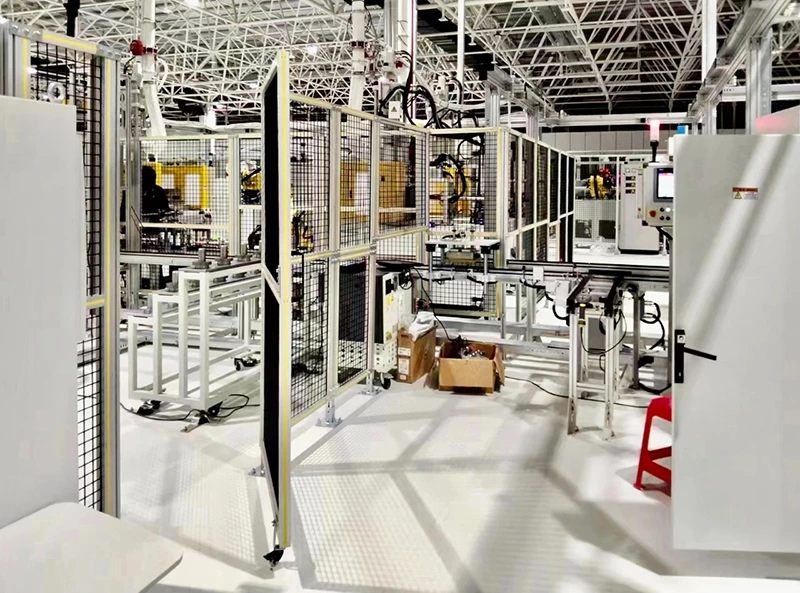
Where to apply the solid-panel and mesh combination
- Welding cell guarding: place tinted, red, or clear solid panels at the arc-facing boundary and use mesh on the remaining perimeter after a heat and visibility review.
- Robot cell guarding: combine the reinforced mesh option with a defined hinged or sliding access door, interlock, and maintenance route.
- Automated production line guarding: use continuous modular frames and selected panel sections around conveyors, fixtures, and neighboring workstations.
- Retrofit guarding: replace only damaged or unsuitable infill, then reconfigure posts and doors as the production line changes instead of cutting and re-welding the whole boundary.
Alfence is intended for indoor machine guarding, light-corrosive, clean, and frequently modified production environments. It should not be specified as an automatic substitute for a high-impact steel enclosure or an outdoor security fence.
Confirm these inputs before releasing the guarding drawing
Record the welding process temperature at the proposed panel position, spatter direction, arc-light line of sight, required viewing area, mesh-to-solid-panel transition, door swing, material-flow opening, and anchoring surface. Then check the selected opening and boundary against the machinery risk assessment and the applicable EN ISO 14120 and EN ISO 13857 design principles. These references guide the design discussion; they are not a statement that this page represents a certificate or a project-specific compliance approval. The final drawing should also identify whether the standard or reinforced mesh is required and how the safety interlock or light curtain interfaces with the machine controls.
Build a welding cell boundary that can be changed without starting over
Send the cell outline, equipment position, access side, arc direction, and expected panel temperature. SGF can help map the Alfence aluminum profile frame, solid welding-zone panels, reinforced mesh areas, doors, and floor anchors into a practical industrial safety fence specification.