EN
 DE
 RU
 PT
 JA
 ES
 IT
Machine protection system fence development history

The Evolution of Machine Protection System Fences
Machine protection system fences have a rich history of development, with their origins dating back to the Industrial Revolution. As mechanization and automation became prevalent in manufacturing processes, the need to safeguard workers from the dangers of machinery became apparent. Over the years, advancements in materials, technology, and safety standards have led to the evolution of these fences, ensuring the protection of both operators and machines.
During the early days of industrialization, basic wooden barriers were used to prevent access to hazardous machinery. However, these primitive barriers offered limited protection and were often insufficient in preventing accidents. As the industry grew, so did the demand for more robust and effective machine protection.
Advancements in Modern Machine Protection System Fences
The 20th century marked a significant turning point in the development of machine protection system fences. The introduction of steel and metal alloys allowed for the construction of sturdier and more durable fences, providing better protection against potential hazards. Additionally, regulations and safety standards were implemented to ensure workplaces complied with essential safety practices.
In recent decades, the integration of technology has further enhanced machine protection system fences. Automated safety features, such as interlocking mechanisms and sensor-based systems, have been incorporated to improve overall safety levels. These innovative additions ensure that machinery is inaccessible during operation, reducing the risk of accidents caused by human error.
Moreover, the materials used in modern machine protection system fences have evolved to be more versatile and adaptable. Steel, aluminum, and reinforced polymers are commonly employed to create fences that can withstand harsh industrial environments while remaining lightweight and easy to install.
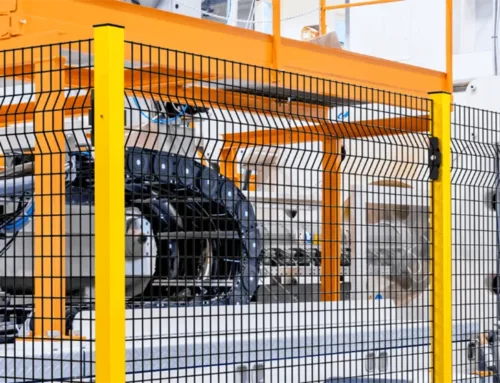
Today, machine protection system fences are designed not only for safety but also for improved productivity. Transparent panels and modular designs allow operators to monitor machinery while maintaining a safe distance, optimizing workflow efficiency.
The history of machine protection system fences is a testament to the ongoing efforts to prioritize worker safety in industrial settings. From rudimentary wooden barriers to modern sensor-equipped structures, these fences have come a long way in providing a secure working environment. As technology continues to advance, the future of machine protection system fences looks promising, with even more sophisticated and efficient safety measures on the horizon.
Money Welded to the Floor: Mefence Frameless Industrial Safety Fence Re-Zones a Packaging Plant in One Weekend
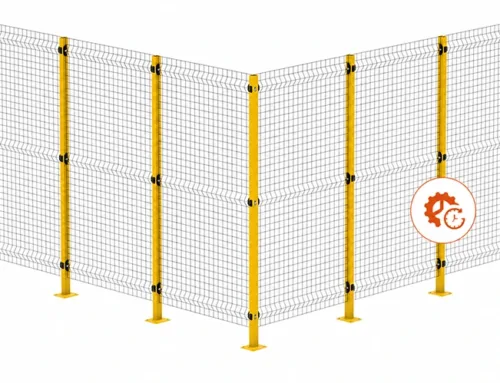
A packaging plant on a 14-day order book redraws its zones faster than a welded perimeter can be justified. Mefence frameless industrial safety fence is a Q235 welded mesh boundary with 3-4 mm wire, 20x100 or 50x50 mm mesh openings and clip-and-screw fixing on base plate posts with slotted mounting holes - unclip the panels, cut the last bay on site, re-bolt them into the new layout. Built for warehouse zoning, storage area separation, pedestrian vehicle separation, forklift path barrier and AGV lane control, with strike points routed to the impact-rated Machine Fence line.
Mesh Opening Over Panel Thickness: Frameless 3D Industrial Safety Fence for Robot Palletizer Cells
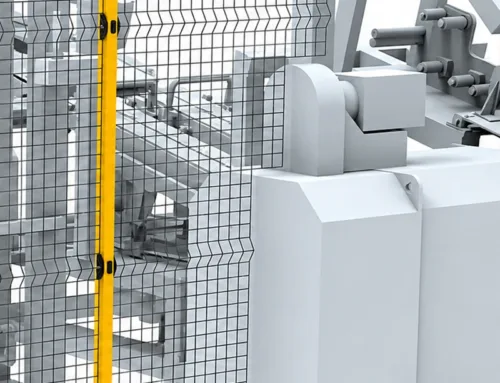
An end-of-line palletizer needs a boundary that keeps people out without taking the sightline with it. Mefence frameless 3D industrial safety fence is a Q235 welded mesh boundary with 20 x 100 mm or 50 x 50 mm openings, clip and self-tapping screw fixing on base plate posts, on-site cut panels and T-shaped ridges that carry interlock, sensor and camera cable — built for robotic workstation enclosure, AGV lane separation and warehouse zoning, with impact-rated strike points on the Machine Fence line.
Open-Mesh Frameless Safety Fencing for Robot Palletizing Cells: Sightline, Camera and AGV LiDAR Without a Solid Panel Wall
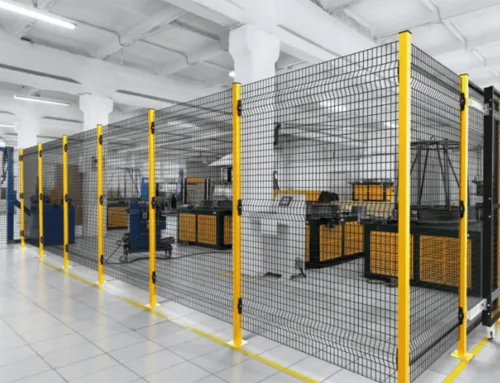
Solid panel walls around an end-of-line palletizer keep people out and blind everyone else: the operator cannot see the cycle, the camera sees a grey rectangle, and the AGV map has a new hard surface in it. Mefence frameless 3D safety fencing is a Q235 welded mesh boundary with 20x100 or 50x50 mm openings, clip and self-tapping screw fixing on base plate posts, on-site cut panels and a T-shaped ridge that carries interlock and camera cable — built for robotic workstation enclosure, AGV lane separation and warehouse zoning, with strike points routed to the impact-rated Machine Fence line.