EN
EN  DE
DE  RU
RU  PT
PT  JA
JA  ES
ES  IT
IT 
Roof Safety Rail
The Roof Safety Rail is a specialized device designed to provide safety protection for roof work areas. It features a robust and durable structure, suitable for various industrial and construction environments, ensuring reliable safety protection for workers working on rooftops. The standard dimensions are 2200*1200*1500mm, with outstanding load-bearing capacity and stability.
What is Roof Safety Rail?
The Roof Safety Rail is a specialized safety protection device designed for roof work areas. It consists of sturdy supports, guardrails, and connectors, all constructed from high-quality structural steel, ensuring its strength and durability. The Roof Safety Rail can be quickly installed, providing reliable protection, and is suitable for various rooftop work scenarios, including construction and maintenance.

Installation of the Guardrail
The installation process of the Roof Safety Rail is straightforward and intuitive. First, place the supports in the rooftop area that requires protection and secure them using connectors. Next, install the guardrails, securing them with connectors. Once these steps are completed, the Roof Safety Rail provides reliable safety protection, ensuring the safety of workers working on the rooftop.
Preventing Falls
The Roof Safety Rail features additional support bars on the guardrails to enhance stability and reliability, effectively preventing workers from accidental falls. It is an excellent safety solution that provides crucial protection for workers working on rooftops.
Adapting to Different Roof Work
The Roof Safety Rail can accommodate the needs of various rooftop work requirements, including construction, maintenance, and repairs. It offers multiple size options and customization choices to meet the requirements of different rooftop work scenarios. Whether it’s rooftop construction or rooftop maintenance, the Roof Safety Rail is a reliable safety protection device.
Product Application
When Must Roof Safety Rail Be Used?
- Need to provide reliable safety protection in rooftop work areas.
- Require a safety protection solution that can adapt to different rooftop work requirements.
- Need to ensure the safety of workers in rooftop work areas, especially during construction and maintenance.
- Customers operating in the construction, maintenance, or other rooftop work-related industries.
- Rooftop work is part of the job tasks and requires safety protection.
Interlock Switch Mounting Without Drilling: Why Alfence T-Slot Posts End Phantom Stops
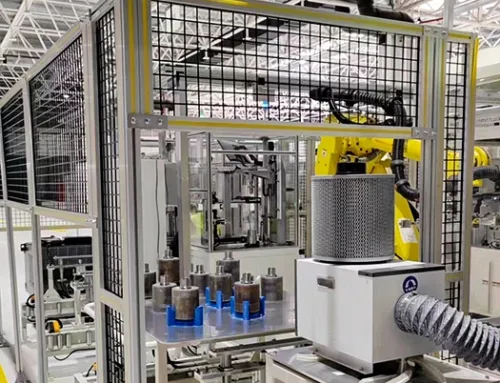
Bolting an interlock switch bracket through a powder-coated steel post drills the coating, drops swarf into the cell and leaves a rust line — and when the hinged leaf sags, the tongue misaligns and the PLC reports a phantom guard fault. Alfence mounts sensors, e-stops and conduit in the T-slot groove of a 40×40 mm or 45×45 mm aluminum post, with door hardware sized to keep the safety switch aligned.
Phantom Safe Torque Off Stops: T-Slot Guarding Fence Posts Mount Interlocks Without Drilling
Painted steel guarding posts force maintenance to drill for interlock switches, dropping swarf in the cell and breaking the coating where rust starts. Sagging hinge doors then misalign the interlock tongue and the PLC trips Safe Torque Off while the gate is closed. Alfence industrial safety fence mounts sensors, e-stops and cable routing into the T-slot aluminum profile post without drilling, and uses hinged, folding or sliding door frames that keep interlock geometry stable - protecting OEE through phantom stops and line changes.
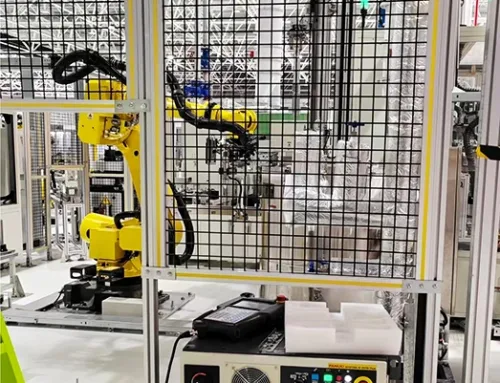
Automotive Plant Industrial Safety Fence: Keep the Robot Cell Close to the Hazard
Automotive plants cannot afford to lose production floor to an oversized machine guarding perimeter. Alfence combines 20×100 mm mesh with slim 40×40 mm or 45×45 mm aluminum posts for a compact, reconfigurable industrial safety fence layout, with final clearance confirmed by the project risk assessment.