DE
DE  EN
EN  RU
RU  PT
PT  JA
JA  ES
ES  IT
IT 

For manufacturing engineers designing high-speed Automated Assembly Lines, floor space is often the most expensive asset. Standard off-the-shelf fencing forces compromised layouts, creating unusable “dead zones” around CNC-Maschinen und Conveyor Systems. Utilizing flexible Industrielle Sicherheitszäune allows integrators to tighten the production footprint without violating ISO 13857 safety distances. This article examines how custom-width panels and zero-swing door systems recover valuable square footage in complex Bereiche der Materialhandhabung.
Escaping the “Standard Width” Trap in Factory Layouts
A common friction point in Schlüsselfertige Lösungen is the mismatch between the machine footprint and standard fence dimensions. If a robotic cell requires a 3.2-meter protective run, relying on a catalog that only offers 1.5-meter panels forces the integrator to oversize the cell to 4.5 meters. This results in 1.3 meters of wasted floor space—a significant loss in high-density Automobil-Schweißstationen.
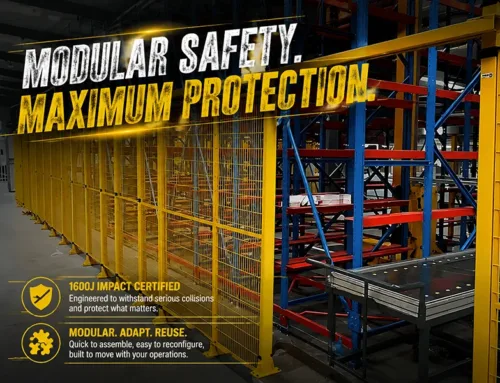
High-value Schutz von Maschinen systems solve this through a “Build to Print” approach. By utilizing a modular design where Q235 Kohlenstoffstahl mesh panels can be manufactured to exact widths, engineers can wrap the perimeter tightly around the hazard zone. This precision allows for the integration of Kundenspezifische Maschinen into existing brownfield sites where every millimeter of aisle width counts, eliminating the need for on-site cutting or welding that damages Pulverbeschichtung finishes.

Figure: Custom layout optimization for large-scale perimeter isolation.
Streamlining Logistics with Zero-Swing Access
In modern smart factories, the interaction between Lager AGV/AMR-Pfade and production cells is continuous. Traditional hinged doors are a bottleneck; their swing radius obstructs traffic aisles and creates safety hazards for passing forklifts. For a Systemintegrator, maintaining clear logistics channels is as important as the cell safety itself.
Integrating suspended or floor-track sliding doors eliminates this swing radius entirely. Heavy-duty systems utilizing Lagerschienen ensure that even large 3000mm openings can be operated smoothly with one hand. This is critical for Bereiche der Materialhandhabung where operators need to move pallets in and out of the cell frequently. By keeping the door footprint linear, you preserve the aisle width required for Association for Advancing Automation (A3) compliant mobile robot navigation.
Visual Management and Process Visibility
Safety does not require opacity. In Quality Inspection Cells and assembly zones, operators need clear lines of sight to monitor Industrieroboter. The choice of mesh color and material plays a functional role here. Black powder-coated wire mesh offers superior transparency compared to yellow or light colors, as it absorbs light reflection, allowing the eye to focus on the equipment inside.
For processes involving coolant splash or flying debris, such as near Lathes oder Mills, modular systems allow for the substitution of wire mesh with Polycarbonate (PC) panels. This hybrid approach provides the necessary impact containment of steel framing while maintaining the visual connection essential for process monitoring and “Visual Factory” management standards.
Accommodating Vertical Variance Without Shims
A practical challenge often overlooked in design is the unevenness of factory floors. Rigidly welded fence panels require time-consuming shimming to install level on uneven concrete. A modular system utilizing adjustable fixing rings decouples the mesh panel from the post height. Installers can slide the panel up or down the post to achieve a level top line regardless of floor undulations. This feature significantly reduces installation time for Schlüsselfertige Lösungen, ensuring a professional, aligned finish that passes site acceptance testing (SAT) without rework.

Compact sliding door solutions for space-constrained production environments.
Häufig gestellte Fragen
1. How much floor space can be saved using custom-width fencing?
By using “Build to Print” panels that match the exact dimensions of your machine layout, you can eliminate the dead space caused by standard panel increments. In large assembly lines, this can recover dozens of square meters of valuable factory footprint.
2. Are sliding doors safer than hinged doors for AGV routes?
Yes. Sliding doors do not swing out into the aisle, eliminating the risk of collision with passing AGVs, AMRs, or forklifts. They maintain a consistent, safe clearance width for logistics traffic at all times.
3. Can the system accommodate different heights for specific machines?
Yes. While standard heights are 1200mm and 2000mm, the system can be customized up to 2440mm. This is useful for containing high-trajectory hazards in robotic cells or differentiating between walkway barriers and full machine guards.
4. What is the benefit of using black mesh panels?
Black powder-coated mesh reflects less light than yellow or galvanized mesh. This provides much better “see-through” visibility for operators to inspect the machinery and processes inside the cell without eye strain.
5. Do I need to drill holes on-site to install the fencing?
No. The system is designed for mechanical assembly. Posts are anchored with expansion bolts, and panels are attached using adjustable fixing rings. This eliminates on-site drilling and welding, keeping the installation area clean and safe.