DE
DE  EN
EN  RU
RU  PT
PT  JA
JA  ES
ES  IT
IT 

|
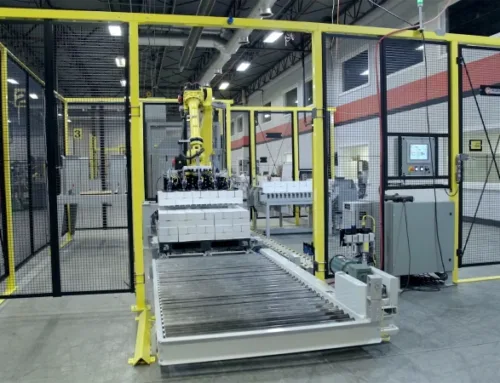
In high-speed automotive assembly and robotic welding cells, a “virtual” line isn’t enough. When you are integrating ABB or Fanuc arms moving at 2 meters per second, you need more than a painted line—you need a calculated physical separation that guarantees ISO 14120 compliance without killing your cycle time. We engineer barriers that integrate seamlessly with your PLCs and keep your line running. |
In the world of industrial automation, “safety” is often viewed as the enemy of “speed.” For a System Integrator or a Plant Manager in the automotive sector, the challenge is distinct: How do you secure a robotic welding station or a high-speed pick-and-place unit without creating a fortress that makes maintenance impossible? The answer lies in moving beyond simple “fencing” to implementing an engineered Industrielle Sicherheitszäune system that acts as an integrated component of your machine’s control logic.
Defining the “Hard Guarding” Perimeter
Electronic sensors like light curtains are excellent for operator loading zones, but for the perimeter of a robotic cell, physical hard guarding is non-negotiable. The primary function here is to establish the calculated safety distance (per ISO 13857) between the hazard zone—where a robotic arm might overshoot or a workpiece might be ejected—and the operator.
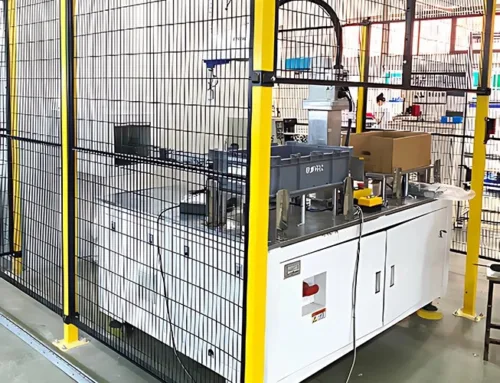
Unlike generic wire mesh, a dedicated Maschinenschutzzäune solution uses framed panels. In an automotive stamping plant or a Tier 1 supplier facility, vibration is constant. Standard open-mesh fencing often rattles loose at the weld points over time. Our solution utilizes a Gerahmte Tafel design (20x30mm steel tube frame) where the mesh is fully welded into the frame, not just tack-welded to the surface. This structure resists the harmonic vibrations of nearby heavy presses and ensures the barrier remains rigid.

The 20x30mm steel frame ensures rigidity against vibration and impact in automated environments.
Integration with Safety Interlocks: The “Handshake”
A physical barrier is only as good as its gate. In modern automation, the fence is part of the electrical safety circuit. A common pain point for integrators is the “retrofit headache”—trying to mount sophisticated safety switches (like Omron D4NL or Pizzato FS series) onto posts that weren’t designed for them. This often leads to onsite drilling, misalignment, and eventual switch failure due to door sag.
Unser Roboter-Schutzzäune system addresses this with pre-engineered Träger mit Sicherheitsverriegelung. These are not generic brackets; they are specialized mounting kits designed to interface directly with our 60x60mm posts and door frames. This ensures that when an operator requests entry and the lock solenoid engages, the mechanical alignment is perfect every time, preventing “nuisance trips” that stop the entire production line.

Specialized mounting options for safety interlocks allow for seamless integration with PLC control systems.
Impact Resistance: Containing the Kinetic Energy
In a perfect world, robots never crash and forklifts never veer off path. In reality, your physical barrier is the last line of defense against kinetic energy. If a 50kg robotic payload is released prematurely, or if an AGV malfunctions, the fence must absorb that energy.
Wir verwenden Q235 Kohlenstoffstahl for our posts and frames. This material offers the ductility needed to absorb impact without immediate brittle fracture. Our posts are anchored using M10x70mm expansion bolts, designed to withstand significant shear forces. For high-risk areas, such as the turning radius of a forklift supply lane, the system’s “High Impact Resistance” (verified by TUV testing) ensures that a minor accident doesn’t become a catastrophic breach of the safety zone.
Access Management for Large Cells
Automated cells often require large access points for bringing in raw materials (like steel coils) or removing finished sub-assemblies. Standard hinged doors are often impractical due to their swing radius interfering with AGV paths or walkways.
For these scenarios, we deploy heavy-duty Industrielle Perimetersicherungen sliding doors. Unlike lightweight residential sliders, our systems use a top-hanging track with bearing rollers capable of supporting wide spans (up to 4300mm for double doors) without sagging. This allows forklifts to enter the cell for die changes without dismantling the safety perimeter, maintaining high operational efficiency.

Double sliding doors provide wide access for forklifts and material handling without obstructing aisle space.
Modular Installation: Beating the Launch Deadline
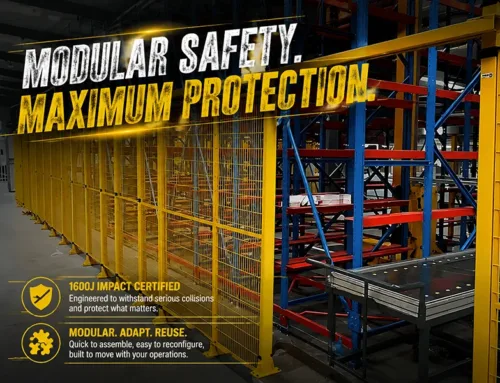
In the automotive industry, a shutdown for installation is measured in minutes, not days. Welding on-site is rarely an option due to “hot work” permit requirements and fire risks. The Mdfence system is entirely modular. Using our specialized fixing rings and flange bolts, a two-man crew can erect meters of fencing rapidly using only impact drivers and hex keys.
This modularity also future-proofs your investment. When the production line retools for a new car model next year, the fencing can be disassembled, reconfigured, and expanded without cutting or scrapping steel. It is a reusable asset, not a sunk cost.
Häufig gestellte Fragen
1. Can your fencing system integrate with Trapped Key Interlock systems?
Yes, our modular door designs and post profiles are compatible with major trapped key systems (like Fortress or Castell) as well as solenoid-locking switches. We provide specific mounting plates to ensure robust installation.
2. Does the system meet ISO 14120 requirements for retention of parts?
Absolutely. Our framed panels and welded mesh are designed to contain ejected parts from within the machine zone. For high-velocity fluid or spark containment (e.g., in robotic welding), we can swap mesh for polycarbonate or sheet steel panels.
3. How do you handle non-90-degree corners in complex layouts?
Automation layouts are rarely perfect squares. Our connection system allows for flexible angular adjustments, and we offer adjustable corner brackets to accommodate odd angles often found in retrofitted factories.
4. Is the yellow powder coating resistant to cutting fluids and oils?
Yes, our posts are powder coated (RAL 1023) to automotive industry standards. The coating passes ISO 9227 salt spray testing, ensuring resistance to common industrial oils, coolants, and mild solvents found in machining environments.
5. What is the standard height for robot guarding?
While 2000mm is the industry standard to prevent reaching over, we can customize heights up to 2440mm for cells involving large industrial robots with high vertical reaches, ensuring compliance with reach-over safety distance calculations.