DE
DE  EN
EN  RU
RU  PT
PT  JA
JA  ES
ES  IT
IT 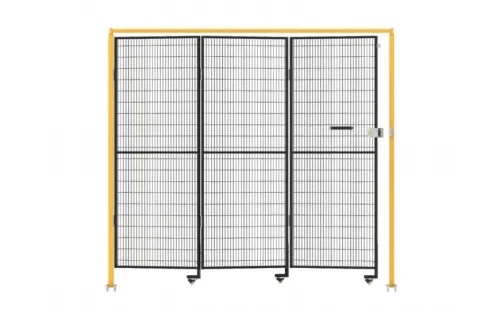

|
Stop fighting rust in your washdown zones. In high-humidity processing plants, standard paint blisters and flakes within months, contaminating your line and failing safety audits. You need a barrier engineered to survive the moisture. |
The Corrosion Battle: Why Standard Guards Fail in Wet Environments
If you are managing a paper mill, a chemical processing unit, or an automotive paint shop, you know the reality of “industrial humidity.” It’s not just about water; it’s about the accelerated oxidation that attacks every piece of exposed metal in your facility. In these environments, a standard Sicherheitszaun Industrie system often becomes a liability before the warranty even expires.
The problem isn’t usually the steel itself; it’s the coating failure. Once moisture penetrates the paint layer—often through microscopic cracks in the welds or scratches from installation—crevice corrosion sets in. The paint bubbles, flakes off (creating a Foreign Material Exclusion nightmare in packaging lines), and the structural integrity of the guard is compromised. You cannot afford to replace perimeter guarding every two years due to rust.
Engineered Resistance: The Mdfence Powder Coating Advantage
To survive in humid plants, the barrier between the steel and the atmosphere must be impermeable. We utilize a high-grade Pulverbeschichtung process that meets GB/T9286-1998 standards for adhesion. Unlike wet paint, which can leave pinholes, our electrostatic powder coating creates a uniform, thick skin over the Q235 Kohlenstoffstahl core.
Crucially, this system has passed ISO9227 salt spray testing. This means the posts and panels are verified to withstand corrosive atmospheres without blistering or peeling. This is essential for maintaining the visual standard of your facility and ensuring that the “Safety Yellow” (RAL1023) remains visible to operators, rather than turning into a dull rust-brown.

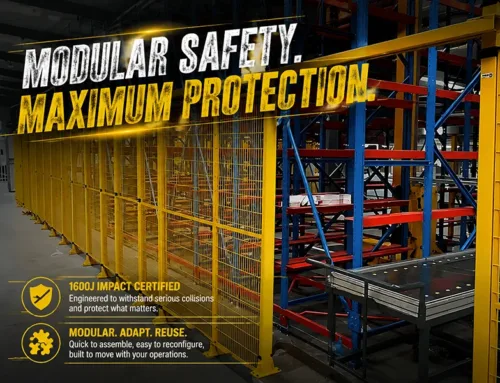
Figure 1: The Q235 steel posts feature a 1.5mm to 2.0mm wall thickness and a sealed base design, critical for preventing water accumulation at the anchor points.
Eliminating Water Traps: Flat Welding and Sealed Posts
In humid plants, water accumulation is the enemy. Traditional fencing often uses spot welding or open-channel frames where water pools, becoming a breeding ground for rust and bacteria. Our Maschinenschutzzäune utilizes a Gerahmte Tafel design with full flat welding technology.
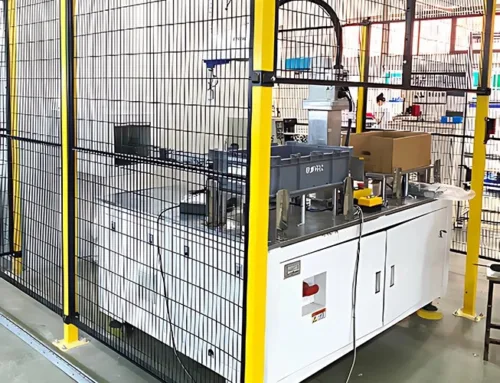
Every contact point between the wire mesh and the 20x30mm frame is fully welded and flattened. This eliminates sharp burrs and, more importantly, closes the crevices where moisture typically enters. Furthermore, our posts come with plastic top caps and a specialized two-piece post base protective cover. This cover shields the anchor bolts—the most vulnerable point of any fence—from direct splashes during floor cleaning, preventing the anchors from rusting out of the concrete.
Space-Saving Access for Automated Lines
Humid processing lines, such as bottling or canning conveyors, are often tightly packed. You rarely have the floor space for a large swing door radius. For these applications, we recommend the Schiebetür system.
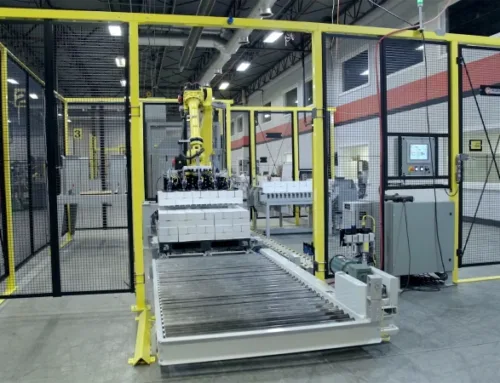
Our sliding doors use an overhead rail or bottom bearing system that keeps the door movement smooth, even after years of operation in damp conditions. Because the door slides parallel to the fence line, you don’t block the narrow walkways used by maintenance teams. For larger openings, such as bringing in pallets of raw materials, the double sliding door offers an opening width of up to 4300mm (approx. 14 feet).

Figure 2: Double Sliding Door system ideal for wide access requirements in space-constrained processing areas.
Smart Integration: Locking Out Hazards
A physical barrier is only half the solution. In automated plants, you need to ensure that opening a gate immediately halts the machinery. Mdfence systems are designed as active Roboter-Schutzzäune components.
We provide pre-engineered Träger mit Sicherheitsverriegelung (such as the KKCK-LCK series) that are compatible with major switch brands like Omron and Pizzato. Instead of your maintenance team drilling holes into the powder coat—which would immediately void the rust protection—we supply ready-to-mount brackets. This ensures your interlocks are mounted securely and the protective coating of the fence remains intact.

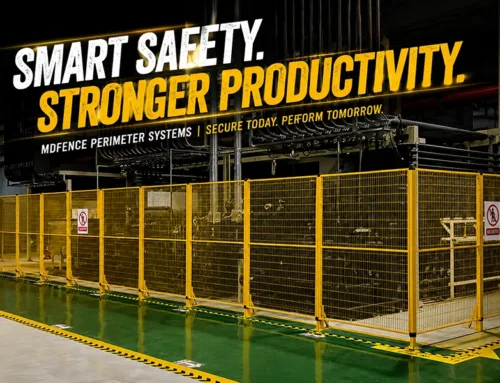
Figure 3: Various locking options and interlock mounting accessories designed for seamless integration with safety PLCs.
Frequently Asked Questions: Safety Fencing in Humid Plants
1. Will the powder coating withstand daily washdowns with chemical cleaners?
Yes, the powder coating is cured to withstand industrial cleaning. However, we recommend verifying the pH level of your specific cleaning agents against our chemical resistance data sheet to ensure longevity.
2. Can we install this fencing on wet concrete floors?
Absolutely. We use M10 x 70mm expansion bolts for anchoring. For constantly wet floors, we recommend using stainless steel anchors (optional upgrade) and utilizing our plastic base covers to protect the mounting point.
3. Do you offer stainless steel mesh for extremely corrosive areas?
While our standard is powder-coated Q235 carbon steel, which is sufficient for most humid manufacturing environments, we can customize panels with stainless steel or aluminum for areas with direct acid exposure.
4. How does humidity affect the modular assembly?
The Mdfence system uses a clamp-and-bolt assembly method. Since there is no on-site welding required, you don’t burn off the protective coating during installation, which is the #1 cause of rust in humid plants.
5. What is the lead time for a custom layout involving multiple sliding doors?
Because our system is modular, we can configure complex layouts quickly. For standard height (2000mm) components, we maintain stock. Custom layouts are typically finalized within days of receiving your CAD files.