DE
DE  EN
EN  RU
RU  PT
PT  JA
JA  ES
ES  IT
IT 

Your controls engineer is fabricating brackets on-site again, trying to get that Omron D4NL to align with the door on your new robot cell. That’s not integration; it’s a costly, time-consuming workaround that puts your project timeline at risk. A Roboter-Schutzzäune system shouldn’t create integration problems; it should solve them.
Stop Fabricating, Start Integrating: The Problem with “Dumb” Robot Cell Fencing
For any system integrator, the final stages of a robot cell commissioning are where timelines get compressed and budgets evaporate. The mechanical build is complete, the robot is programmed, but the safety circuit integration hits a snag. The culprit is often the most overlooked component: the safety fence door.
You’ve specified a standard safety interlock switch—a Pizzato FS or Omron D4NL—to ensure the cell powers down when an operator enters. The problem? Your Maschinenschutzzaunfelder have no native provision for mounting it. This forces your highly-paid controls engineer to stop integrating the PLC and start acting like a metal fabricator. They spend hours drilling into posts, creating custom brackets, and fighting with alignment, all while the project clock is ticking. This on-site modification is not just inefficient; it’s a point of failure that can compromise the integrity of your entire safety-rated system.
From Passive Barrier to Active Safety Component
A modern robot safety fencing system must be more than just a physical barrier. It needs to be an integral part of the machine’s control system. This requires a design philosophy that anticipates integration needs from the very beginning. Instead of treating the fence as an afterthought, we treat it as a foundational component of your automation cell.
Our Mdfence system is engineered around this principle. The core of this solution is our pre-engineered **Träger mit Sicherheitsverriegelung**. This isn’t just a piece of metal; it’s a purpose-built mounting solution designed to accept industry-standard interlock switches seamlessly.

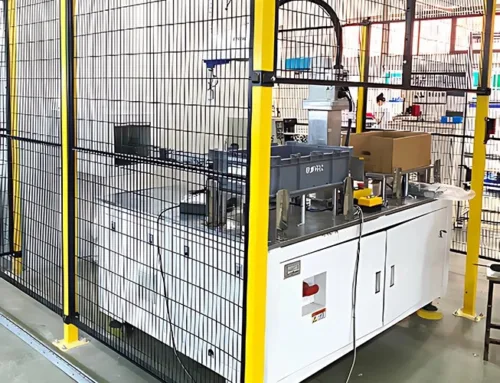
The Mdfence Safety Interlock Carrier (right) eliminates custom fabrication for mounting standard safety switches.
The benefits for a system integrator are immediate and quantifiable:
- Eliminate On-Site Fabrication: Your team simply bolts the Omron, Pizzato, or other standard switch directly onto the carrier. What used to take hours of custom work now takes minutes.
- Ensure Perfect Alignment: The carrier and lock components are designed to work together, ensuring the switch actuator and body align perfectly every time the door closes. No more nuisance trips or failed circuits.
- Maintain System Integrity: By providing a dedicated, robust mounting point, you avoid compromising the structural integrity of the fence posts or doors through ad-hoc drilling.
- Accelerate Commissioning: You reduce the time from mechanical completion to a fully commissioned, safety-compliant system, allowing you to hand over the project to your client faster.
Engineered for the Demands of Automated Environments
Beyond seamless electronic integration, the entire Mdfence system is built to withstand the rigors of a modern manufacturing plant. A flimsy fence can lead to costly downtime if impacted by a forklift or a malfunctioning robot arm.
Robust by Design
Our system’s strength comes from its core components, specified for high-risk industrial environments:
- Posts: Constructed from 60 x 60mm (2.36″ x 2.36″) Q235 carbon steel tubes, anchored to the concrete floor with four M10 expansion bolts. This provides a rigid foundation for the entire perimeter.
- Framed Panels: Standard panels feature a 20 x 30mm (0.79″ x 1.18″) steel tube frame with 4mm wire mesh welded inside. This framed design provides superior Schlagfestigkeit compared to frameless mesh, crucial for protecting high-value automation assets.
- TUV-Certified Performance: The system is tested and certified to meet stringent international safety standards, including ISO 14120, giving you and your client confidence in its protective capabilities.
Modular Solutions for Any Layout
No two automation cells are the same. Whether you’re guarding a single collaborative robot or enclosing a complete automotive welding line, our modular system provides the flexibility you need. We work directly from your CAD drawings to deliver a kit that matches your exact layout, including complex angles and multiple access points.
Our door systems are designed to solve specific access challenges:
- Hinged Doors: The standard for personnel access, available in single or double-leaf configurations up to 3000mm (approx. 9.8 ft) wide.
- Sliding Doors: Ideal for wide openings where swing space is limited, perfect for material loading/unloading zones.
- Folding Doors: Provide the maximum possible opening for very large access requirements, such as equipment installation or maintenance, without requiring a massive footprint.

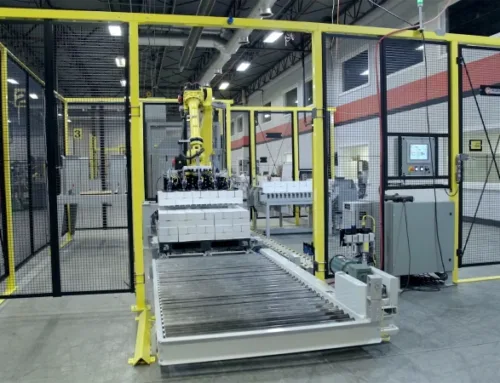
A double sliding door provides wide access for material handling without obstructing walkways.
By delivering a complete, pre-engineered industrielle Schutzzäune kit—including the correct panels, posts, doors, and safety interlock carriers—we help you transform a project risk into a competitive advantage. You deliver a safer, more professional, and more reliable system to your client in less time.
Frequently Asked Questions for System Integrators
1. Can your fence system accommodate non-standard interlock switches?
Yes. While we offer pre-engineered carriers for popular models like the Omron D4NL and Pizzato FS series, we can design and supply custom mounting plates based on the datasheet for virtually any safety-rated interlock switch, solenoid lock, or trapped key system you specify.
2. How do you handle complex floor layouts with angles or cutouts for conveyors?
Our system is fully modular. We work from your layout drawings (e.g., DWG or STEP files) to create a tailored solution. This includes providing posts for any angle, custom-width panels, and panels with specific cutouts to accommodate conveyors, cable trays, or other existing equipment, ensuring a clean fit without on-site modifications.
3. What is the typical lead time from final drawing approval to delivery?
Standard configurations typically have a lead time of 2-3 weeks. For highly customized projects involving special colors, panel types, or custom interlock carriers, lead times may extend to 4-5 weeks. We provide a firm delivery schedule upon project confirmation to align with your integration timeline.
4. Does the fencing meet RIA R15.06 requirements for robot safeguarding?
Absolutely. Our system is designed and built to meet or exceed the requirements of major global and regional safety standards, including ISO 14120 (general requirements for guards) and supports compliance with ANSI/RIA R15.06 (the US standard for robot safety). The specified mesh opening and required mounting distances are calculated to prevent reach-through to the hazard zone.
5. We need to install the fence on an uneven floor. How is this managed?
Our standard post design allows for some leveling using shims under the baseplate. For more significantly sloped or uneven surfaces, we can provide posts with extended baseplate stems or custom-length posts to ensure the top of the fence line remains level and all safety gaps are compliant, maintaining a professional and secure installation.