DE
DE  EN
EN  RU
RU  PT
PT  JA
JA  ES
ES  IT
IT 

|
You are commissioning a high-speed automotive welding cell, and the deadline is next week. If your perimeter guarding fails the EHS impact test or the safety interlocks don’t align perfectly with the PLC, the entire automated line halts. You don’t need generic wire mesh that sags; you need a TUV-certified physical barrier that guarantees ISO 14120 compliance, stops a 220 lbs ejected part dead in its tracks, and integrates seamlessly with your Omron or Pizzato switches without on-site hot work. |
The Hidden Bottlenecks in Robotic Cell Commissioning (Before)
For system integrators and facility managers in the automotive and heavy automation sectors, the physical barrier is often the last thing considered but the first thing to cause commissioning delays. Relying on local fabricators for Schutzsysteme für Maschinen often leads to a nightmare on the factory floor. Hot work permits are required for on-site welding, sending sparks flying near sensitive CNC machining centers and optical sensors. Worse, frameless mesh panels flex when a worker leans on them, causing heavy hinged doors to sag. This misalignment forces the safety interlock keys out of position, triggering phantom STO (Safety Torque Off) faults that kill your OEE (Overall Equipment Effectiveness).
Why TUV-Certified Guarding is a Structural Necessity (Why it Works)
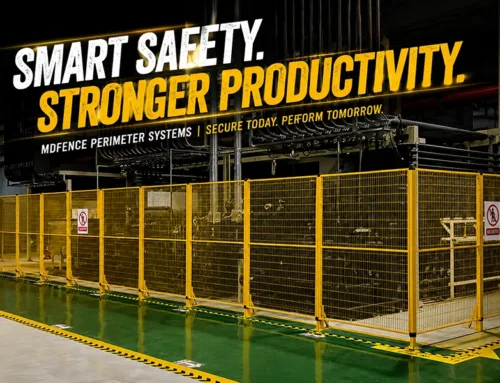
The Mdfence system is engineered purely on physics and material science to eliminate these integration headaches. It is not just a fence; it is a passive defense mechanism designed to absorb kinetic energy.

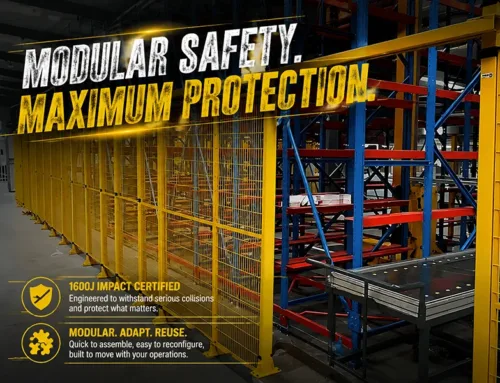
Unlike cheap, frameless “bend-wire” alternatives, our Industrielle Sicherheitszäune utilizes a fully welded 20x30x1.5mm Q235 carbon steel framed architecture. When a 6-axis robot drops a heavy aluminum engine block, or an errant forklift bumps the perimeter, the impact load is dispersed through the flattened weld points across the tubular frame, transferring the 1600 Joules of kinetic energy directly to the 60x60mm posts and down into the concrete floor via M10 expansion bolts. It bends to absorb the shock rather than snapping into dangerous shrapnel, securing your TUV and ISO 14120 compliance instantly.
Reclaiming High-Value Floor Space (After)
Floor space in a modern automotive assembly plant is calculated in thousands of dollars per square foot. Standard 50x50mm (2″x2″) mesh allows fingers to pass through, forcing you to install the perimeter guard up to 850mm (33.5 inches) away from the hazard to meet ISO 13857 reach-distance standards.
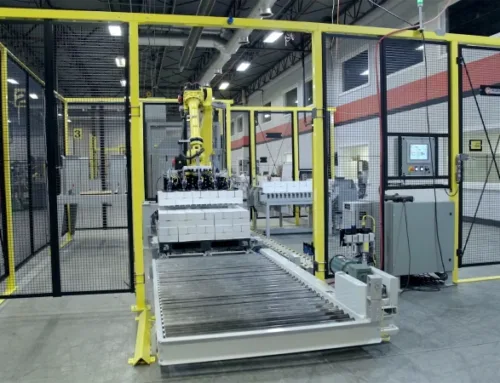
By utilizing our anti-climb 20x100mm (0.78″x3.9″) finger-safe mesh, the safety distance is legally reduced to just 120mm (4.7 inches). For a 150-foot automated production line, pulling the Roboter-Schutzzäune inward saves massive amounts of square footage, allowing you to widen your AGV (Automated Guided Vehicle) paths or squeeze in an additional quality inspection cell.
Plug-and-Play PLC Integration
System integrators despise drilling into freshly powder-coated steel to mount safety switches. It introduces metal shavings into clean environments and voids corrosion warranties.

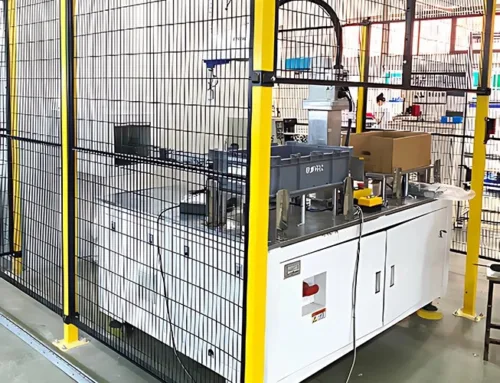
We transformed the physical barrier into an active logic control interface. Our systems feature pre-engineered lock carriers (e.g., KKCK-LCK-B-D4NL-SET) specifically mapped to the hole patterns of industry-standard interlocks like Omron D4NL and Pizzato FS series. You simply bolt the switch onto the rigid tubular frame. The door’s robust caster wheels and heavy-duty hinges ensure zero sagging over millions of cycles, meaning the actuator key aligns flawlessly with the switch body every single time.
Cold Assembly: Drastically Reducing MTTR

When layouts change—and they always do—weld-on fences become scrap metal. Our modular bolt-on design, utilizing high-strength connection clips and M8x16 hex screws, allows for a 100% cold assembly process. Two technicians can install 150 feet of perimeter guarding in a single day using only hand tools. If a forklift damages a panel, your maintenance crew can swap it out in 10 minutes, minimizing your Mean Time To Repair (MTTR) and getting the robotic cell back online instantly.
Workflow Efficiency Comparison
| Operational Phase | Traditional Fabricated Fencing | Mdfence Modular System |
|---|---|---|
| Einrichtung | Hot work permits required. Sparks risk damaging optical sensors. | Cold assembly. No sparks, no dust. 40% faster deployment. |
| PLC Integration | On-site drilling required for interlocks. High risk of misalignment. | Pre-drilled lock carriers for Omron/Pizzato. Perfect actuator alignment. |
| Layout Modifications | Requires angle grinders to cut. Zero asset reuse value. | Unbolt and reconfigure. 95% asset reuse rate for future robotic cells. |
Frequently Asked Questions (FAQs)
1. Does this system comply with ISO 14120 for robotic work cells?
Yes. The system is designed according to ISO 14120 general requirements for fixed guards, ensuring it can withstand the specific impact forces calculated during your robotic line’s Risk Assessment.
2. How much impact energy can the framed panels absorb?
Our TUV-certified Q235 steel panels can withstand impacts of ≥ 1600 Joules. This is equivalent to safely intercepting a 100kg (220 lbs) object moving at 20 km/h (12.4 mph), preventing ejected parts from breaching the perimeter.
3. Can we integrate our existing Omron D4NL safety interlocks?
Absolutely. We provide pre-engineered lock carriers (such as the KKCK-LCK-B-D4NL-SET) that map directly to the hole patterns of standard Omron and Pizzato switches, allowing for seamless integration into your PLC’s emergency stop circuit without custom drilling.
4. How does the 20x100mm mesh size help with floor space?
According to ISO 13857, the 20mm width prevents finger and hand reach-through. This allows you to legally install the guarding just 120mm (4.7 inches) away from the hazard, saving valuable floor space compared to standard 50x50mm mesh which requires up to an 850mm clearance.
5. Do you offer solutions for overhead crane access in heavy assembly areas?
Yes. The modular design allows for “top-open” configurations, meaning the perimeter remains secure while overhead cranes can safely lower heavy automotive molds or engine blocks directly into the CNC or welding cell from above.