DE
DE  EN
EN  RU
RU  PT
PT  JA
JA  ES
ES  IT
IT 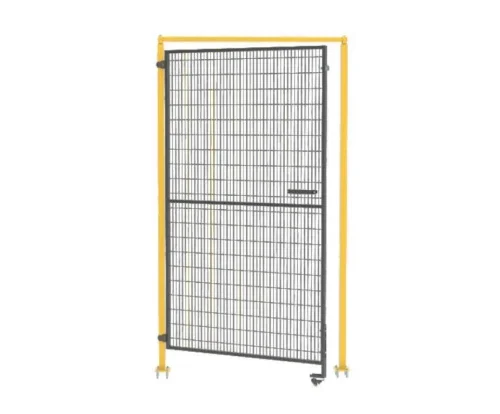

|
Integrating conveyors into your robotics layout without failing ISO 13857 safety audits is a nightmare for system integrators. Hand-cutting and welding standard mesh on the factory floor leaves sharp edges, destroys the powder coating, and delays your turnkey delivery. You need a modular barrier that bridges the gap between active material flow and strict machine guarding compliance. |
Is an Industrial Safety Fence required for conveyors?
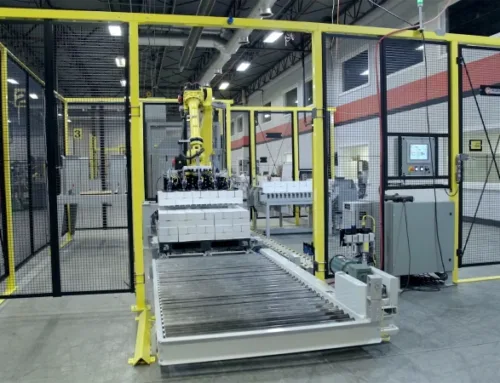
Yes, whenever a conveyor belt transports parts—such as engine blocks or stamped chassis components—into or out of a hazardous automated production line, an Industrielle Sicherheitszäune system is absolutely mandatory. The challenge for automation integrators isn’t just putting up a wall; it is creating precise openings that allow material to pass while strictly preventing an operator’s hands from reaching the pinch points of the CNC machining center or the active envelope of an industrial robot.
The Integrator’s Dilemma with Conveyor “Tunnel” Openings
Das Szenario: You are setting up an automatic high-speed manufacturing line. The conveyor must pass through the perimeter guard. Standard, cheap wire mesh requires you to manually cut large, messy holes on-site. If the gap is too large, operators can reach their arms through, failing the ISO 13857 reach-distance audit. Furthermore, on-site hot work (grinding and welding) creates sparks near sensitive PLC/HMI equipment and destroys the anti-corrosion coating, leading to rust within months.
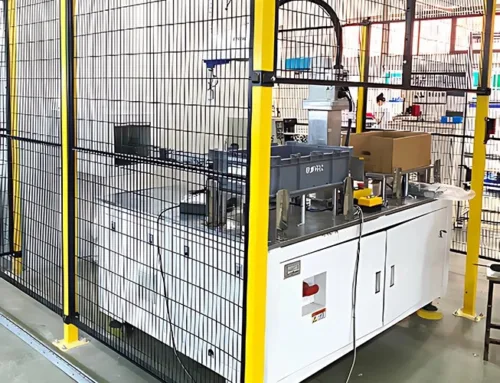
Why Mdfence Works: Our system utilizes a rigid, framed mesh architecture. Every panel features a seamless 20x30x1.5mm steel tube frame with a tightly woven 20x100mm (0.78″ x 3.93″) mesh profile. This allows our engineering team to design pre-fabricated “Tunnel Guards” that perfectly contour around your specific conveyor dimensions. The narrow 20mm mesh slot restricts penetration to just the fingertips.

The Actual Benefit: You achieve perfect ISO 13857 compliance, allowing the barrier to be installed just 4.7 inches (120mm) away from the hazard. This saves highly valuable floor space in tight automotive plants. Because everything is pre-engineered and bolted together via cold assembly, there are no hot work permits required, no grinding dust on your servo motors, and zero delays to your project handover.
Active Material Flow vs. PLe/SIL3 Safety Interlocks
Das Szenario: Conveyor lines require frequent maintenance access. When you use frameless, low-cost fencing, the mesh sags the moment an operator leans on it. Over time, this structural weakness causes the access doors to drop. Even a millimeter of sag misaligns the safety interlock switches, triggering phantom E-stops (Emergency Stops) that halt the entire automotive welding station and destroy your Overall Equipment Effectiveness (OEE).
Why Mdfence Works: Unser Schutzsysteme für Maschinen are built from high-tensile Q235 carbon steel. The rigid frames prevent any out-of-plane deformation. More importantly, we provide pre-engineered mounting plates (lock carriers) specifically designed for industry-standard safety switches like the Omron D4NL or Pizzato series.

The Actual Benefit: The mechanical integrity of the door remains flawless over thousands of cycles. Your safety switches stay perfectly aligned, eliminating nuisance trips and unexplained downtime. You deliver a reliable turnkey solution where the physical barrier and the PLC control logic work in perfect harmony.
Heavy-Duty Impact Protection for AGV and Conveyor Intersections
Das Szenario: In modern logistics and automotive plants, warehouse AGV paths frequently intersect with conveyor offload zones. Collisions are inevitable. If a rogue forklift or AGV bumps into a brittle aluminum profile guard, the aluminum snaps, sending dangerous shrapnel into your expensive robotics layout.
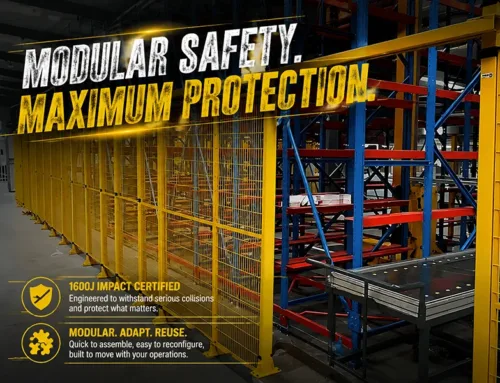
Why Mdfence Works: Engineered for extreme environments, our Roboter-Schutzzäune is TUV certified to withstand up to 1600 Joules of impact. This is the equivalent of a 220 lbs (100 kg) object crashing into the barrier at 12.4 mph (20 km/h). The 60x60mm Q235 steel posts are anchored deep into the concrete using four M10x70mm expansion bolts per base plate. Instead of shattering, the low-carbon steel yields and absorbs the kinetic energy.

The Actual Benefit: You gain a physical insurance policy for your automated assembly systems. Even during a severe collision, the barrier holds, protecting the critical machinery inside. Furthermore, because of the modular design, your maintenance team can simply unbolt the damaged panel and swap it out in under 10 minutes, drastically reducing your Mean Time To Repair (MTTR).
Managing Wide Conveyor Exits with Space-Saving Doors
Das Szenario: Occasionally, quality inspection cells require operators to manually pull large pallets or rejected engine blocks off the conveyor line using a pallet jack. Standard hinged doors require a massive swing radius, eating up valuable floor space and obstructing forklift traffic in the aisle.
Why Mdfence Works: For tight layouts, our Sicherheitszaun Industrie solutions feature heavy-duty sliding doors suspended on low-friction bearing rails. We offer double sliding configurations that can open up to 169 inches (4300mm) wide without requiring a single inch of outward swing space.

The Actual Benefit: You maintain a fully compliant, high-security perimeter around your conveyors without sacrificing aisle maneuverability. The smooth sliding mechanism ensures fast, ergonomic access for material handling, keeping your high-speed mechanical assembly machines fed and running efficiently.
Frequently Asked Questions (FAQs)
1. How do we calculate the safe distance for a conveyor tunnel opening?
The distance is calculated based on ISO 13857 standards, which correlate the size of the opening with the distance to the hazard. Our 20x100mm mesh restricts reach to just the fingertips, allowing the guard to be placed as close as 120mm (4.7 inches) to the moving conveyor parts.
2. Can the fence integrate directly with our Siemens PLC safety logic?
Yes. We provide pre-engineered lock carriers that serve as precise mounting brackets for PLe/SIL3 rated safety interlock switches. This ensures the physical door status is flawlessly communicated to your PLC to trigger an immediate Safety Torque Off (STO) when opened.
3. What happens if an AGV hits the fence near the conveyor outfeed?
Our Q235 steel system is tested to absorb 1600 Joules of impact energy. The steel will plastically deform (bend) to absorb the shock rather than snapping like aluminum, preventing dangerous shrapnel from damaging your robotics layout.
4. Do we need hot work permits to modify the fence for a new conveyor line?
No. The entire system uses a modular, bolt-together design (cold assembly). You can remove panels, add tunnel guards, or shift posts using just an Allen wrench, completely eliminating the need for welding, grinding, or fire watches on the factory floor.
5. Are the black mesh panels compliant with visual management standards in automotive plants?
Absolutely. The standard RAL 9005 (Deep Black) powder coating on the mesh utilizes optical absorption to eliminate glare from factory LED high-bays. This creates a “see-through” effect, giving operators and cameras a perfectly clear view of the automated assembly systems inside.