DE
DE  EN
EN  RU
RU  PT
PT  JA
JA  ES
ES  IT
IT 

|
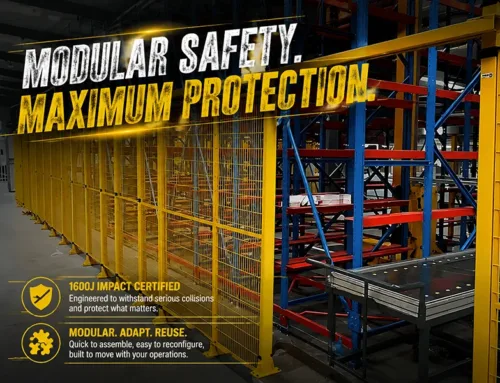
Failing an EHS factory audit just weeks before a new automotive assembly line launch is a system integrator’s worst nightmare. When your 6-axis robots and high-speed CNC machining centers are flagged for non-compliant safety distances or flimsy barrier rigidity, every hour of delay burns through your project’s cash flow. You don’t need generic wire mesh; you need an ISO 14120 and ANSI/RIA R15.06 compliant physical barrier engineered to integrate seamlessly with your PLC safety circuits, handle 1600J impacts, and pass strict automotive safety audits on the first try. |
Robot Safety Fence Standards for Factory Audits: Securing the Automated Production Line
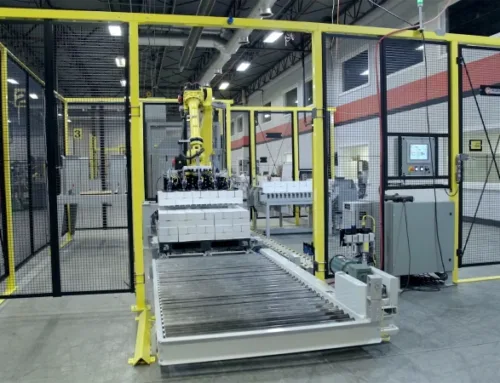
In the high-stakes environment of automotive manufacturing and robotics integration, the physical perimeter around an automated production cell is heavily scrutinized during safety audits. Auditors aren’t just looking for a visual boundary; they are calculating reach distances, verifying structural deflection under load, and checking the mechanical reliability of your interlock switches. Upgrading to compliant Roboter-Schutzzäune is the critical difference between a smooth site acceptance test (SAT) and a costly line shutdown.
The Audit Nightmare: Why Frameless Mesh Fails in the Weld Cell
The Scenario (Before): You’ve integrated a state-of-the-art robotic welding station. To save on initial BOM costs, standard frameless wire mesh was installed. During the OSHA or internal EHS audit, the inspector leans against the mid-span of the panel. The frameless wire bows inward significantly. Worse, the standard 2″ x 2″ (50x50mm) mesh allows a worker’s arm to reach through. According to ISO 13857 standards, this large mesh requires a safety distance of up to 33.5 inches (850mm) from the hazard. Your fence is installed only 15 inches away. You instantly fail the audit, forcing you to either move the heavy machinery (ruining your AGV path layout) or scrap the entire perimeter.

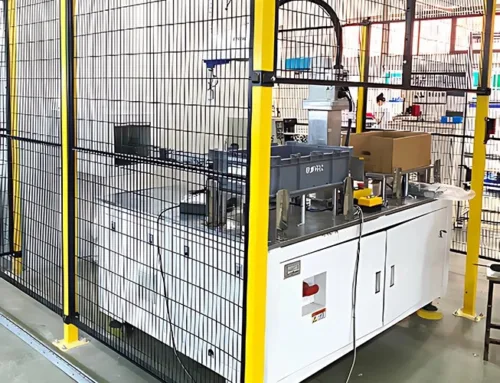
Our Logic (Why It Works): Mdfence eliminates panel deflection through a fully welded framed architecture. Every panel is built with a robust 0.8″ x 1.2″ (20x30mm) Q235 carbon steel tubular frame. The 3.0mm or 4.0mm wire is flat-welded directly to this frame, eliminating sharp burrs that could catch a worker’s uniform. More importantly, our system utilizes a tight 0.8″ x 4″ (20x100mm) “finger-safe” mesh profile.
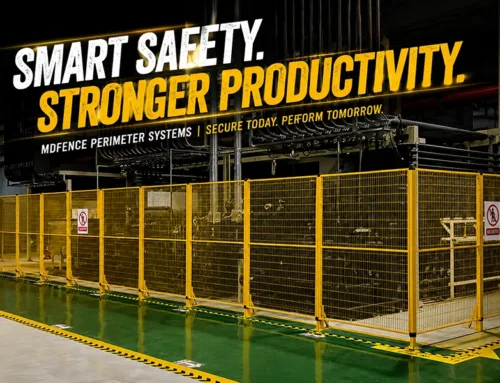
Actual Benefit (After): Because the 20x100mm mesh restricts penetration to just the fingertips, ISO 13857 allows you to legally install the Industrielle Sicherheitszäune as close as 4.7 inches (120mm) from the hazard. In a tight automotive plant where floor space is calculated at a premium, this reclaims nearly 10 square feet per robot cell, allowing you to widen your forklift and AMR (Autonomous Mobile Robot) aisles without compromising compliance.
Anchoring and Impact: Surviving the 1600 Joule Test
The Scenario (Before): In a CNC machining center or heavy material handling area, the risk isn’t just workers reaching in; it’s parts flying out, or a 5,000 lb forklift clipping the corner post. Flimsy aluminum T-slot extrusions or poorly anchored steel posts will shear at the base upon impact, turning the barrier itself into a dangerous projectile and leaving your $250,000 machine exposed.

Our Logic (Why It Works): Compliance with ISO 14120 requires proven energy dissipation. Our standard 2.4″ x 2.4″ (60x60mm) Q235 steel posts are anchored using four heavy-duty M10 x 70mm expansion bolts per base plate. The system is engineered and certified to withstand a 1600 Joule impact. In real-world terms, this means the fence can absorb the kinetic energy of a 220 lb (100 kg) object striking it at 12.4 mph (20 km/h). The low-carbon Q235 steel is specifically chosen for its ductility—it will plastically deform (bend) to absorb the crash energy rather than snapping like brittle cast iron or aluminum.
Actual Benefit (After): You hand the auditor the TUV certification proving the 1600J impact rating. The liability is mitigated. Furthermore, in the event of an accidental forklift bump, the post absorbs the blow, protecting the expensive servo motors and tooling inside the cell. You simply unbolt the damaged panel and swap it out in 10 minutes, drastically reducing your Mean Time To Repair (MTTR).
Integrating Safety Interlocks: Eliminating Phantom Machine Stops
The Scenario (Before): Your automation line relies on PLCs to manage Safe Torque Off (STO) functions. You buy a generic fence, but the doors sag over time due to the weight of the steel. This sagging causes the mechanical key on the door to misalign with the Omron or Pizzato safety interlock switch mounted on the post. The PLC reads a “door open” fault, abruptly halting the high-speed assembly line. Maintenance spends hours trying to realign the switch while your Overall Equipment Effectiveness (OEE) plummets.

Our Logic (Why It Works): We treat Schutzsysteme für Maschinen as active components of your control architecture, not just passive metal. For large access points required for tooling changes or AGV entry, we utilize heavy-duty double sliding doors suspended on industrial bearing rails. For hinged doors, we integrate caster wheels to support the cantilevered weight. Furthermore, we provide pre-engineered Lock Carrier brackets (e.g., KKCK-LCK-B-D4NL-SET) perfectly drilled for industry-standard safety switches.
Actual Benefit (After): The structural integrity of the door frame combined with precise rolling hardware guarantees that the safety switch actuator aligns flawlessly with the receiver 100% of the time, even after 10,000 cycles. You eliminate nuisance trips and phantom downtime. Plus, your electrical engineers save hours of on-site fabrication because they don’t have to drill and tap custom brackets on the factory floor.
Modular Reconfiguration for Model Year Changeovers
The Scenario (Before): The automotive industry demands flexibility. When a new car model is introduced, the robotics layout must change. If you used a local fabrication shop to weld your perimeter guards directly to embedded floor plates, reconfiguration means issuing hot work permits. Sparks fly near sensitive electro-optical elements, paint fumes fill the air, and the old fence is ultimately scrapped as zero-value waste.

Our Logic (Why It Works): The system is 100% modular, utilizing a patented bolt-on clip connection (M8x16 hex screws). No drilling or welding is required on site. Even the post bases are fitted with protective plastic covers to conceal the anchor bolts, creating a clean, snag-free environment that 5S auditors love.
Actual Benefit (After): When the layout changes, two technicians with Allen wrenches can dismantle and reassemble 150 feet of fencing over a single weekend. Your asset reuse rate hits 95%. It is a cold-work assembly process—no sparks, no fire watches, and zero disruption to adjacent active production lines.
| Audit-Anforderung | Traditional Fencing Failure | Mdfence Engineered Solution |
|---|---|---|
| ISO 13857 Reach Distance | 50x50mm mesh requires 850mm clearance, wasting floor space. | 20x100mm mesh allows 120mm (4.7″) close-proximity installation. |
| ISO 14120 Impact Resistance | Frameless mesh bows; aluminum profiles shear at base. | Q235 steel with 1600J rating absorbs heavy part ejection. |
| Safety Interlock Reliability | Doors sag, causing switch misalignment and PLC faults. | Bearing-rail sliding doors ensure 100% switch alignment. |
Frequently Asked Questions: Automotive & Robotics Safety Audits
Q: Does the 20x100mm mesh comply with OSHA and ISO 14120 for robotic welding cells?
A: Yes. The 20x100mm (0.8″x4″) mesh profile is specifically designed to exceed ISO 13857 “finger-safe” requirements, preventing operators from reaching through the barrier to access the pinch points of a 6-axis robot. For welding applications, we also offer solid sheet metal or dark polycarbonate panels to block weld spatter and arc flash.
Q: How does the 1600 Joule impact rating translate to real-world factory hazards?
A: A 1600J rating means the fence structure is certified to stop a 220 lb (100 kg) object moving at roughly 12.4 mph (20 km/h) without the projectile breaching the perimeter. This is crucial for CNC machining centers or high-speed assembly lines where catastrophic tool failure or part ejection is a risk.
Q: Can we mount our own Omron or Allen-Bradley safety interlock switches to your doors?
A: Absolutely. We provide pre-engineered, customized mounting plates (Lock Carriers) designed specifically for industry-standard safety switches like Omron D4NL, Pizzato, or Schmersal. This ensures perfect alignment and seamless integration into your PLC’s STO circuit without on-site drilling.
Q: How quickly can the fencing be reconfigured if we change our automated production line layout?
A: The system is 100% modular and bolt-together. Disassembling and reassembling a section requires only standard hand tools (no angle grinders or welders). This cold-work process means you can reconfigure a robotic cell over a weekend shift without halting adjacent operations or requiring hot-work permits.
Q: Are the posts and panels resistant to industrial coolants and CNC cutting fluids?
A: Yes. All Q235 carbon steel components undergo a rigorous epoxy polyester electrostatic powder coating process. This coating passes ISO 9227 neutral salt spray tests, ensuring long-term corrosion resistance against harsh synthetic coolants, machine oils, and industrial washdown chemicals.