DE
DE  EN
EN  RU
RU  PT
PT  JA
JA  ES
ES  IT
IT 

|
Is your robot cell’s footprint being dictated by outdated guarding standards? Every square foot of wasted space around your automation is a direct hit to your project’s ROI and your client’s Overall Equipment Effectiveness (OEE). The wrong mesh size isn’t just a compliance issue; it’s a costly engineering compromise. |
The Hidden Tax of Large Mesh: Why 50x50mm Guarding Inflates Your Footprint
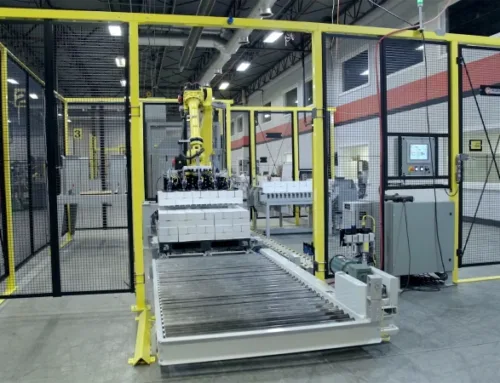
When designing a Roboter-Schutzzäune system, specifying a 50x50mm (approx. 2″x2″) mesh grid seems like a straightforward, common-sense choice. It’s widely available and often perceived as the “standard.” However, this seemingly simple decision carries a significant hidden cost that directly impacts your factory layout and operational efficiency. The core of the issue lies in international safety standards, specifically ISO 13857, which governs the safety distances required to prevent human limbs from reaching hazardous areas.
The logic is simple: the larger the opening in a guard, the farther away that guard must be placed from the hazard. A 50x50mm mesh allows fingers and even parts of the hand to pass through. To be compliant, this forces a safety distance (Sr) that can be as much as 850mm (nearly 34 inches). For a system integrator designing a robot cell for an automotive Tier 1 supplier, this is a critical failure point. In a modern, high-density factory, wasting a perimeter of nearly 3 feet around a 160-foot production line is unacceptable. It can mean the difference between a viable project and one that gets rejected for failing to meet the client’s spatial constraints.
From Compliance Cost to Competitive Advantage: The ROI of Optimized Guarding
The solution is not to simply accept this wasted space as a cost of doing business. The solution is to choose a mesh size engineered for modern industrial automation. An Mdfence Maschinenabschirmung system utilizes a 20x100mm (approx. 0.8″x4″) “finger-safe” mesh aperture. This narrow 20mm opening is specifically designed to prevent even a fingertip from passing through, drastically changing the compliance calculation.
According to ISO 13857, this small opening allows the safety distance to be reduced to just 120mm (approx. 4.7 inches). This isn’t a minor tweak; it’s a fundamental shift in layout design capabilities.
Let’s quantify the impact. For that same 164-foot (50-meter) production line, reducing the required safety distance from 850mm to 120mm saves over 375 square feet (35 square meters) of high-value production space. For the system integrator, this translates to a more competitive bid and a design that fits into tight client layouts. For the factory manager, it means creating wider, safer forklift aisles, finding space for an additional quality inspection cell, or simply lowering the cost-per-square-foot of the entire operation.
A Compliant Mesh Demands a Rigid Structure
However, specifying the correct mesh size is only half the battle. A compliant mesh is useless if it’s held in a flimsy, unsupported structure. Many low-cost “bent wire” or frameless panels will sag, deform under minimal impact, or vibrate excessively. This structural weakness creates a new set of problems, particularly with access doors.
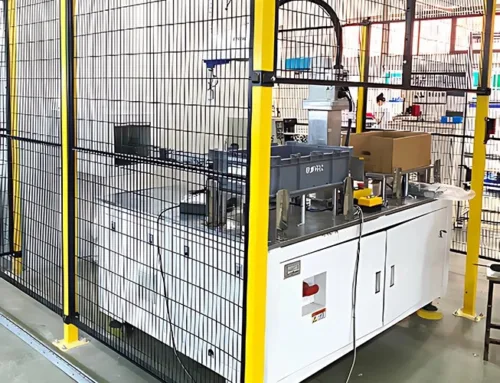
A sagging door will cause constant misalignment with its safety interlock switch (like an Omron D4NL or a Pizzato), leading to nuisance trips in the PLC and costly, intermittent production stoppages that are a nightmare to diagnose. Mdfence solves this by welding the mesh into a rigid 20x30mm full-tube steel frame. This robust, fully-welded architecture provides the essential面外刚度 (Out-of-plane Stiffness) needed to ensure the entire system, including gates and doors, maintains its precise geometry over years of industrial use. This means your safety interlocks stay aligned, your machines stay running, and your OEE is protected.

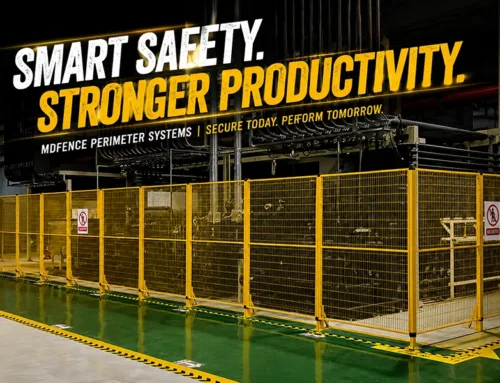
Ultimately, the choice of mesh size for your Maschinenschutzzaun is not a minor detail to be overlooked. It is a strategic engineering decision with direct, measurable impacts on your project cost, factory efficiency, and compliance integrity. Choosing a system designed with both the letter and the spirit of ISO 13857 in mind is a direct investment in a safer, leaner, and more profitable automated environment.
Häufig gestellte Fragen
1. What exactly is ISO 13857 and why does it dictate mesh size?
ISO 13857 is an international safety standard titled “Safety of machinery — Safety distances to prevent hazard zones being reached by upper and lower limbs.” It provides a formulaic relationship between the size of an opening in a guard and the minimum safe distance that guard must be from a hazard. A smaller, “finger-safe” opening like 20x100mm allows the guard to be placed much closer to the machine than a larger 50x50mm mesh, which is the primary reason mesh size is a critical design choice.
2. Can’t I just use a smaller custom mesh with any cheap fence frame?
While possible, it’s not advisable. The overall safety and compliance of a Maschinenschutzsystem depend on its structural integrity, not just the mesh size. Low-cost, frameless panels lack the rigidity to withstand impact forces (as required by ISO 14120) and are prone to sagging, which can compromise the function of safety interlocks on doors. An engineered system like Mdfence ensures the frame, posts, and mesh work together to meet all relevant standards.
3. Does the 20x100mm mesh size compromise visibility into the robot cell?
No, quite the opposite. Mdfence panels use a RAL 9005 (deep black) powder coating. This black color leverages the optical principle of light absorption, which minimizes glare and reflections. This actually enhances visibility into the work cell, making it easier for operators and technicians to monitor equipment compared to lighter-colored or galvanized fencing that can create visual noise and reflections.
4. How does a smaller mesh size affect the integration of other safety devices like light curtains?
A smaller mesh size complements other safety devices. In areas requiring frequent access for material loading/unloading, a physical door can slow down cycle times. Here, a light curtain is often used. The rigid Mdfence system provides dedicated 80x80mm posts designed specifically to mount light curtain transmitters and receivers, seamlessly integrating them with the physical barrier for a comprehensive safety solution.
5. Is a 20x100mm mesh strong enough to meet impact resistance standards like ISO 14120?
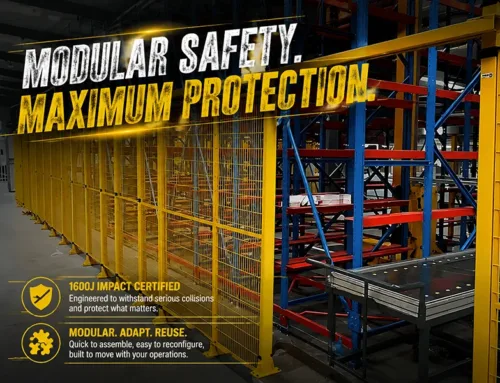
Yes, absolutely. The impact resistance of a guard is a function of the entire system, not just the mesh. The strength of the Mdfence system comes from its use of high-tensile Q235 carbon steel, the fully-welded 20x30mm tube frame around the mesh, robust 60x60mm posts, and secure connections. This complete engineered system is certified to withstand an impact of 1600 Joules, equivalent to a 100 kg (220 lbs) object hitting it at 20 km/h (12.4 mph), far exceeding the requirements for most industrial applications.