DE
DE  EN
EN  RU
RU  PT
PT  JA
JA  ES
ES  IT
IT 

|
The robot is programmed, the PLC is live, but the safety interlock doesn’t fit the guarding you ordered. Now your team is facing on-site drilling, hot work permits, and a project timeline that’s about to be shattered. That last-minute “quick fix” is costing you more than just time; it’s damaging your reputation as a premier system integrator. There’s a better way. |
For a system integrator, the most dangerous phrase on a project is “we’ll fix it on-site.” When it comes to Maschinenschutzzaunfelder, these on-the-fly “fixes” are a direct attack on your project’s profitability and your client’s trust. You’ve meticulously designed a turnkey automation solution, only to see its professionalism undermined by a hand drill and a can of touch-up paint because the guarding couldn’t accommodate the specified safety components.
These aren’t quick fixes; they are long-term liabilities. This article explores how to eliminate them entirely by treating safety guarding not as a commodity, but as a critical, integrated component of your automation system.
The On-Site “Fix” That Bleeds Your Project Margin
The scenario is all too familiar. The robot cell is assembled, and the guarding panels are in place. But the Omron D4NL or Pizzato safety switch your client specified has a mounting pattern that doesn’t align with the generic fence post. The quick fix begins:
- Drilling and Tapping: Your technician spends an hour drilling into a powder-coated steel post. This not only takes time but instantly compromises the anti-corrosion layer, guaranteeing a rust spot that the end-user’s EHS manager will notice during the final audit.
- Welding Brackets: A worse alternative. This requires a hot work permit, a fire watch, and cordoning off the area—halting all other commissioning activities. The weld burns the powder coating, and the resulting hand-painted patch job screams “afterthought.”
- Project Delays: What should have been a simple mechanical assembly now becomes a bottleneck, delaying the electrical team and software commissioning. Every hour wasted is an hour you’re not moving on to the next project.
This approach turns a high-quality, precision-engineered automation cell into something that looks patched together. It’s a risk to your reputation and a drain on your resources.
The Real Fix: Designing for Integration, Not Fabrication
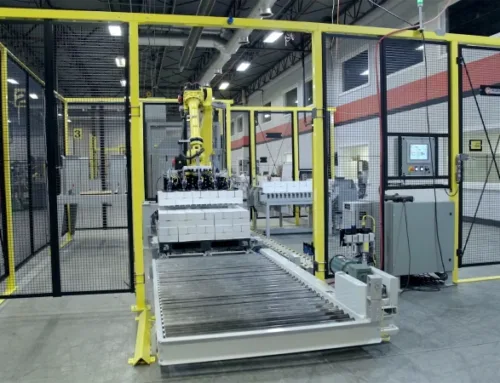
The only true “quick fix” is to prevent the problem from ever occurring. This requires a shift in mindset: your Roboter-Schutzzaun-Systeme must be as modular and “plug-and-play” as the PLC and HMI you’re installing.
Engineered for Your Bill of Materials (BOM)
Instead of forcing a standard panel to fit your custom needs, our system is designed with the integrator’s process in mind. The most critical component is often the safety interlock integration.
We’ve engineered dedicated “Safety Interlock Carriers”—pre-drilled, perfectly-sized mounting plates designed specifically for the industry’s most common safety switches. Whether your spec sheet calls for an Omron, Pizzato, Schmersal, or other major brand, we provide a clean, bolt-on solution. No drilling, no welding, no compromise. This is the detail that transforms your installation from a construction site into a seamless assembly process.
From Complex CAD File to Flawless Physical Install
Your projects are complex. Your guarding solution should simplify, not complicate, that complexity. We start where you start: with the CAD layout.
Virtual Prototyping, Real-World Precision
As we did for system integrator GBM Automation, we work directly from your layout designs. By providing you with 3D STP files of our components, you can integrate our entire fencing system into your master assembly file. This allows you to verify every clearance, access point, and safety distance (per ISO 13857) before a single piece of steel is cut.
Solving Access Challenges Before They Arise
A robot cell is useless if you can’t get tooling, parts, or maintenance personnel in and out efficiently. For a project in Singapore requiring a wide 6-foot (1.83m) opening in a tight footprint, a standard hinged door was not an option. The solution was a pre-engineered, top-guided sliding door system that provided full access without sacrificing floor space. By planning for this specific need, we delivered a solution that worked out of the box, with no on-site modifications.

The Details That Ensure a Smooth Client Handover
The final 5% of a project can make or break the client’s perception of your work. A successful EHS audit and a clean, professional finish are non-negotiable.
Our system is built with these final acceptance criteria in mind. The details matter:
- No Sharp Edges: Panel mesh is welded flat inside the frame, eliminating sharp burrs that can snag clothing or cause minor injuries.
- Clean Floor Lines: Two-piece plastic post base covers snap into place over the M10 anchor bolts. This prevents trip hazards, stops debris from accumulating, and provides a clean, finished look that facility managers appreciate.
- Verified Compliance: Our systems are designed to meet key international standards like ISO 14120 and ANSI/RIA R15.06, giving you the documentation and confidence needed to sail through the most stringent safety sign-offs.

Stop applying costly “quick fixes” to your Industrielle Perimetersicherungen. Instead, choose a system that is engineered to be a quick, seamless, and profitable part of your integration process from day one. Your engineers, your project managers, and your clients will thank you for it.
Frequently Asked Questions for System Integrators
1. Can I get CAD/STP files of your components for my master layout design?
Absolutely. We provide a complete library of 3D models for our posts, panels, doors, and accessories. This is a standard part of our process to help you de-risk your design, eliminate clashes, and generate a precise Bill of Materials before placing an order.
2. We use specific safety interlocks (e.g., Schmersal, Pizzato, Omron). Do you have standard mounting solutions?
Yes. This is one of our core value propositions. We offer a range of pre-engineered “Safety Interlock Carriers” with the correct mounting patterns for most major safety-rated switch brands. This eliminates the need for on-site drilling or bracket fabrication and ensures a clean, professional, and robust installation.
3. What happens if my end-client requests a layout change mid-project?
Our fully modular, bolt-together system is designed for this exact scenario. Unlike welded guarding, our panels and posts can be easily disassembled, reconfigured, and re-assembled in a new layout. This protects your client’s investment and saves you from the high cost of scrapping and re-fabricating the entire safety perimeter.
4. Our automation cell has a conveyor passing through the guarded area. How do you handle this?
We design and provide custom tunnel guards or cutouts that are fully compliant with ISO 13857 safety standards. These openings are sized precisely to allow your client’s product or pallets to pass through while preventing any part of a human body from reaching the hazard zone, ensuring a safe and functional design.
5. How much faster is a typical Mdfence installation compared to a custom-welded solution?
On average, our modular system installs 40% to 70% faster than a comparable welded solution. The primary savings come from eliminating “hot work” (welding, grinding) and all associated permit delays and fire safety precautions. Assembly requires only standard hand tools, allowing for rapid deployment that doesn’t disrupt other commissioning activities on the factory floor.