DE
DE  EN
EN  RU
RU  PT
PT  JA
JA  ES
ES  IT
IT 
The vision of the “smart warehouse” is no longer science fiction. It’s on the strategic roadmap of every competitive logistics company. We imagine a seamless ballet of Automated Guided Vehicles (AGVs) gliding down aisles, robotic arms picking orders with near-perfect accuracy, and AI-driven analytics optimizing every cubic inch of space. But in this hyper-optimized ecosystem, a critical question arises: What becomes the single greatest point of friction, risk, and data corruption?
The answer is the unpredictable human element. Specifically, the constant flow of external visitors—like truck drivers—who are not part of the controlled, automated system.
As we automate the tasks inside the warehouse, the chaos we tolerate at the entry point today becomes an existential threat to the efficiency and safety of the entire operation tomorrow. Investing in robotics without first solving the human access problem is like building a supercomputer in a dusty barn. The environment itself will compromise the system.
The New Conflict: Unstructured Humans in a Highly Structured World
The “good enough” methods of managing visitors in a manual warehouse are completely untenable in an automated one. The stakes are exponentially higher.
Robots Demand Absolute Predictability
An AGV navigating via LiDAR or following a magnetic track is programmed with a precise digital map of its environment. It expects its path to be clear. An unexpected human stepping into its path isn’t just a safety risk; it’s a system failure. The AGV may stop, causing a logistical traffic jam that cascades through the grid, or worse, it may not register the person in time. The entire efficiency model of automation is built on a foundation of zero deviation.
Data Integrity Becomes Paramount
A smart warehouse runs on clean data. Your Warehouse Management System (WMS) is the brain, tracking the time and efficiency of every single task. When a driver wanders onto the floor and interrupts a worker who is supposed to be interacting with an automated system, the data becomes corrupted. The task that your AI predicts should take 90 seconds now takes five minutes. This “human interference” introduces noise and inaccuracies into the very data sets you are relying on to optimize your multi-million-dollar investment.
The Escalated Human-Robot Safety Risk
The danger is no longer just a loud, visible, human-operated forklift. It could be a silent, low-profile AGV moving at speed. The “human-robot interface” becomes the most critical and dangerous point in your facility. Ensuring that this interface only happens in designated, controlled areas is not just a best practice; it is an absolute necessity.
The Gateway as a Strategic “Human-to-System Interface”
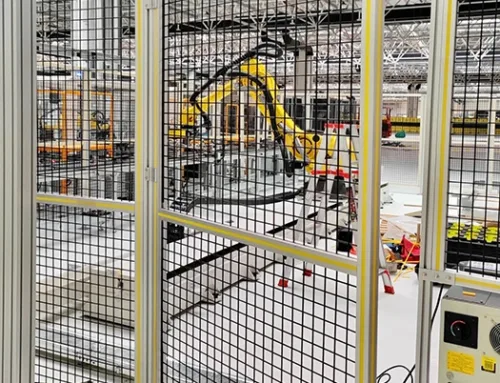
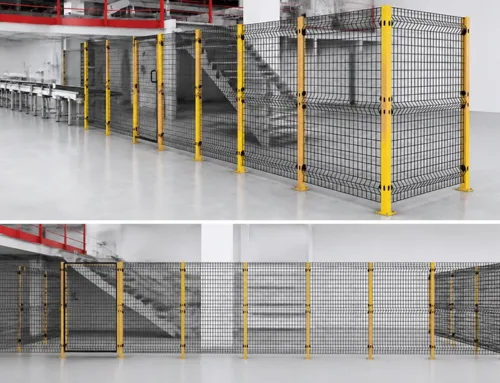
To solve this, we must reframe our thinking. An access control point, often constructed from durable wire security cage panels, is no longer just a “driver cage.” In the context of the automated warehouse, it becomes a strategic “Human-to-System Interface Protocol.” It is the formal, managed “API” that allows the chaotic, analog human world to connect safely and efficiently with the structured, digital world of your warehouse.
It Functions as an “Operational Air Lock”
Think of a cleanroom or a space station. To enter the main, controlled environment, you must first pass through a secure chamber. The access control gateway serves this exact purpose. It ensures that only the essential data (via a scanner or keypad) and goods (on the truck) can enter the automated ecosystem, while the unpredictable human operator remains safely and efficiently contained.
It Becomes a Critical Data Capture Point
A modern gateway with an integrated electronic lock, QR code scanner, or RFID reader becomes the first clean data point in your inbound logistics chain. The moment a driver checks in, your WMS knows the truck has arrived, and can automatically assign a dock door and dispatch an AGV. The process is touchless, instantaneous, and data-rich.
It Guarantees the Sanctity of the Automated Zone
By creating an impassable physical barrier, you guarantee to your automation systems, your insurers, and your own management team that the “automated floor” is a sterile, human-free environment (except for authorized technicians). This operational certainty is what allows automation to deliver on its promise of maximum efficiency and safety.
Building the Foundation for Tomorrow, Today
The race to build the warehouse of the future is on. Many leaders are focused on the exciting new technologies that will operate inside it. But the wisest leaders understand that you must first secure the perimeter.
Investing in a robust system of wire security cage panels and tech-enabled access control today is not a reactive purchase to solve a current problem. It is one of the most strategic, forward-looking decisions you can make. It is a foundational investment in your automation readiness.
Phase 1 (Today)
It solves your immediate safety and efficiency problems, delivering a clear ROI in your current manual or semi-automated environment.
Phase 2 (Tomorrow)
As you begin to deploy AGVs and other robotic systems, the essential control infrastructure is already in place, de-risking your automation rollout.
Phase 3 (The Future)
The system is upgradeable. The simple keypad can be swapped for a WMS-integrated QR code scanner. The door can be tied to your automated dock assignment system. Your initial investment evolves with you.
The most advanced automated systems can be brought to a grinding halt by one person in the wrong place at the wrong time. Before you invest millions in the robots that will run your floor, make the foundational investment in the system that will manage your door. The seamless integration of the human world outside with the automated world inside begins at the gateway.