DE
DE  EN
EN  RU
RU  PT
PT  JA
JA  ES
ES  IT
IT 
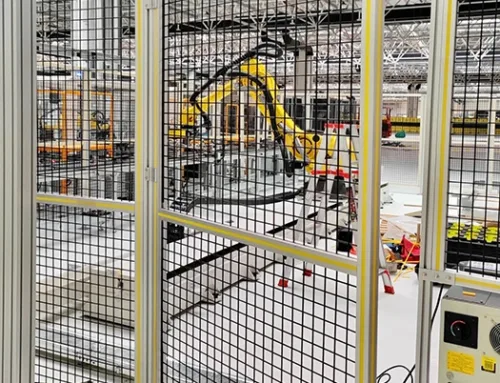
You just spent $500K on a new FANUC robotic welding cell, but your perimeter guarding is holding up the commissioning. Why? Because the local fabricator welded the panels on-site, triggering hot work permits, and the mesh size fails the ISO 13857 reach distance audit. Stop letting amateur installations tank your OEE, trigger nuisance STO (Safety Torque Off) faults, and delay your automated line launch.
Mistake 1: Ignoring ISO 13857 Reach Distances (The Space Waster)
The Pain Point (Before): Many automation integrators default to cheap 2×2 inch (50x50mm) frameless wire mesh. Because human fingers can easily reach through these large gaps, EHS auditors will force you to push the fence back at least 33.5 inches (850mm) from the hazard zone. In a tight automotive assembly plant, you just lost valuable floor space that should have been used for your AGV (Automated Guided Vehicle) material handling paths.
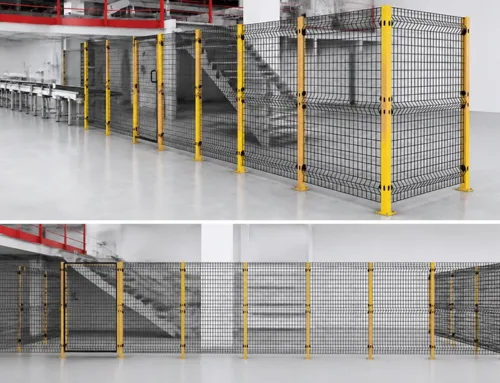
Why it works (Our Logic): The Mdfence system utilizes a highly specific 0.78 x 3.93 inch (20x100mm) narrow mesh design, welded flat onto a rigid 20x30mm tubular steel frame. This “anti-climb” and “finger-safe” geometry is mathematically engineered to restrict reach.
Actual Benefit (After): You can legally install this Arbeitsschutzzaun just 4.7 inches (120mm) away from the moving robotic arm or CNC spindle. You instantly reclaim nearly 10 square feet per machine cell, widening your logistics corridors and eliminating forklift bottlenecks.

Mistake 2: Relying on On-Site Welding (The Commissioning Killer)
The Pain Point (Before): Hiring local ironworkers to weld custom barriers seems cheap until the sparks start flying near oily CNC machining centers. You have to shut down adjacent lines, pull hot work permits, and wait days for the paint to dry. Worse, when the automotive model year changes and you need to reconfigure the layout, that welded fence becomes zero-value scrap metal.
Why it works (Our Logic): Wahr Roboter-Schutzzäune must be modular. Our system uses a patented “cold assembly” connection clip. The framed panels lock into the 2.36 x 2.36 inch (60x60mm) posts using standard M8x10 flange bolts. No drilling, no tapping, no welding.
Actual Benefit (After): Two technicians with basic wrenches can install 160 feet of perimeter guarding in a single shift without interrupting nearby production. When your manufacturing line evolves, you simply unbolt the panels and rebuild the cell. It’s a 100% reusable asset.

Mistake 3: Botching Safety Interlock Integration (The Nuisance Trip Trap)
The Pain Point (Before): Standard fencing doors sag over time. When a heavy door drops even a fraction of an inch, the actuator key for your Omron or Pizzato safety switch misaligns. The PLC registers a fault, the high-speed mechanical assembly machine slams to a halt, and your Mean Time To Repair (MTTR) skyrockets while operators jiggle the door trying to reset the circuit.
Why it works (Our Logic): We treat doors as active machine safety components, not just metal gates. For wide spans (up to 118 inches / 3000mm), our double hinged doors are reinforced with heavy-duty 40x60mm hinges and integrated caster wheel kits to bear the load. Furthermore, we provide pre-engineered installation carriers (like the KKCK-LCK-B-D4NL-SET) specifically machined for third-party electronic safety interlocks.
Actual Benefit (After): The door remains perfectly plumb for tens of thousands of cycles. The safety switch aligns flawlessly every time, eliminating nuisance STO trips and keeping your automated production line running at peak efficiency.

Mistake 4: Underestimating Forklift Impact (The Aluminum Profile Fallacy)
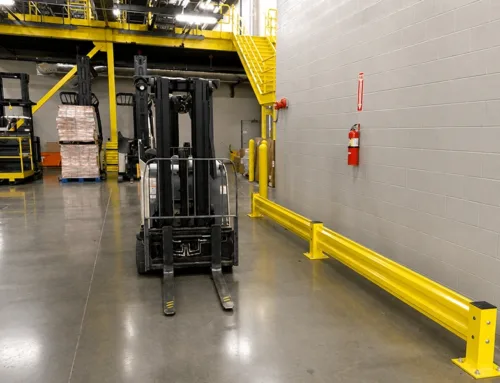
The Pain Point (Before): Many facilities use T-slot aluminum profiles because they look sleek. But when a forklift bumps the cell at 5 mph while loading a heavy engine block, the brittle aluminum snaps or permanently deforms. T-nuts vibrate loose from the CNC machine’s harmonics, and the entire cell fails the safety audit.
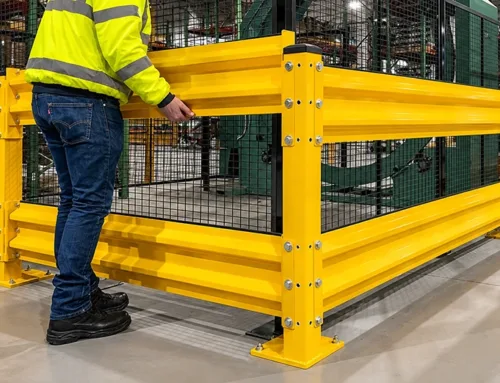
Why it works (Our Logic): We rely on the physical truth of Q235 cold-rolled carbon steel. Our standard posts feature a robust welded baseplate anchored by four M10x70mm expansion bolts. This structure translates overturning moments directly into the concrete foundation. It is TUV-certified to withstand 1600 Joules of impact energy—equivalent to intercepting a 220 lbs (100kg) object moving at 12.4 mph (20 km/h).
Actual Benefit (After): In the event of a rogue AGV or forklift collision, the steel plastically deforms to absorb the kinetic energy rather than shattering into dangerous shrapnel. Your high-value robotics are protected, and your operators walk away safe.

Quick Comparison: Traditional vs. Modular Schutzsysteme für Maschinen
| Operational Phase | Traditional Welded / Aluminum Guarding | Mdfence Modular Steel System |
|---|---|---|
| Einrichtung | Requires hot work permits, welding, and painting on-site. Disrupts production. | Cold assembly with standard bolts. No downtime, no sparks, rapid deployment. |
| Space Efficiency | Large 50x50mm mesh requires 850mm (33.5″) clearance from hazards. | 20x100mm finger-safe mesh allows installation just 120mm (4.7″) from hazards. |
| PLC Integration | Custom drilling required. Doors sag, causing nuisance STO faults. | Pre-engineered lock carriers for Omron/Pizzato. Rigid framed doors prevent sagging. |
| Wiederverwendung von Assets | Must be cut and scrapped during layout changes. | 100% reusable. Unbolt and reconfigure like industrial Lego blocks. |
Frequently Asked Questions (Automotive & Automation Integration)
1. How close can I install the fence to my CNC machining center or robotic arm?
Thanks to our 20x100mm narrow mesh design, which prevents finger penetration, ISO 13857 standards allow you to install the barrier as close as 4.7 inches (120mm) from the hazard zone, saving massive amounts of floor space compared to standard fencing.
2. Can we integrate our standard Omron D4NL or Pizzato safety switches without drilling on-site?
Absolutely. We provide pre-engineered installation carriers (e.g., KKCK-LCK-B-D4NL-SET) specifically designed to mount these third-party electronic interlocks directly to our posts and doors without any field modifications, ensuring seamless integration with your PLC.
3. Do we need hot work permits to install this perimeter guarding in an active plant?
No. The entire system utilizes a modular cold-assembly process. Panels connect to the posts using specialized clips and M8x10 bolts. There is no welding, cutting, or grinding required on-site, meaning zero fire hazards and no disruption to adjacent assembly lines.
4. What happens if an AGV or forklift bumps the Q235 steel posts?
Unlike brittle aluminum profiles, our Q235 cold-rolled carbon steel posts are designed to undergo plastic deformation. The system is TUV-certified to absorb 1600 Joules of impact energy, dissipating the force through the M10 expansion bolts into the concrete, preventing catastrophic cell breaches.
5. How does your packaging help with our urgent turnkey line integration?
We utilize flat-pack palletized shipping. This not only drastically reduces ocean freight volume and costs but also ensures that all standardized components arrive organized with redundant hardware backups, allowing your integration team to deploy the system immediately upon arrival.