DE
DE  EN
EN  RU
RU  PT
PT  JA
JA  ES
ES  IT
IT 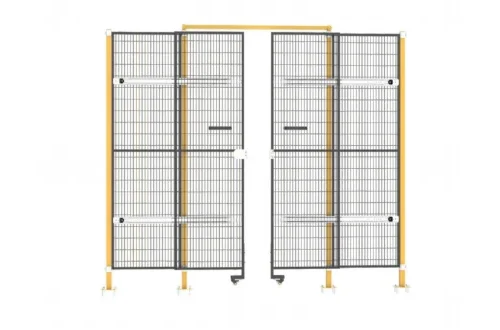

In the high-stakes environment of automotive manufacturing and robotics integration, production line layouts are constantly evolving. Relying on static, custom-welded barriers to protect your high-speed mechanical assembly machines is a bottleneck waiting to happen. You need a physical perimeter that adapts as fast as your CNC centers and 6-axis robots, without triggering phantom machine stops or compromising ISO 14120 safety distances.
The Rigidity Trap: Why Traditional Guarding Chokes Automotive Automation (Before)
When integrating a new automated production line or upgrading a robotic welding station, system integrators often treat the physical perimeter as an afterthought. The default instinct is to hire local fabricators to weld standard wire mesh on-site. This creates immediate operational nightmares.
First, on-site welding requires hot work permits, generating sparks and dust that threaten sensitive electro-optical elements and vision systems nearby. Second, cheap frameless mesh uses large 2″ x 2″ (50x50mm) openings. According to ISO 13857, a mesh this large requires a safety reach distance of up to 33.5 inches (850mm). This forces the perimeter far away from the machine, eating up highly valuable floor space and narrowing the paths for your Warehouse AGVs. Finally, standard welded hinges inevitably sag under industrial use. A sagging door means the safety interlock switch (like your Omron D4NL) misaligns. The PLC loses the signal, triggering a Safe Torque Off (STO), and your entire high-speed assembly line halts. You are bleeding OEE (Overall Equipment Effectiveness) simply because a door dropped by a quarter of an inch.

The Engineering Logic: Modular Rigidity Meets Active Safety (Why It Works)
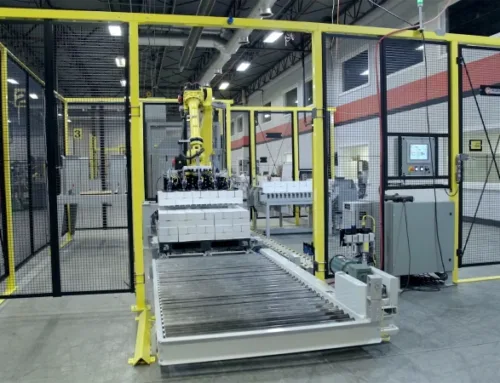
To future-proof your layout, you need Roboter-Schutzzäune engineered as an active machine component, not just a passive wall. The Mdfence system shifts the paradigm through structural mechanics and modularity.
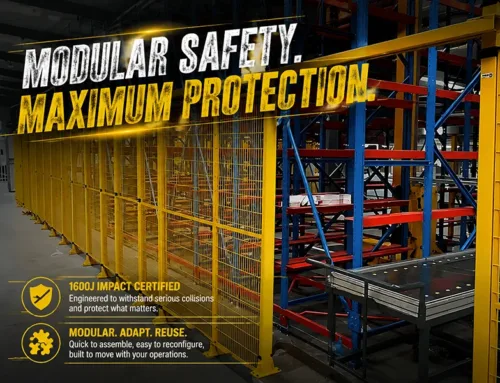
Impact Dissipation: Built from Q235 carbon steel, the system utilizes a fully framed panel architecture (0.78″ x 1.18″ / 20x30mm tubular frames). Instead of snapping upon impact, it absorbs kinetic energy. It is certified to withstand 1600 Joules of impact—equivalent to stopping a 220 lbs (100 kg) object moving at 12 mph. If a CNC machine throws a part or a forklift bumps the perimeter, the structure deforms plastically rather than fracturing into dangerous shrapnel.
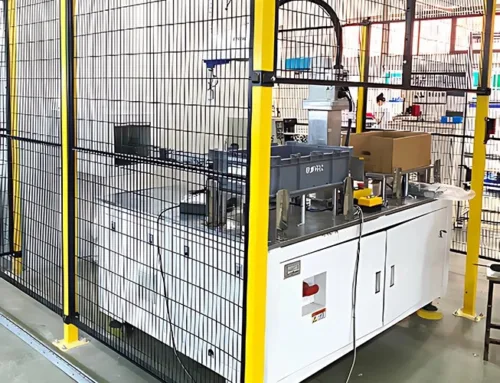
Finger-Safe Footprint: The 0.78″ x 3.9″ (20x100mm) narrow mesh design completely changes the layout math. By restricting penetration to just the fingertips, ISO 13857 allows you to install these Schutzsysteme für Maschinen a mere 4.7 inches (120mm) away from the hazard. You instantly reclaim nearly 30 inches of floor space around every robotic cell, widening your AGV pathways.
Seamless PLC Integration & 100% Asset Reuse (The After)
By standardizing your perimeter with modular Industrielle Sicherheitszäune, the headaches of field-fabrication vanish. When a tier-1 auto supplier needs to reconfigure a dedicated manufacturing line to accommodate a new chassis model, the fencing isn’t scrapped. It is unbolted and reassembled in the new layout within hours, yielding a 95%+ asset reuse rate.

Furthermore, wide access points for material handling are no longer an engineering challenge. Utilizing heavy-duty double sliding doors supported by bearing rails ensures that a 14-foot wide opening remains perfectly aligned. The system provides pre-engineered lock carriers specifically designed for industry-standard interlocks (like Pizzato or Omron). Your electrical team simply bolts the switch onto the pre-drilled bracket—no metal shavings, no ruined powder coating, and zero alignment issues. The result is a drastic reduction in MTTR (Mean Time To Repair) and the complete elimination of nuisance trips.

| Operational Phase | Custom Welded Guarding | Modular System Integration |
|---|---|---|
| Einrichtung | Hot work permits required. Sparks risk damaging vision systems. | Cold assembly. Bolt-on design allows deployment during active shifts. |
| Interlock Reliability | Doors sag over time. Misaligned switches cause phantom STO halts. | Framed panels and bearing rails keep Omron/Pizzato switches perfectly aligned. |
| Layoutänderungen | Cut with angle grinders. Asset value drops to zero. High disposal costs. | Unbolt and reassemble. 95%+ asset reuse for new robotic layouts. |
Frequently Asked Questions (FAQs)
1. How close can we install the fence to a 6-axis robot cell without violating ISO 13857?
Thanks to our 0.78″ x 3.9″ (20x100mm) finger-safe mesh design, the barrier can be installed as close as 4.7 inches (120mm) from the hazard zone, saving valuable floor space compared to standard 2″x2″ mesh which requires up to 33.5 inches of clearance.
2. Can the system integrate with our existing Omron D4NL safety interlocks?
Yes. The system provides pre-engineered mounting plates specifically designed to act as carriers for standard safety switches like Omron D4NL and Pizzato, eliminating the need for on-site drilling and ensuring precise alignment for PLC integration.
3. What happens to the fencing when we reconfigure our automotive welding station next year?
The system is entirely modular. You can unbolt the panels and posts with standard hand tools and reassemble them in your new layout. This provides a near 100% asset reuse rate and requires zero hot work or cutting.
4. Does the fencing withstand impacts from automated guided vehicles (AGVs)?
Yes. The Q235 carbon steel posts and framed panels are TUV certified to withstand impacts of up to 1600 Joules. This is equivalent to absorbing the kinetic energy of a 220 lbs object traveling at 12 mph, protecting your high-value automation equipment from collisions.
5. How does the framed panel design prevent phantom machine stops?
Standard wire mesh flexes and sags, causing door hinges to drop and safety switches to misalign. Our 20x30mm tubular steel frame provides immense out-of-plane stiffness, ensuring doors remain rigid and perfectly aligned with the interlock keys, thereby eliminating false Safe Torque Off (STO) signals.