DE
DE  EN
EN  RU
RU  PT
PT  JA
JA  ES
ES  IT
IT 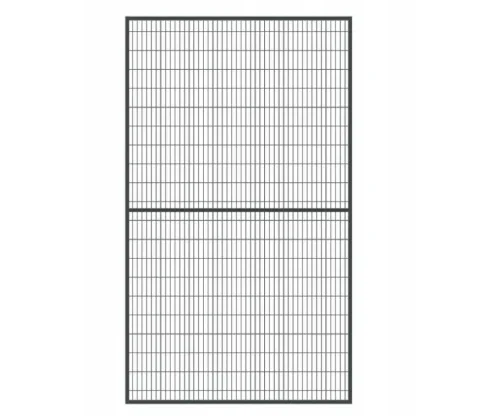

|
Your multi-station assembly line is a dynamic, high-value asset. But is it being held hostage by static, welded-on-site guarding? The constant project delays from hot work permits, the failed EHS audits from makeshift conveyor cutouts, and the costly scrap heap created every time you reconfigure a work cell—these are the hidden costs of outdated safety barriers. It’s time for a system engineered for the pace of modern automation. |
The Integrator’s Dilemma: When “Simple” Guarding Grinds Your Assembly Line to a Halt
As an automation system integrator or plant engineer, you live by the project timeline. A multi-station assembly line is a complex dance of robotics, conveyors, and human interaction. The final piece of the puzzle, the Maschinenabschirmung, should be the simplest. Yet, it often becomes the biggest bottleneck. Relying on local fabrication and welding introduces a cascade of problems that seasoned engineers know all too well:
- The “Hot Work” Holdup: Every welded joint requires a hot work permit. This means delays, fire watches, and bringing fume-generating, spark-throwing processes into your otherwise clean assembly environment. Installation can’t happen in parallel with other sensitive work, stalling the entire project.
- The Compliance Gamble: A welder’s “best guess” for a conveyor opening or a safety switch mount rarely survives an EHS audit. Non-compliance with ISO 13857 or ANSI/RIA R15.06 means costly, last-minute rework, pushing your go-live date back even further.
- The Zero-Value Asset: The moment your line needs a minor layout adjustment, that custom-welded cage becomes scrap metal. You pay for the steel, you pay for the welding, and then you pay again to have it cut out and hauled away. It’s a one-time solution in a world that demands flexibility.
Engineered for Flow: The Modular Approach to Assembly Line Safety
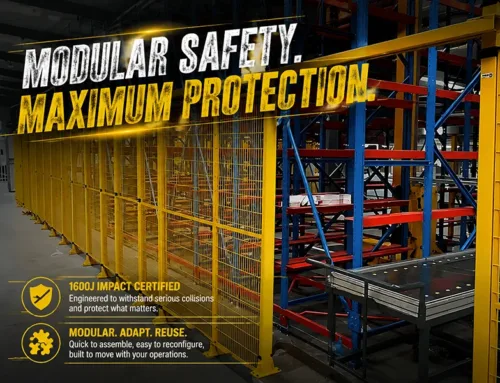
A modern assembly line is a modular system. Your safety guarding should be too. The Mdfence system is not just a barrier; it’s a pre-engineered, bolt-together ecosystem designed to eliminate the uncertainties of field fabrication. It transforms safety guarding from a project risk into a predictable, efficient component of your automation cell.
From Welding Fumes to a Whisper-Quiet Wrench
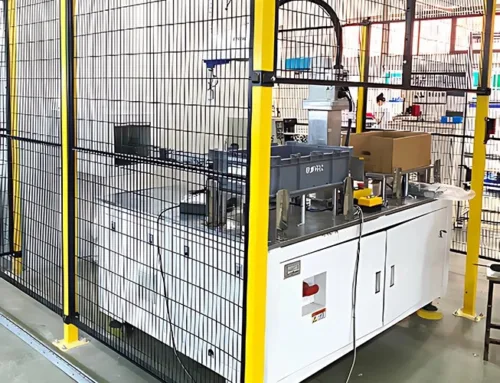
Imagine installing 50 meters of robust, compliant guarding in a single day with just two technicians and a set of Allen wrenches. That’s the reality of a modular system. Our entire Roboter-Schutzzäune system is a “cold assembly” process. Standardized posts, panels, and patented connectors eliminate all on-site welding, cutting, and grinding.

The process is simple and repeatable: anchor the Q235 steel posts, snap the lower fixing rings into place, set the framed mesh panel, and secure it with the upper ring. This method is up to 70% faster than traditional welding, allowing you to install guarding during off-hours or even alongside sensitive electronics commissioning without disruption.
Precision-Fit for PLCs: Integrating Safety Interlocks Without a Drill
Your safety PLC relies on clean signals from door interlocks. A poorly aligned switch on a sagging, field-fabricated gate is a primary cause of nuisance trips that kill your Overall Equipment Effectiveness (OEE). We’ve engineered this problem out of existence. Mdfence offers pre-designed mounting plates and lock carriers specifically for industry-standard safety switches like the Omron D4NL or Pizzato series.

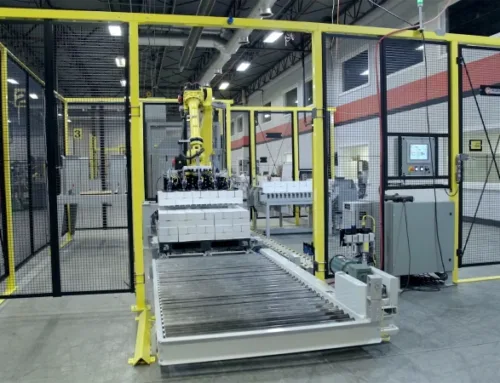
As demonstrated in our project with automation integrator GBM Automation, we provided a complete solution based on their exact CAD files, including pre-engineered mounting kits for their specified interlocks. This “plug-and-play” approach saved them dozens of hours in field engineering and ensured the physical guard integrated seamlessly with the machine’s control logic from day one.
From Static Cost to Dynamic Asset: The ROI of Reconfiguration
The true value of a modular safety guarding system is realized the first time your production needs change. Whether you’re adding a new robot, modifying a conveyor path, or relocating an entire cell, the Mdfence system adapts with you.
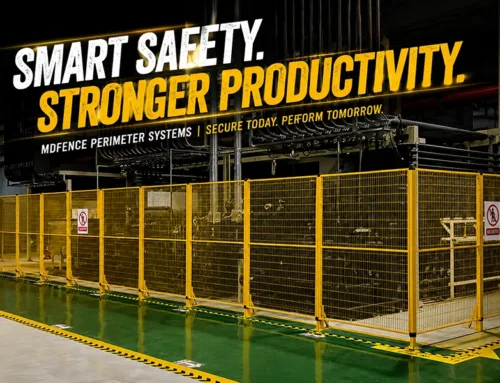
Consider a large-scale project for a U.S. facility that required fencing off a 184-foot perimeter with multiple access gates and a 45-degree corner. The entire layout was designed and deployed using standard, off-the-shelf components.

If this line needs to be expanded next year, 100% of the components can be unbolted and redeployed in the new configuration. The asset is preserved. This high reusability means that over the lifecycle of your production line, a modular system delivers a significantly lower total cost of ownership compared to the build-and-scrap cycle of welded barriers. It’s not just a fence; it’s a long-term investment in your plant’s agility.
Häufig gestellte Fragen
1. How does the system handle the uneven concrete floors often found in older manufacturing plants?
Our posts are designed with a degree of adjustability at the base. The connection clips that hold the panels can also be positioned vertically along the post, allowing for compensation to ensure the entire guarding line remains level and secure, even on imperfect surfaces.
2. Can we mount HMI panels, tool holders, or air lines to the fence panels?
Absolutely. The core strength of our system comes from the 20x30mm full steel tube frame around every mesh panel. This provides a rigid structure that, unlike frameless or bent-wire alternatives, can easily support the mounting of light-duty accessories without buckling or sagging.
3. What is the typical lead time for a complex, custom layout?
Because the system is fully modular, even highly complex layouts are built from a stock of standard components (posts, panels of various widths, doors, connectors). This means we can typically ship a complete, custom-fit solution much faster than the time it would take to source raw steel and schedule a fabrication crew.
4. How does the 20x100mm mesh size benefit a crowded multi-station assembly line?
This narrow mesh opening is a critical safety feature. According to ISO 13857, it prevents fingers from reaching through, allowing the guard to be placed as close as 120mm (approx. 4.7 inches) from the hazard. A wider 50x50mm mesh could require a safety distance of 850mm. On a long assembly line, this difference can save dozens of square feet of valuable floor space.
5. What happens if a panel is damaged by a forklift? What is the repair process?
This is a key advantage of modularity. Instead of a multi-hour shutdown for cutting and re-welding, a damaged section can be replaced in minutes. Simply unbolt the four connection clips holding the damaged panel, swap in a new standard panel, and tighten the bolts. The Mean Time To Repair (MTTR) is minimal, getting your line back into production almost immediately.