DE
DE  EN
EN  RU
RU  PT
PT  JA
JA  ES
ES  IT
IT MEFENCE | INDUSTRIAL SAFETY FENCING
Construction Site Barrier Fence for Global Factory Zoning
For a manufacturing group operating about 340 factories across more than 70 countries, a construction site barrier fence must do more than mark an area. It must let local maintenance teams reproduce the same warehouse zoning, pedestrian separation, and machine guarding standard without relying on local welding skill. Mefence uses a frameless 3D welded mesh, standardized posts, and clip-fixed connections so one drawing can become the same industrial safety fencing system at every site.
Why Global Factory Projects Move Away from Welded Site Fences
Group EHS and food-safety teams can issue one global requirement, but installation quality still changes from country to country. A welded square-tube fence depends on the availability and workmanship of local welders. On factory retrofits, that can mean inconsistent joints, additional hot-work controls, delayed handover, and costly rework. Barrier tape and rope barriers are faster, but they do not provide a defined workplace safety barrier for a robot workstation, forklift path, or storage area. Mefence replaces the variable welding step with a repeatable assembly logic: standard mesh panel, post, plastic clip, self-tapping screw, and specified floor fixing.
| Spezifikation | Mefence documented option |
|---|---|
| Product structure | Frameless 3D welded wire mesh with multiple horizontal T-shaped ridges |
| Material and finish | Q235 carbon steel with electrostatic powder coating; standard yellow and black or custom color |
| Wire and mesh | 3 mm or 4 mm wire; 20×100 mm or 50×50 mm mesh opening |
| Panel range | Width 200–1400 mm; height 200–3000 mm; 140 mm ground clearance |
| Posts and fixing | 40×60 mm or 60×60 mm posts; base plate posts with expansion bolts available |
| Montage | Plastic clip and self-tapping screw; one-person, three-step installation documented, with 50%+ installation time reduction |
How Mefence Turns a Global Standard into a Repeatable Installation
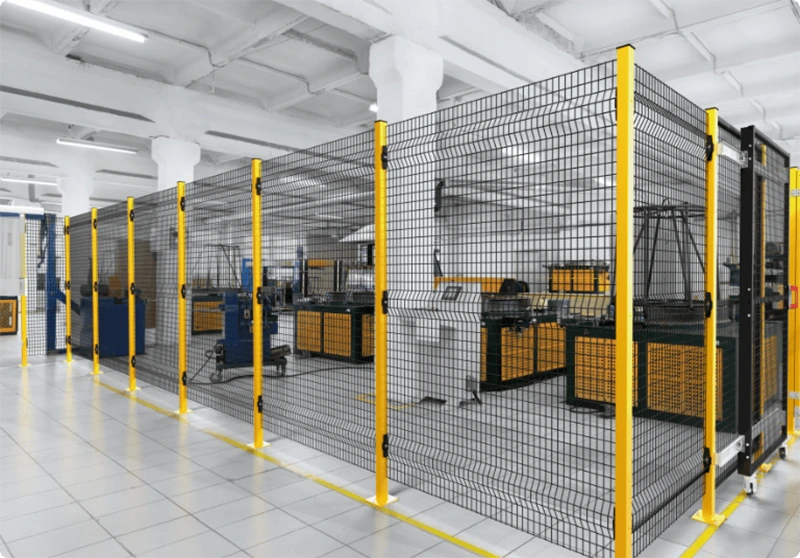
1. Frameless panels adapt to local site dimensions
The absence of a perimeter frame keeps the wire mesh panel slim and makes on-site cutting practical for irregular workshop edges, retrofit partitions, and changing warehouse layouts. A maintenance worker can follow the group drawing, position the 40×60 mm or 60×60 mm posts, fix the base plates, and clamp the panel without a site welding operation. This is the core reason Mefence fits a construction site barrier fence brief where local construction capability is uneven.
2. The 3D welded mesh supports routing and visibility
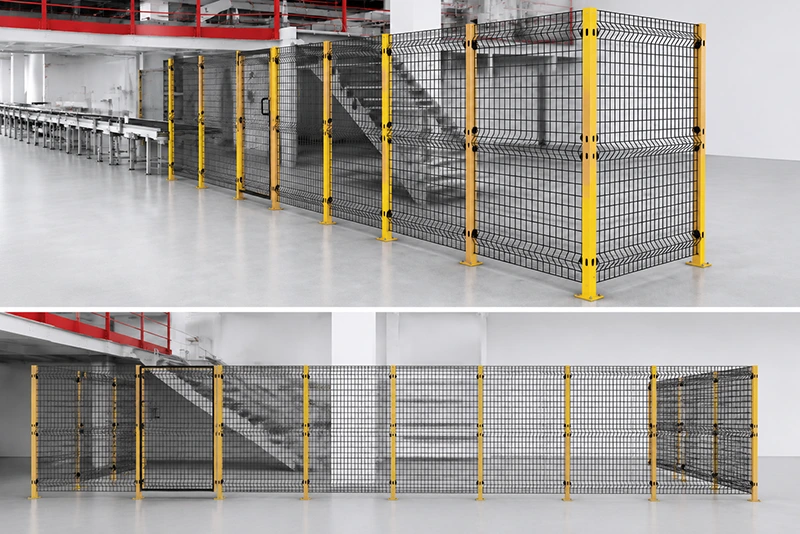
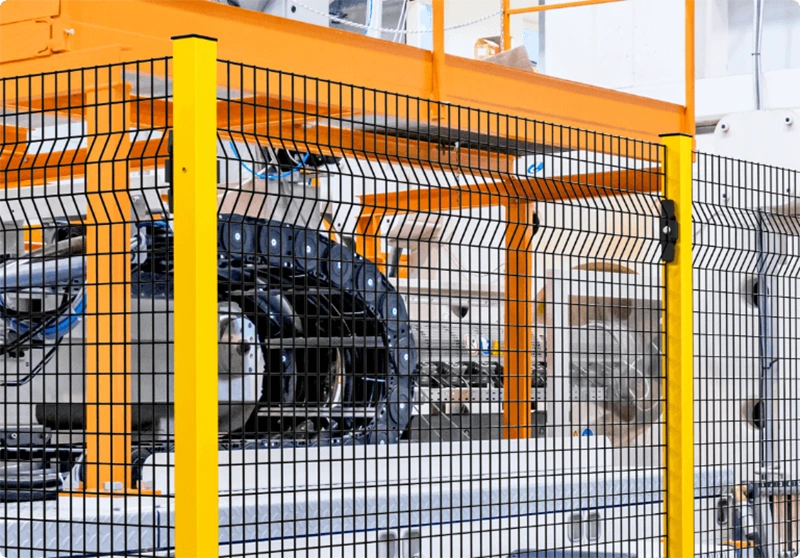
The T-shaped ridge creates usable space around the panel profile. It can help route cables so lines do not hang outside a cable management fence, and it can accept wood slat inserts where a project needs visual shielding. At the same time, the open 3D welded mesh preserves visibility around automated equipment, AGV lanes, and conveyor belt isolation zones. The result is a visible boundary rather than a blind wall.
3. Modular access points keep the layout usable
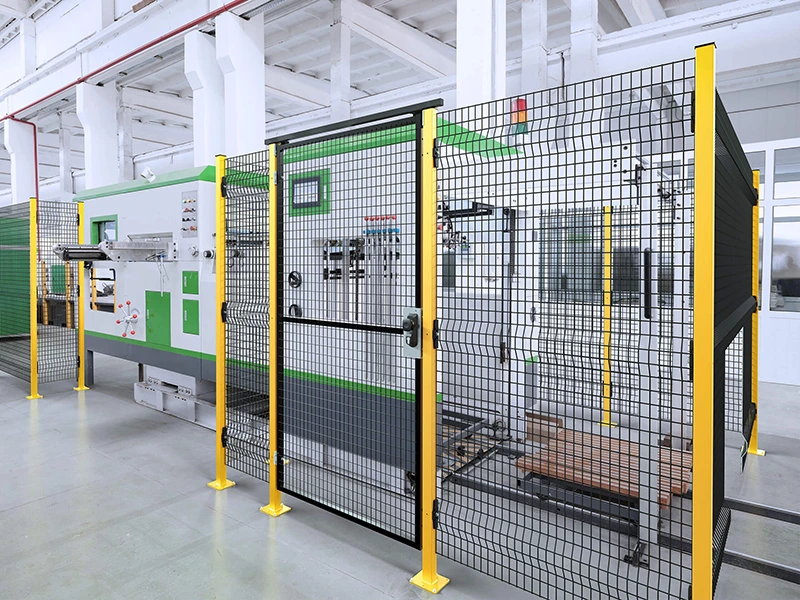
Standardized panels and posts create a modular reconfigurable fence that can be relocated when equipment moves or a line expands. The single access gate shown here demonstrates how a defined entry point can be coordinated with machine guarding and pedestrian-vehicle separation. For warehouse zoning, forklift path barriers, and robotic workstation enclosures, that physical boundary is more controllable than temporary tape while remaining easier to revise than a welded framed installation.
Where a Standardized Construction Site Barrier Fence Fits
- Lagerzonierung: separate pedestrian routes, forklift paths, storage areas, and tool crib enclosures with a consistent yellow-black safety fence.
- Automation projects: define robot safety fence perimeters, automated equipment guarding zones, conveyor isolation, and AGV/AMR lane separation.
- Factory retrofit work: install a temporary partition or workshop isolation during a short shutdown without scheduling a welding crew.
- Group procurement: issue one panel, post, clip, finish, and fixing specification for OEM and batch purchasing, with custom colors available for local or corporate standards.
Mefence is intended for area demarcation, traffic control, and non-high-impact machine guarding. It should not be specified as certified anti-collision containment. Where direct impact containment is the design requirement, the higher-spec Machine Fence line is the appropriate route.
From One Drawing to Consistent Site Results
A global standard only works when the installed parts and installation sequence are equally clear. Mefence gives procurement and EHS teams a practical standardization package: defined Q235 carbon steel mesh panels, post sizes, mesh openings, powder-coated colors, clip fixing, and floor-anchor options. The same specification can be released for OEM production and batch shipment, while local maintenance teams complete the documented three-step assembly. That reduces dependence on local welding skill, supports faster area setup, and makes future relocation or reconfiguration predictable.
Make Factory Zoning a Globally Orderable Standard Part
Share your panel heights, site dimensions, traffic routes, machine perimeter, color standard, and country delivery plan. SGF can help map the Mefence modular fence specification for group-wide purchasing and repeat installation.