DE
DE  EN
EN  RU
RU  PT
PT  JA
JA  ES
ES  IT
IT WAREHOUSE FORKLIFT IMPACT PROTECTION
Lagerschutz-Einzelgeländer für Gabelstapler-Aufprallschutz und Kontrolle von Anlagenstillstandszeiten
A single rail guardrail planning approach helps warehouses define a direct collision-protection line around rack ends, posts, equipment and pedestrian routes. Hsafety warehouse guard rails use corrugated steel barriers, floor-mounted posts and anchored base plates to keep forklift traffic away from critical assets and reduce accident downtime.
Why a defined guardrail line matters in forklift zones
In a distribution center, a forklift does not need to hit a rack squarely to create a costly event. A turn into an aisle, a loading dock approach or a tight maneuver beside equipment can bend a rack upright, damage a wall or stop a production asset. The result is more than a repair bill: inventory may be moved, access may be restricted and the affected operation may lose working time.
Steel pipe railing fabricated on site often leaves inconsistent clearances and welded joints that are difficult to relocate. Concrete bollards occupy isolated points rather than forming a continuous barrier. Wooden barriers and rope or strap barriers provide visual separation, but they are not a suitable collision protection layer for powered material-handling traffic. The design question is therefore practical: where does the forklift need to be kept away from the asset, and what barrier geometry can follow that boundary?
| Konstruktionsanforderung | Hsafety warehouse guard rails response |
|---|---|
| Rack end protection | Corrugated steel beams and square posts create a continuous buffer in front of pallet-rack uprights. |
| Equipment isolation | Custom height and length can trace cabinets, conveyors and machine boundaries instead of forcing a generic footprint. |
| Schlagfestigkeit | Q235 carbon steel construction, with a 4mm plate option and a 16mm-thick base used in custom case 15176, gives the system a substantial steel load path. |
| Concrete floor anchoring | Floor-mounted base plates and anchor bolts transfer the barrier installation into the concrete floor. |
| Corrosive environments | Hot-dip galvanized steel is suited to cold storage, outdoor and coastal high-humidity applications where low maintenance matters. |
Structure and field evidence behind the protection plan
1. Protect the asset boundary, not just a single contact point
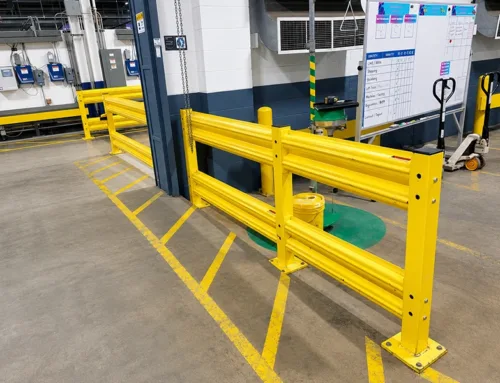
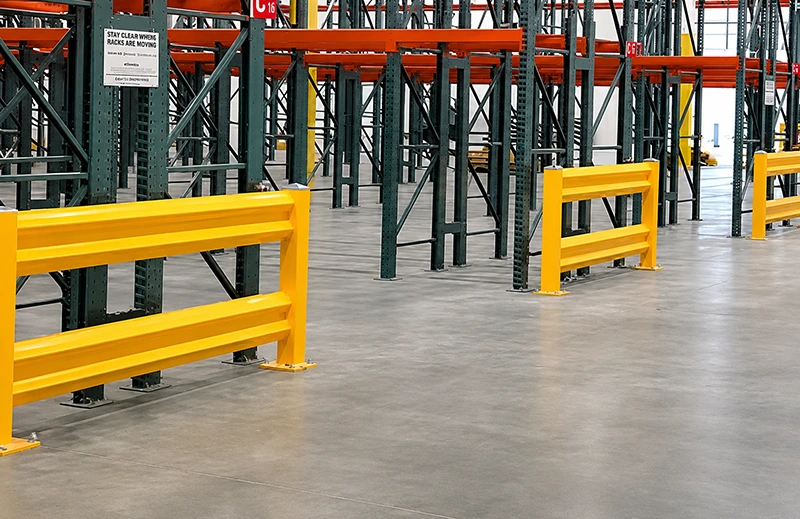
The warehouse image shows a double-rail barrier set directly ahead of pallet-rack uprights. This is the useful distinction between a freestanding bollard and a warehouse safety barrier: the corrugated rails create a visible, continuous line across the likely forklift approach. For a rack end, wall edge or loading dock protection zone, the posts and rails can be arranged as a modular, bolted guard rail system. The single rail guardrail specification can be used when a project requires a simpler rail line; the installed reference shown here uses two corrugated beams where the exposure calls for a broader physical buffer.
2. Match height, length and base detail to the equipment
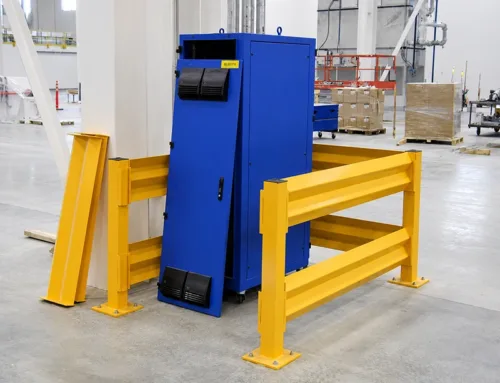
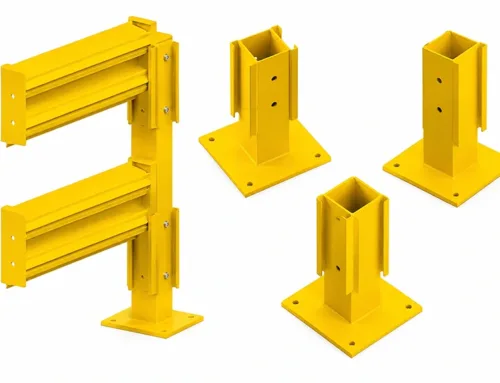
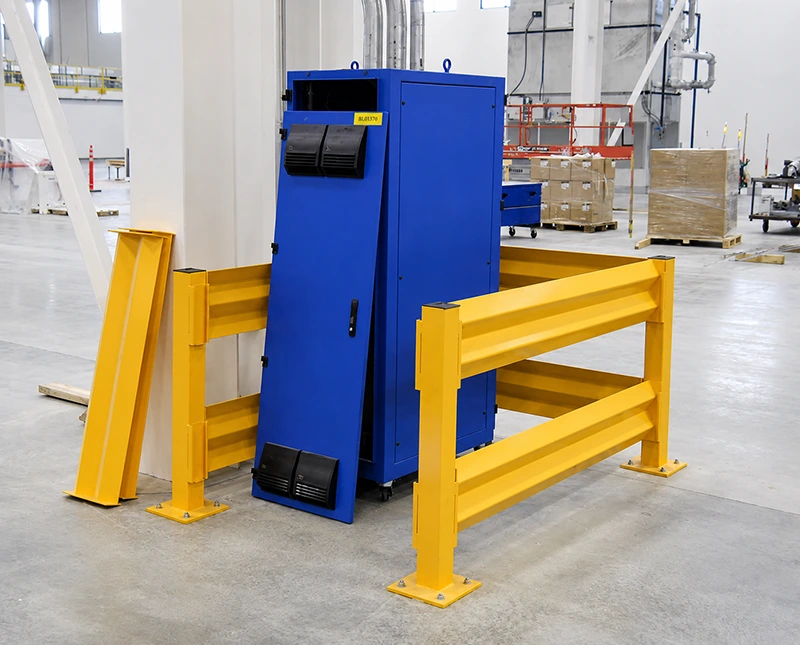
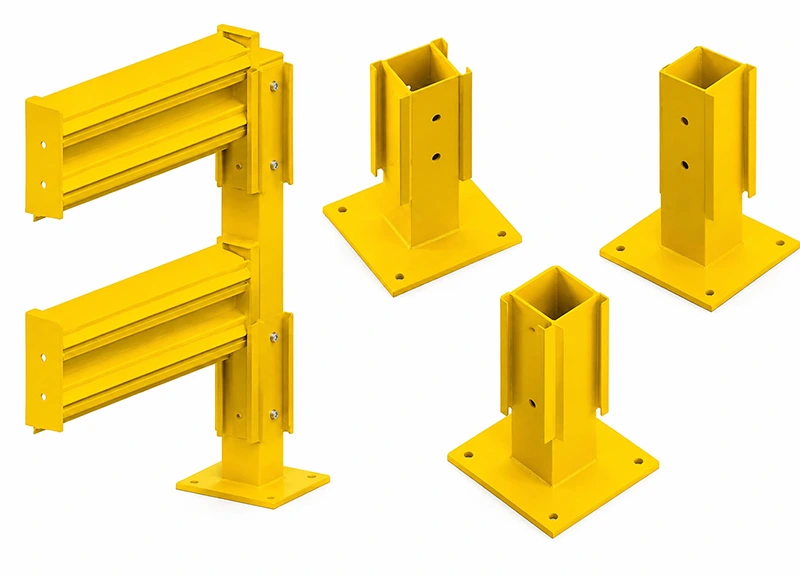
A blue industrial cabinet enclosed by yellow corrugated rails demonstrates equipment isolation rather than simple aisle marking. Hsafety can be specified with a custom length and height so the guard follows the cabinet, conveyor or machine footprint while leaving access points usable. The visible square posts, side connections and floor plates show how a bolt-on installation can be laid out in straight runs and around corners. This supports machine guarding, production line separation and pedestrian-vehicle separation without replacing the equipment itself.
3. Make the barrier visible and maintainable
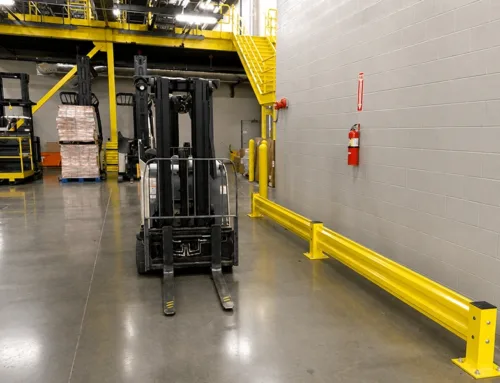
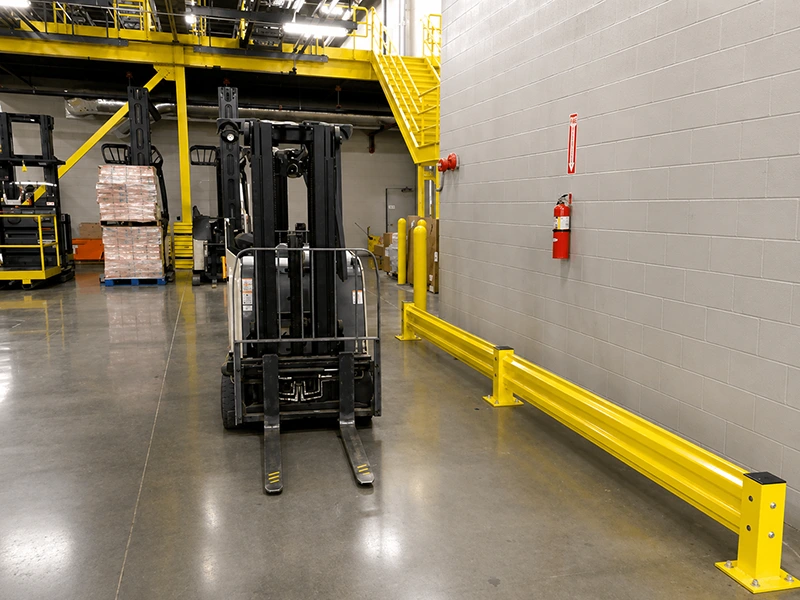
The yellow floor-mounted barrier beside industrial trucks shows why visibility and anchoring must work together. Yellow safety coating makes the boundary easier to identify in a busy warehouse, while the steel rail, square posts and base plates provide the physical separation. Where the site includes a cold storage area, outdoor loading route or coastal atmosphere, a hot-dip galvanized finish can be selected to improve corrosion resistance and reduce routine maintenance compared with unprotected steel.
Where Hsafety warehouse guard rails fit
- Zahnstangen-Endschutz: shield rack uprights and aisle ends from turning forklifts.
- Laderampenschutz: define the edge around dock equipment, walls and staging areas.
- Equipment isolation: protect electrical cabinets, conveyors and production assets with a fitted barrier line.
- Fußgänger-Fahrzeug-Trennung: separate walking routes from forklift areas with a visible steel guard rail.
- Cold storage and high-corrosion sites: use hot-dip galvanized steel where moisture and salt exposure increase maintenance demands.
For an OSHA guardrail compliance review, the final layout should be checked against the site’s traffic pattern, impact exposure, anchor condition, access requirements and applicable local rules. Hsafety provides the physical barrier configuration; the customer’s engineer or safety team confirms the project-specific compliance basis.
Specify the barrier around the real hazard
Start with the asset to protect, the forklift approach direction and the concrete floor condition. Then confirm required height, custom length, rail arrangement, post spacing and finish. Typical references include approximately 1000mm overall height, 310mm rail width, 85mm wave height and 1500mm post spacing; final dimensions should be selected from the approved project drawing. The 4mm plate option and the 16mm-thick base used in custom case 15176 are available reference points for a heavier impact-protection design.
Turn forklift exposure into a defined safety boundary
Share your rack layout, equipment footprint, traffic direction and environment. Hsafety can help develop a custom single rail guardrail or multi-rail corrugated steel barrier for asset protection, collision protection and reduced accident downtime.