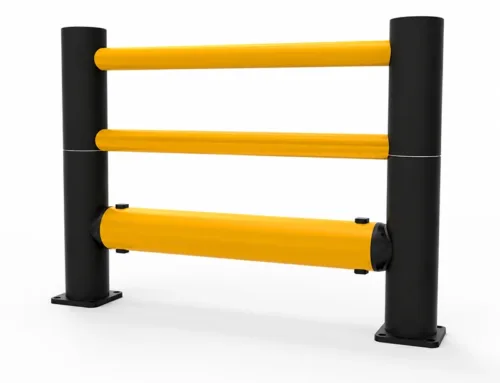
DE
DE  EN
EN  RU
RU  PT
PT  JA
JA  ES
ES  IT
IT Industrial Safety Barriers | AGV / Robotic Palletizing Cells
Continuous-Production Layout Rebalances for AGV Corridors and Robotic Palletizing Cells
A modern robotic palletizing cell or AGV pickup lane carries six figures of capital — and a forklift strike on a hard steel barrier can damage the LiDAR array, the gearbox housing or the arm joint before the barrier even flexes. FCBarrier ARMORFLEX™ polymer crash barriers absorb roughly 80% of impact energy and rebound, so the strike stays outside the cell instead of punching through to the robot. The mortise & tenon quick-release lets a single damaged segment come out and go back in during a shift change, and the modular post-rail-grid layout moves with the robot fleet as NPI drives a new automation footprint.
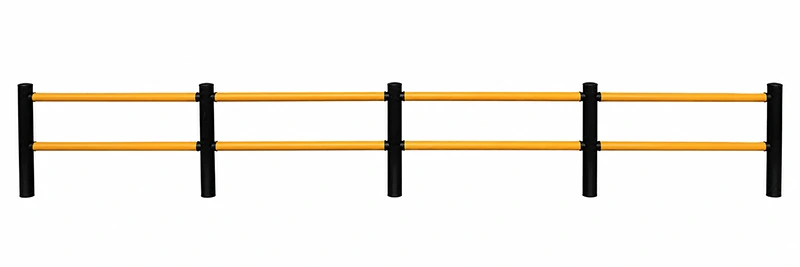
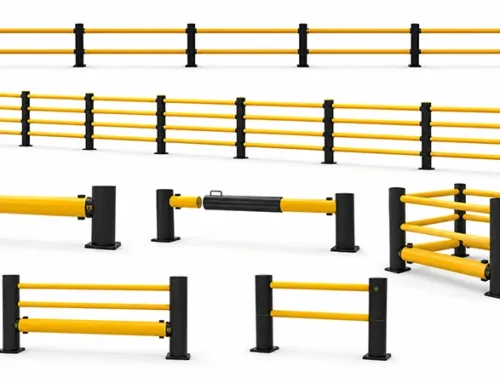
FCBarrier ARMORFLEX™ Polymer Crash Barrier — Energy Ladder and Modular Form
ARMORFLEX™ is a polymer engineered to flex under forklift strike, absorb roughly 80% of impact energy, and rebound to its original profile. The mortise & tenon rail-to-post joint is what makes single-segment swap possible without disturbing the rest of the perimeter around a robotic workcell or AGV lane.
| Series / Form | Typical Application and Energy Envelope |
|---|---|
| FCBarrier SR Series — Single Rail | Light AGV lanes, AMR pickup / drop corridors, light robotic workcells; ~3,850 J envelope |
| FCBarrier DR Series — Double Rail | Standard robotic palletizing cell perimeter, mid-weight AMR routes; rated to 28,950 J (8 t forklift @ 9.6 km/h) |
| FCBarrier TR Series — Traffic Rail | Robotic arm cell enclosures, ISO 10218 area boundary, pedestrian side of AGV / AMR lanes |
| FCBarrier CTR Series — Column Protector | Robot base column protection, AGV charging dock posts, structural column guarding adjacent to cells |
| Mortise & Tenon Quick-Install | Single-segment swap in minutes; no welding, no anchor pull-out; modular post spacing 1,500 mm standard |
Why FCBarrier ARMORFLEX™ Polymer Replaces Steel at the AGV / Robotic Cell Perimeter
1. Residual Impact Force: Strike Stays at the Rail, Not in the Robot
A 4 t forklift striking a steel barrier at 6 km/h transfers a significant residual impulse through the rail and into whatever is behind it. For a robotic palletizing cell that hosts a six-axis arm, a 2D LiDAR puck and a six-figure gearbox, the residual impulse bends the rail inward, dents the housing, or shoves the robot off its anchor — and the line is down for weeks of parts and recalibration. FCBarrier ARMORFLEX™ polymer absorbs roughly 80% of the strike energy, deflects the rail, and rebounds to its original profile; the cell behind the barrier keeps its geometry and its calibration. The same 28,950 J envelope that protects a rack end also protects the LiDAR puck and motor housing of an AGV or a palletizing arm.
2. Mortise & Tenon Quick-Release: Single Segment Out, Single Segment In, Line Stays Up
A palletizing cell is a single point on a continuous-production line: when the perimeter is breached for a segment repair, the cell behind it has to stop until the rail is welded, repainted and re-anchored. FCBarrier uses a mortise & tenon joint between rail and post — the post is floor-bolt fixed, the rail slides into the post pocket and locks without welding. A damaged segment comes out and a replacement goes in during a shift change or a planned micro-stop, without arc, paint curing or anchor pull-out. The other segments of the perimeter stay where they are, so the surrounding AGV corridor and palletizer feed stay in service.
3. Modular Layout Rebalance: Move the Perimeter with the Robot Fleet, Not Behind It
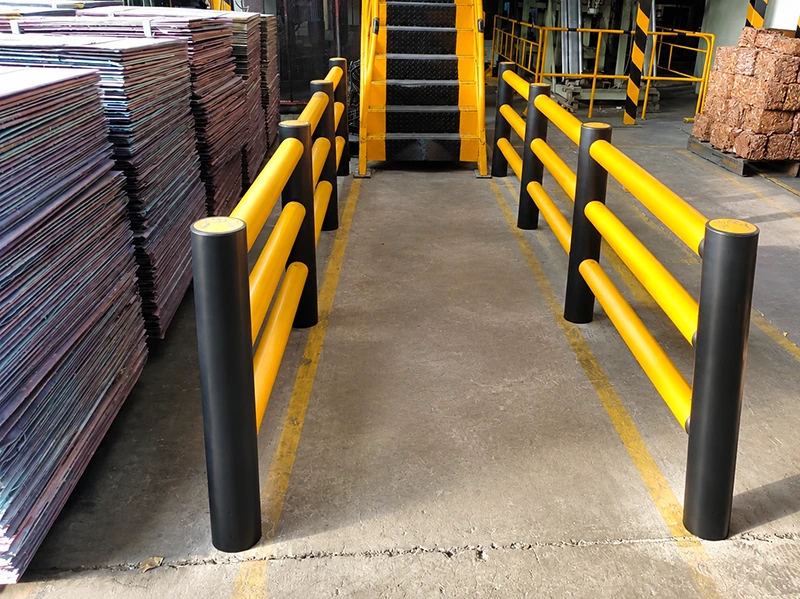
An automation footprint does not stay still. A new NPI cycle pulls the robotic palletizing arm 4 m to the east, splits an AGV pickup lane into two, or moves the AMR charging dock to the opposite wall. A welded steel cage becomes scrap in the first rebalance; a single-piece concrete bollard layout becomes an obstacle. FCBarrier post-and-rail segments are modular — posts on 1,500 mm centers, rails in single-span modules, corner units and column protectors as separate items. The same post anchors move with the layout, the same rail lengths redeploy the next module, and the perimeter stays an NPI / automation-rebalance asset instead of a sunk-cost demolition item.
Where FCBarrier ARMORFLEX™ Polymer Barriers Fit on an AGV / Robotic Cell Floor
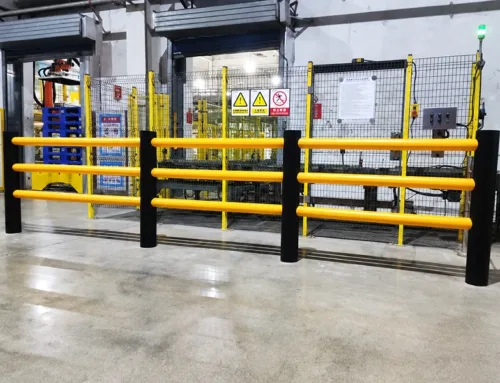
- Robotic palletizing cells — six-axis and parallel-axis palletizer enclosures, end-of-arm-tooling zones, slip-sheet staging areas where a steel cage would damage the arm or sensor array on impact
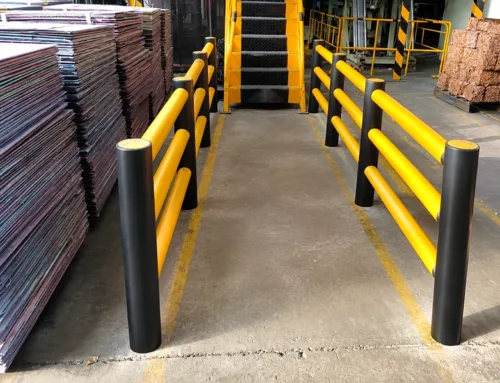
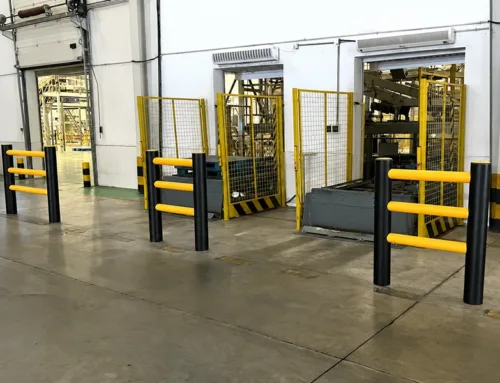
- AGV / AMR pickup and drop corridors — dedicated AGV lanes between storage and tacking, separated from pedestrian pickers by a polymer boundary that does not bruise the AGV LiDAR puck on secondary contact
- Robotic workcell enclosures (ISO 10218 area boundary) — perimeter guard for collaborative or power-and-force-limited robotic cells where the cell must be visible, the arm must be protected, and the perimeter must move with the cell
- AMR charging docks and robot base columns — CTR Series column protectors around AMR charge stands and palletizer base columns; same modular post and rail inventory, no special fabrication
- NPI-driven automation rebalance cycles — temporary or permanent perimeter moves as the line layout shifts every 6–12 months; the same FCBarrier modules redeploy instead of being scrapped
The honest disclosure: FCBarrier does not currently hold a public PAS 13 third-party certificate. Procurement teams specifying FCBarrier for a multi-site AGV / robotic cell rollout should request the internal energy ladder, the mortise & tenon install documentation, and the modular layout kit directly — third-party PAS 13 testing is the next item on the FCBarrier roadmap before any multi-plant ISO 10218 area sign-off.
Download the FCBarrier AGV / Robotic Palletizing Cell Pack
Request the FCBarrier ARMORFLEX™ polymer energy ladder, the mortise & tenon quick-install procedure, and the modular layout kit for AGV pickup corridors, AMR drop lanes, robotic palletizing cell boundaries and NPI rebalance cycles.
Specify FCBarrier for Your AGV and Robotic Palletizing Cell Layout
If your robotic palletizing cell or AGV corridor is being re-laid-out, expanded or rebuilt, send the cell footprint, the AGV traffic envelope, and the NPI rebalance interval — we will return an FCBarrier ARMORFLEX™ polymer barrier layout with single-segment swap paths, mortise & tenon rail-to-post connections, and a modular layout that moves with the robot fleet.