
 DE
DE  EN
EN  RU
RU  PT
PT  JA
JA  ES
ES  IT
IT 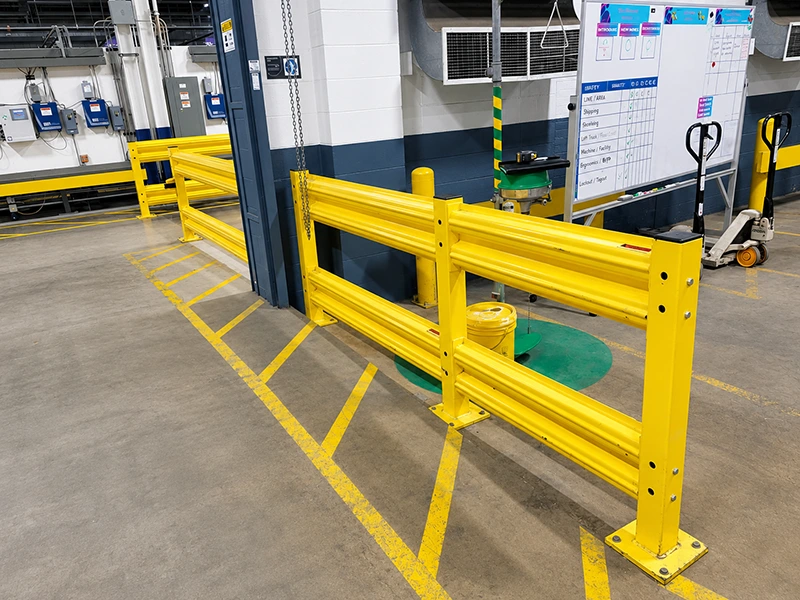
Trennung von Fußgängern und Fahrzeugen im Kühlhaus
Kühlhaus-Gabelstapler geben bei -25 °C nicht nach: Wie eine Q235-Lager-Schutzplanke den UWB- und Blaulicht-Stapler-Fußgänger-Trennstapel vervollständigt
In einer Tiefkühlzelle kollabieren Nebel, Kondensation und eine dicke Handschuh-Schicht jede aktive Warnung zu einem einzigen weißen Rauschen. Eine verschraubte, doppelschienige Q235-Wellstahl-Lagerschutzplanke mit hochsichtbarer gelber Beschichtung und optionalem Reflexband ist die passive harte Grenze, die hinter UWB-Tags und Blaulichtlampen sitzt — die Schicht, die nicht auf Schulung, Aufmerksamkeit oder die Stimmung des Bedieners angewiesen ist, bevor eine Fußgängerkollision die Schicht beendet.
Kühlhaus-Grenzspezifikation — Was die Hardware tragen muss
Eine Fußgänger-Fahrzeug-Grenze in einer Tiefkühlzelle muss drei Belastungen gleichzeitig überstehen: einen -25 °C-Boden, einen kontinuierlichen Dock-zu-Pick-Zyklus und einen Handhubwagen, der fehlsteuert, weil der Bediener die Farblinie durch den Nebel nicht erkennen kann. Die Q235-Wellstahlplatte auf einer verschraubten Bodenplatte ist die Spezifikation, die alle drei ohne laufende Lackausbesserungen übersteht.
| Spezifikation / Abmessung | Kühlhaus-Sicherheitswert |
|---|---|
| Material | Q235 Kohlenstoffstahl; feuerverzinkt oder pulverbeschichtet gelb |
| Plattenprofil | 2-Rippen W-Profil-Doppelschiene; 3-Rippen-Option für schwerere Schubmaststapler-Zonen |
| Plattenbreite | ~300–310 mm; Rippenabstand ~194 mm; Wellenhöhe ~85 mm; Amplitude ~40 mm |
| Plattenstärke | 3 mm Standard; 4 mm für höherenergetische Gabelstapler-Hüllkurven |
| Oberschienenhöhe | ~1.000 mm über Boden |
| Unterschienenversatz | ~100 mm über Boden auf der 6 mm Bodenplatte |
| Pfostenprofil | 80 × 80 × 6 mm Vierkantrohr, Höhe 1.000 mm |
| Pfostenabstand | 1.500 mm Standardachsmaß |
| Bodenplatte | 160 × 160 × 16 mm, vier Betonankerbolzen |
| Ankerbolzen / Boden | Dehnungsanker in Beton ≥ 150 mm dick |
| Plattenlänge | ~1.500 mm Standard; 680–1.140 mm kundenspezifisches Füllstück für nicht-modulare Verläufe |
| Sichtbarkeitsoptionen | Gelbe Polyester-Deckschicht, Reflexbandstreifen, optionale LED-Beschilderung |
| Endabschlüsse | Poller-Endkappen an gemeinsamen Kühlhaus-Toren; herausnehmbares Segment über frostbedingten Fugen |
| Modul | Verschraubt, keine Schweißarbeiten vor Ort, keine Heißarbeitserlaubnis, herausnehmbar |
Warum eine passive Grenze aktive Warnungen in einer Tiefkühlzelle übertrifft
Aktive Warnungen enden an der Nebelgrenze
UWB-Näherungsetiketten, Blaulicht-Fußgängerlampen, Geschwindigkeitsbegrenzer und Bedienerschulungs-Audits befinden sich bereits auf der aktiven Schicht der meisten modernen Kühlhauseinrichtungen. Sie funktionieren — bis ein Wintervertrag einen temporären Kommissionierer einstellt, der diese Tiefkühlzelle noch nie betreten hat, die Streifenvorhangtür neunzig Sekunden lang offen bleibt und die Nebelbank den Blaulichtstrahl verschluckt. Die Q235-Wellstahl-Lagerschutzplanke ist das egal. Sie absorbiert den Handhubwagen, der die Farblinie um 200 mm verfehlt, und steht dann bereit für den nächsten. Die Barriere ist die passive Schicht, die die OSHA-Hierarchie der Schutzmaßnahmen erwartet, und sie verlangt nicht, dass der Bediener wach, nüchtern oder in dieser bestimmten Schicht geschult ist.
Doppelschienen-Geometrie schließt die „Durchgangs"-Lücke
A single rope, a painted yellow stripe or a single low steel rail pipe can be stepped over by a hurried worker or driven through by a reach truck. The double-rail W-beam cross-section shown in the panel view — top rail at ~1,000 mm and lower rail ~100 mm above the slab — closes that gap. The lower rail catches the wheel of a wayward pallet truck; the upper rail catches the chassis. Together they redirect the strike energy into the post and the 160 × 160 × 16 mm base plate instead of into the picker on the other side. For freezer aisles where visibility drops below five metres, the geometry is the safety case, not the colour.
Poller-Endkappen, Reflexband und die gemeinsame Gefriertür
Every cold-storage pedestrian–vehicle boundary starts and ends at the shared freezer door. Bollard end-caps at each terminus take the corner-strike load that a simple flat end-cap cannot, and reflective tape strips on the rail face give the oncoming reach-truck driver a visual reference at -25 °C when the headlamp scatters off the fog bank. The barrier forms a continuous corridor that pairs with the active UWB and blue-light stack: the lights warn, the bollard resists, the rail contains, and the expansion anchor holds the slab. None of these layers stand alone; remove one and the next strike finds the gap.
Where to Drop the Passive Boundary Inside a Cold Storage Facility
- Shared freezer door / dock vestibule. Both sides of the entry need a double-rail barrier with bollard end-caps; the corridor opens only for an authorised reach-truck cycle.
- Pick-face aisle next to a powered pallet-flow lane. A 1,000 mm high double-rail keeps the picker behind the rail while the reach-truck runs the lane at the same time.
- Cold-loading dock apron. A bollard + rail transition from the freezer to the dock leveller protects the seal and the driver from a runaway hand-pallet jack.
- Pallet-flow rack end in a freezer aisle. The rack-end protection spec is the same — 160 × 160 × 16 mm base plate, four-anchor, double-rail panel, lift-out segment over the slab seam.
- Cold-storage battery / charging room wall. Battery charging walls inside the freezer need the same boundary so a pallet truck cannot push through to the chargers.
- Frost-heaving concrete seam. A lift-out segment over a known frost-heaving seam absorbs slab drift without re-anchoring the entire run.
For shared pedestrian-vehicle supply lines where a hand-pallet jack, reach-truck and picker pass within 1.5 m of each other, the cold-storage Hsafety double-rail corridor is the same bolted spec an automotive plant uses at the JIS drop lane — only the surface treatment is swapped for hot-dip galvanizing or a thicker polyester coat to survive the temperature swing and the daily wash-down.
What to Verify Before You Specify a Cold-Storage Boundary
Before a Hsafety run is signed off for a cold-storage aisle, the spec sheet should lock down six items in writing: (1) hot-dip galvanized versus powder-coated finish, because frost and condensation attack painted welds and bolt pockets first; (2) panel thickness — 3 mm standard, 4 mm for heavier lift-truck envelopes; (3) anchor bolt diameter and concrete slab thickness, with expansion anchors into a slab ≥ 150 mm as the cold-storage starting point; (4) base plate dimension (160 × 160 × 16 mm for typical freezer floor profiles); (5) reflective tape pattern and bollard end-cap detail at every shared freezer door and rack end; and (6) a panel-to-post layout drawing that locks geometry before fabrication, with custom 680–1,140 mm fillers listed for any non-1.5 m run. The Q235 substrate, the bolted connection and the optional reflective / bollard layer are the spec lines that survive the freezer. The third-party impact test for the specific truck-class / zone-class envelope is still an open workstream that should be priced into the project plan rather than assumed.
Senden Sie den Kühlhaus-Grundriss — Erhalten Sie in 48 Stunden eine verschraubte Spezifikation
Drop the freezer floorplan, the reach-truck class and the pedestrian-corridor widths. We'll return a project-cut double-rail layout with 1,500 mm standard panels and 680–1,140 mm custom fillers, hot-dip galvanized finish, reflective tape pattern and bolt-down base plate detail. No on-site welding, no hot-work permit, no shifting painted boundary at -25 °C.

