
 DE
 EN
 RU
 PT
 JA
 ES
 IT
AS/RS AGV PERIMETER GUARDING / WAREHOUSE AUTOMATION SAFETY
One post inside the AGV envelope costs a storage position on every aisle
Storage integrators bidding a high-density AS/RS installation are scored on space utilisation, and the fence is where that score leaks away. A screen that has to stand off gives up rack positions and narrows the AGV corridor; a welded one-off is worse, because every turn becomes a cutting job. AS/RS AGV perimeter guarding built from 20×100 mm narrow-aperture mesh is documented as allowing a 120 mm close-to-machine installation in the standard configuration, and long conveyor runs are closed with standard modules instead of bespoke fabrication. Warehouse automation safety still demands one thing before the drawing is issued: check the corridor against the fence outer edge, then re-check hazard height in the vertical plane.
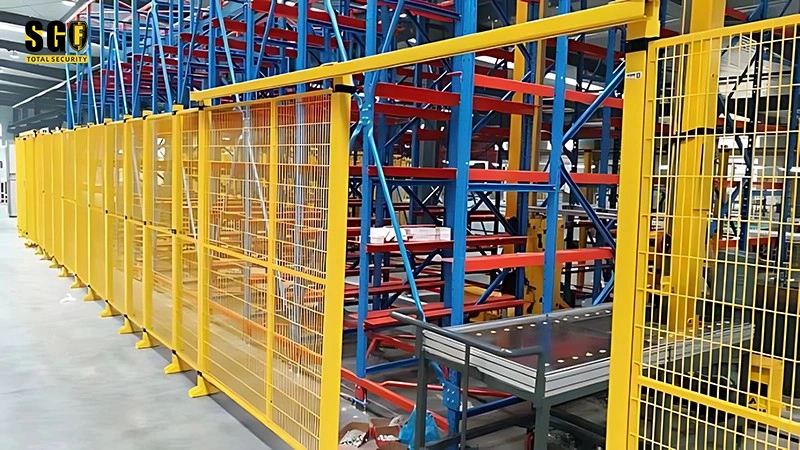
Send your AGV corridor width and stacker envelope for review
The check order that protects the running width
Most disputes start because the fence was drawn to the post centre line while the AGV supplier quoted a clear running envelope. The two numbers are not the same. Base plates, anchors, gate swing and corner posts all sit outside the mesh plane, and integrators discover the difference during commissioning, after the racking is already fixed.
| Prüfen | What is measured and fixed |
|---|---|
| 1. Running envelope | Loaded AGV outline plus positioning tolerance, turning sweep, emergency stop overrun and the client’s own clearance allowance. This gives the minimum clear corridor width that the guarding may not enter. |
| 2. Fence outer edge | Draw the outer face of the 60×60 mm post, the base plate, the anchor heads and the full gate opening arc. Post centre spacing is derived from this line, not the other way round. |
| 3. Vertical re-check | Hazard height, aperture size and reach distance to ISO 13857. The 120 mm close-to-machine value belongs to the 20×100 mm mesh configuration; high-level stacker loads, ejection risk and mezzanine access can demand a taller guard or a top mesh. |
| 4. Long runs and corners | Set post spacing from standard width modules, use a dedicated corner post at each direction change, and close the conveyor transfer opening with a drawn tunnel or light-curtain interface rather than a site-cut panel. |
How a modular perimeter holds the line over a long aisle
Warehouse automation safety starts at the base plate
A machine guarding fence is only as narrow as its fixing detail. Q235 posts on individual base plates with four M10 expansion anchors keep the fence outer edge predictable bay after bay, and the annotated drawing states that dimension once for the whole aisle. Framed mesh panels with a 20x30x1.5 mm border and 3.0 or 4.0 mm wire stay flat between posts, so the plane does not wander into the AGV envelope over a 60 m run. RAL1023 posts with RAL9005 panels also make the boundary legible to forklift drivers working the adjacent lane.
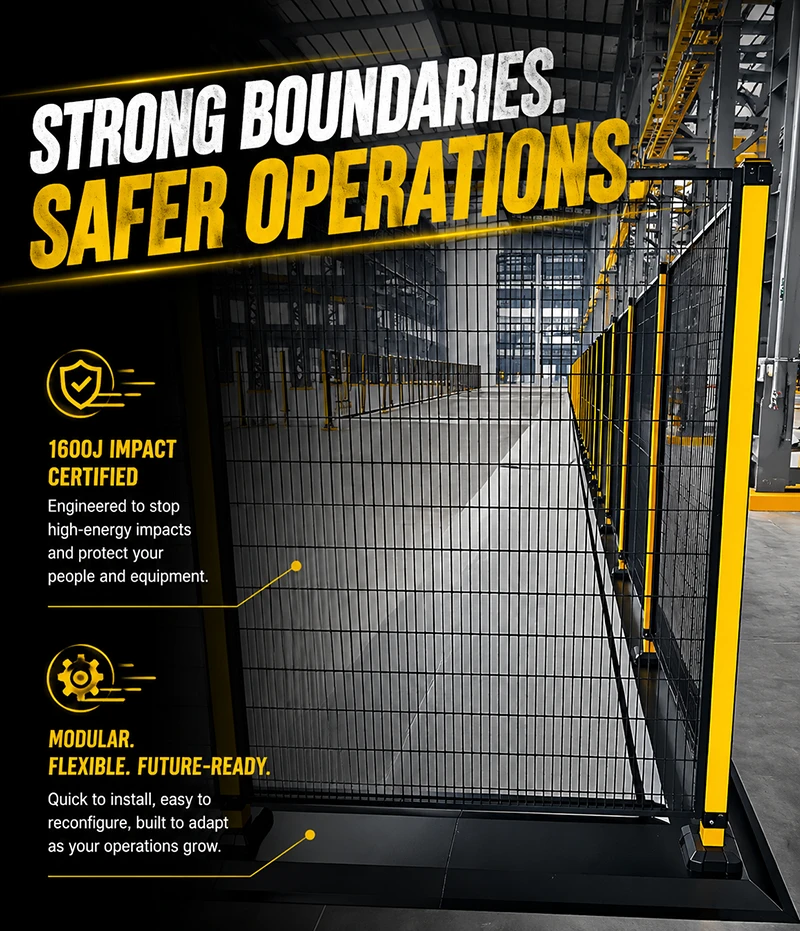
Conveyor line safety guarding without a fabricated one-off
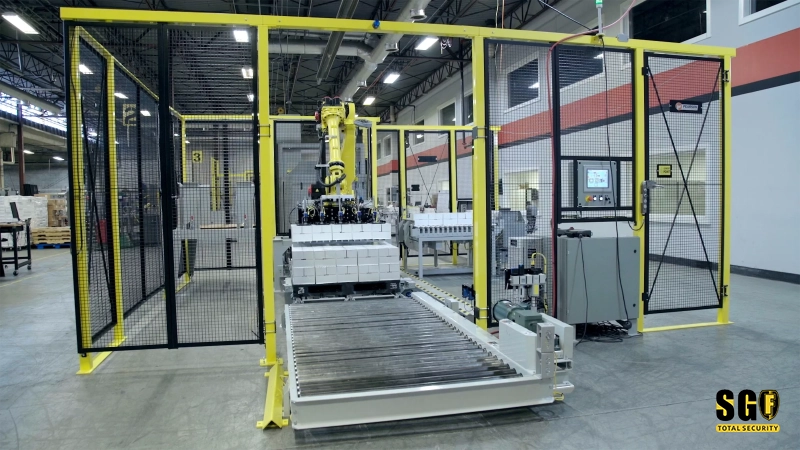
Stacker cranes, roller conveyors and AGV handover points run all day, so a welded screen that needs hot work at every modification is a shutdown liability. A modular safety barrier continues past transfer openings with standard bays, and the openings themselves are dimensioned on the general arrangement drawing for tunnel guarding or a light-curtain interface. Robot cell guarding at the pick face uses the same gate leaf and safety lock mounting carrier, prepared for Omron D4NL or Pizzato FS switches supplied and wired by the project electrical team.
Close to the machine does not mean low risk
A tight footprint is a layout gain, not a relaxation of the risk assessment. Where a stacker can eject a load, where a forklift shares the aisle, or where a person can reach over from a platform, the guard height, impact evidence and top closure have to be re-specified. The 1600 J figure quoted for the standard configuration cannot be carried over to custom widths, door openings or a vehicle impact case without project confirmation. Guard design remains an ISO 14120 review and the interlock circuit stays with the integrator. This system is not intended for pure pedestrian guidance.
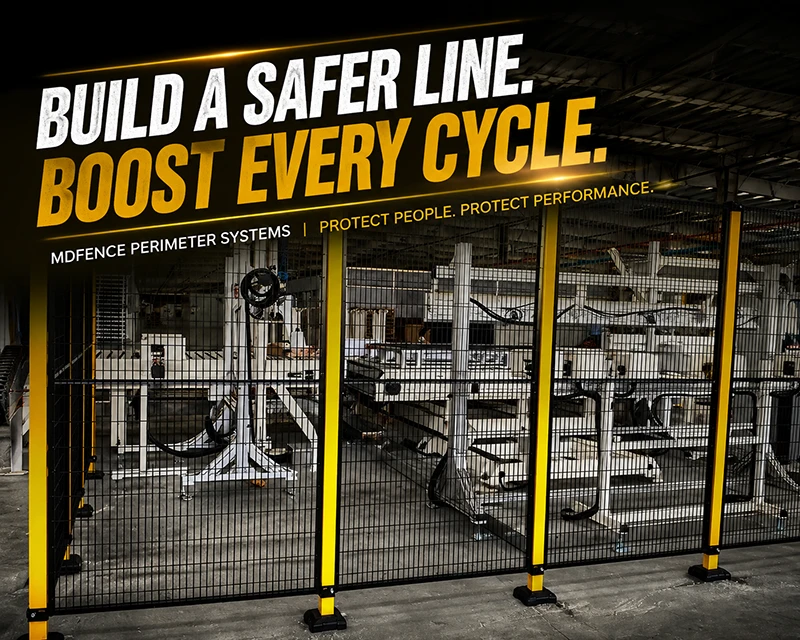
Where the corridor check pays for itself
- AS/RS and high-density storage: holding the fence outer edge outside the stacker envelope protects rack positions counted in the bid.
- AGV corridors and automated material handling safety: the same post and base plate detail repeats for the whole route, including turns.
- Conveyor line safety guarding and palletizer safety guarding: transfer openings are drawn, not cut on site.
- Forklift and pedestrian safety at shared boundaries: vehicle impact is assessed separately before any rating is quoted.
When smart warehouse zoning, machine perimeter guarding and warehouse automation safety are checked in that order, the space utilisation figure in the tender survives commissioning.
What the integrator sends, and what comes back
Send the AGV loaded outline and tolerance, turning sweep, rack and conveyor positions, transfer opening sizes, hazard heights, floor and anchor conditions, door and maintenance access points and the safety switch model. The returned pack carries the general arrangement with the fence outer edge dimensioned, the panel and post BOM with part codes, the corner and gate schedule, the safety distance calculation basis and the acceptance checklist. Local EHS still owns the risk assessment and sign-off.
Keep the aisle you designed
Draw the corridor first, fix the fence outer edge second, and let the standard modules fill the distance. The result is a physical guarding solution that does not quietly consume the positions you sold.

