DE
DE  EN
EN  RU
RU  PT
PT  JA
JA  ES
ES  IT
IT 
Choosing the right safety barrier system is a critical decision for any facility manager. It’s a long-term investment in the safety of your people, the integrity of your equipment, and the efficiency of your operation. For decades, the choice was simple: welded steel. It’s heavy, rigid, and feels strong. But modern material science has introduced a powerful alternative: advanced polymer safety barriers.
The debate between traditional steel and modern polymer often gets stuck on one point: upfront cost. But a truly strategic decision requires looking beyond the initial price tag. It requires a comprehensive comparison of how these two systems actually perform under pressure and what they truly cost over their entire lifecycle.
Round 1: Initial Investment and Perceived Strength
On the surface, the case for steel seems straightforward. A standard steel bollard or guardrail section typically has a lower initial purchase price than its polymer counterpart. Coupled with the perception of strength—the sheer weight and rigidity of steel feels inherently robust—it’s easy to see why it has been the default choice for years. If the decision were based solely on the upfront invoice and a simple “kick-the-tires” test, steel would appear to be the fiscally responsible and secure option. But this initial assessment overlooks the most important factor: what happens at the moment of impact?
Round 2: The Moment of Truth – Performance Under Impact
The entire purpose of a safety barrier is to manage the energy of a collision. Here, the two materials operate on fundamentally different philosophies, leading to drastically different outcomes.
Stahlschranke: Eine Philosophie des starren Widerstands
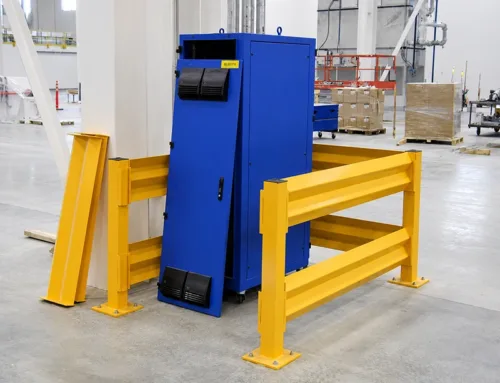
When a forklift impacts a steel guardrail, the barrier does its job—it stops the vehicle. But it does so through brute force. The steel is designed not to bend, which means it absorbs very little energy itself. Instead, it transfers nearly 100% of the collision’s kinetic energy to the floor, the vehicle, and the driver. This results in costly structural damage to the concrete, significant damage to the forklift, and potential injury to the operator. The steel barrier itself is permanently deformed, requiring expensive removal and replacement.
Polymer-Barriere: Eine Philosophie der flexiblen Absorption
In contrast, flexible Sicherheitsbarrieren are engineered not just to stop an impact, but to manage it. When a forklift makes contact, the polymer’s molecular structure allows it to flex and deform, absorbing up to 80% of the impact forces. After dissipating the energy, the barrier’s material memory allows it to return to its original shape, undamaged. This creates a “triple protection” effect: the barrier, the floor, and the vehicle (along with its operator) are all protected from the damaging forces of the collision.
Runde 3: Der finanzielle Showdown - Total Cost of Ownership (TCO)
This is where the initial cost advantage of steel is proven to be a dangerous illusion. Let’s model the TCO for a single, high-traffic corner over a three-year period, assuming two impacts per year. This analysis demonstrates why so many businesses are switching to flexible safety barriers for long-term savings and reliability.
| Kostenkomponente | Jahr 1 | Jahr 2 | Jahr 3 | Insgesamt |
|---|---|---|---|---|
| Stahlschranke | ||||
| Erstkauf & Installation | $1,000 | $1,000 | ||
| Reparieren/Ersetzen (2x/Jahr) | $1,500 | $1,500 | $1,500 | $4,500 |
| Versteckte Bodenschäden | High Liability | High Liability | High Liability | Hoch |
| 3-Jahres-TCO | $5,500+ | |||
| Polymer-Barriere | ||||
| Erstkauf & Installation | $2,000 | $2,000 | ||
| Reparieren/Ersetzen (2x/Jahr) | $0 | $0 | $0 | $0 |
| Versteckte Bodenschäden | Keine | Keine | Keine | Keine |
| 3-Jahres-TCO | $2,000 | |||
(Note: Costs are illustrative examples for comparison purposes in the US market)
Das Urteil: Eine Investition, nicht eine Ausgabe
While a steel barrier may have a lower price tag, it is a product that creates hidden costs and liabilities with every impact. It is a recurring expense disguised as a safety device. A modern polymer barrier is a true one-time investment. It is an engineered system designed to absorb the realities of a dynamic warehouse environment, protecting your entire operation’s financial health, structural integrity, and personnel safety. When you look beyond the initial quote and analyze the total cost of ownership, the choice becomes clear. You are not just buying a barrier; you are investing in a more resilient and cost-effective facility.