DE
DE  EN
EN  RU
RU  PT
PT  JA
JA  ES
ES  IT
IT Forklift Safety Barrier / Polymer Crash Barrier
Steel Crash Barriers vs Polymer Crash Barriers on Concrete Floors: Reading the Hidden-Cost Curve
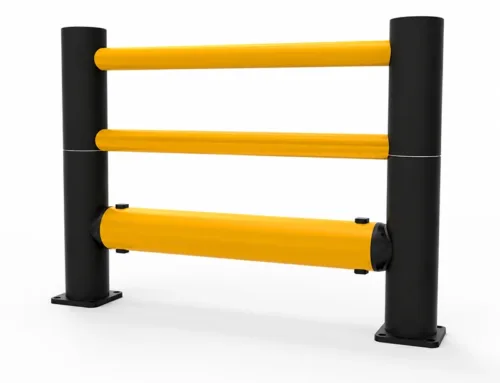
When a forklift strikes a powder-coated steel crash barrier, the barrier does not absorb the hit — it transmits the strike force into the floor anchor and the concrete slab below. A self-rebounding ARMORFLEX™ polymer crash barrier absorbs up to 80% of that energy before it reaches the concrete floor anchor.
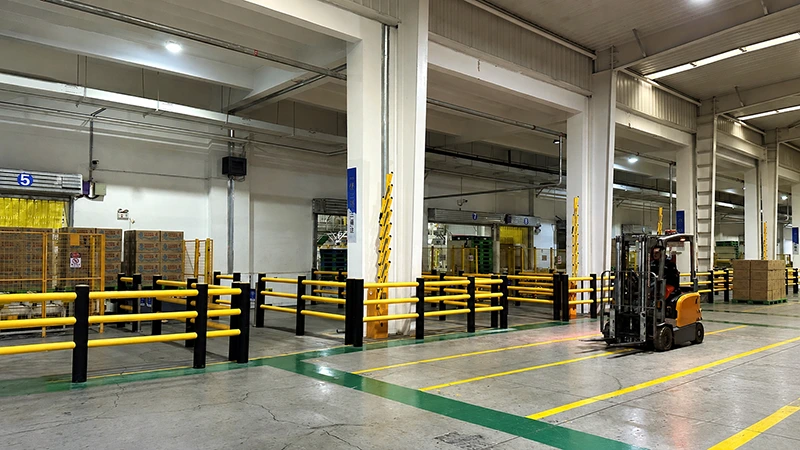
What Steel Barriers Pass Through to the Concrete Floor
A 1.5 t pallet jack at 8 km/h delivers roughly 3,850 J of strike energy. A 3 t forklift at 7.5 km/h delivers 6,500 J. By 8 t @ 9.6 km/h, the figure is 28,950 J. A welded steel guard rail is rated to absorb none of that — it redistributes the energy through the post, the base plate, and the floor anchor, until the slab and the bolt take the rest.
| Vehicle / forklift condition | Strike energy reaching the floor anchor system |
|---|---|
| 1.5 t pallet jack @ 8 km/h | ~3,850 J transmitted (SR100) |
| 3 t forklift @ 7.5 km/h | ~6,500 J transmitted (DR100) |
| 4 t forklift @ 9.6 km/h | ~14,400 J transmitted (SR148) |
| 6 t forklift @ 9.6 km/h | ~19,000–21,350 J transmitted (DR148 / SR190) |
| 8 t forklift @ 9.6 km/h | ~28,950 J transmitted (DR190 / TR190+ / CTR190+) |
How a Polymer Crash Barrier Re-Routes the Curve
ARMORFLEX Polymer: Why Up to 80% of Strike Energy Never Reaches the Concrete
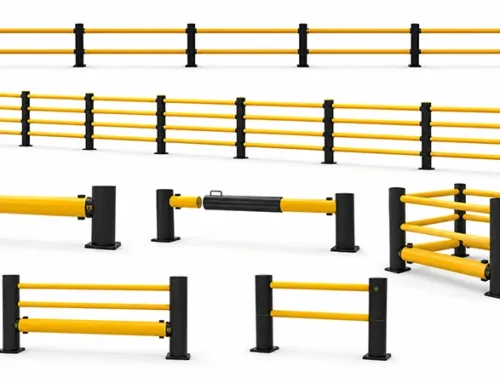
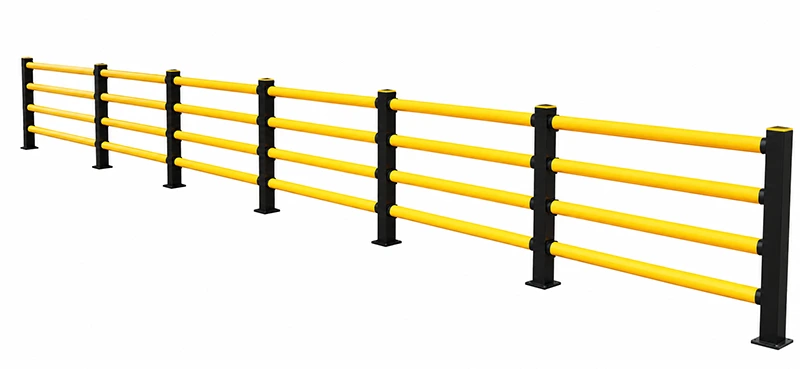
The FCBarrier ARMORFLEX™ polymer crash barrier absorbs up to 80% of strike energy before it reaches the anchor. In the SR, DR, TR and CTR series, that energy is converted into elastic deformation and recovered through the self-rebound of the polymer. The remaining 20% reaches the post base — small enough to leave the concrete floor and the expansion bolt undisturbed. Steel cannot do this. A powder-coated steel tube post takes the same hit and redirects roughly the same number of joules into the slab, into the anchor, and into the next-floor vibration report.
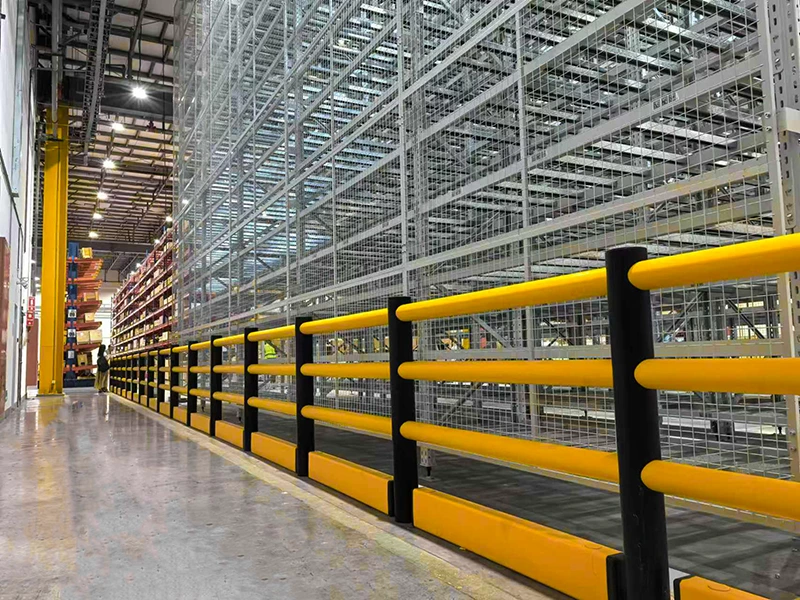
Modular Mortise & Tenon Quick-Release: Swap a Single Rail Without Re-Opening the Anchor
Steel barriers need welding gear, paint cure time, and a fresh anchor hole when a rail deforms past use. The FCBarrier polymer crash barrier uses a mortise & tenon quick-release cell — three rails and two posts per basic unit, locked with an internal long pin and a rubber mallet. When a single rail is struck past its limit, the cell is struck at the rail, not the floor. Crews swap the damaged rail in minutes and the floor anchor is never reopened.
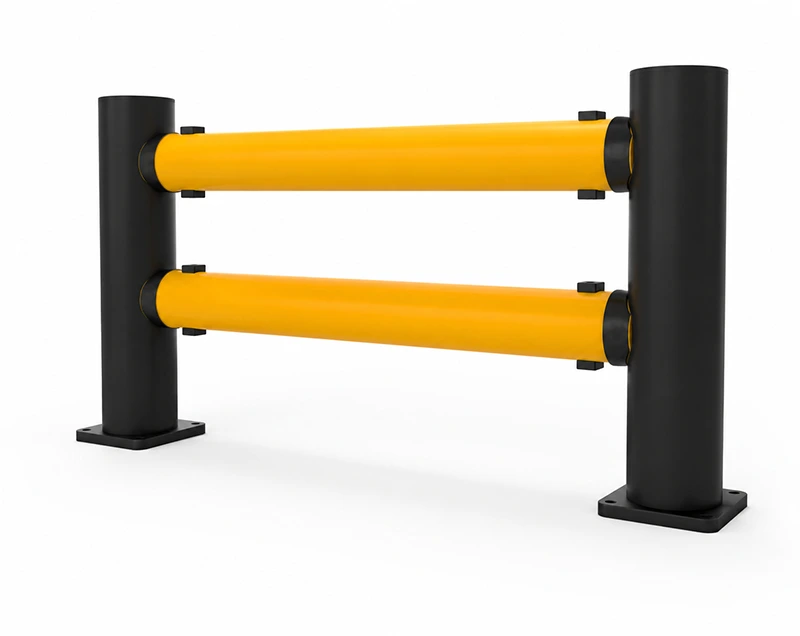
Corrosion-Free, No Repaint, Long Service Life: Lower Hidden Cost Across Every Anchor Cycle
Steel barriers add repaint cycles, rust bleed-off and repaint downtime to the hidden-cost stack. The FCBarrier polymer crash barrier surface is corrosion-free, does not require repainting, and does not shed coating into the floor area. Long service life and a recyclable ARMORFLEX body mean the disposal line item at end of life is also lower than welded steel. The combined effect: a polymer crash barrier on a concrete floor carries a lower annualised TCO per running meter than a steel guard rail across a 10-year cycle.
Where the Hidden-Cost Curve Has to Be Re-Routed
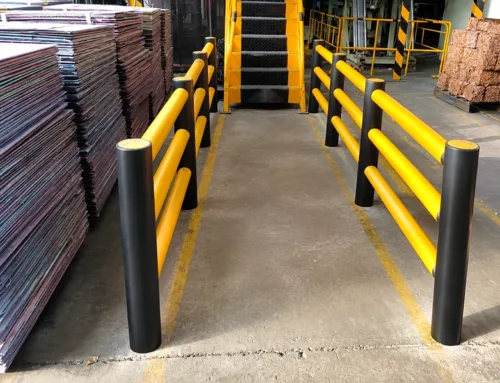
- Warehouse safety barrier zones around pallet racks and rack ends where forklift strikes are routine
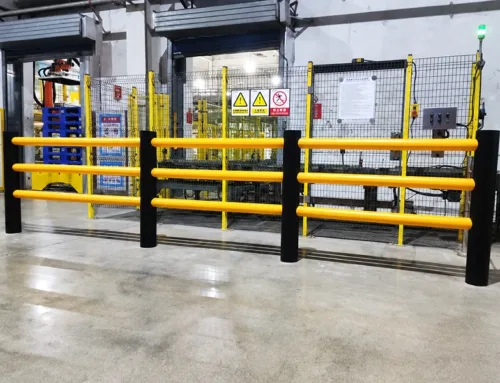
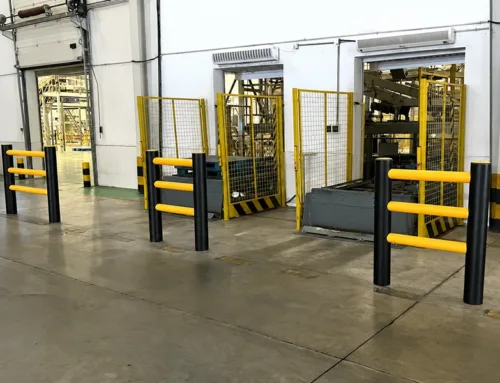
- Forklift safety barrier perimeters at loading bays and dock doors where vehicles turn into the rail at speed
- Racking protection system at aisle entries and rack-end frames where 6 t and 8 t forklifts strike repeatedly
- Manufacturing plant safety cells around conveyors, robotic palletizers and machinery access points
- Logistics centre barrier runs at pedestrian / forklift intersections where the anchor slab takes a corner hit
Anywhere a forklift strikes a barrier, the strike has two addressees: the barrier and the concrete floor anchor. The barrier is the visible line item. The concrete floor is the line item that grows back.
Before You Buy, Audit the Hidden-Cost Stack
The cheapest barrier per running meter is rarely the cheapest barrier per strike cycle. Request the FCBarrier Joule ladder for your forklift fleet (1.5 t through 8 t @ 9.6 km/h), the FCBarrier mortise & tenon install sheet, and a side-by-side TCO worksheet comparing steel vs ARMORFLEX™ polymer crash barrier on a concrete floor in your plant.
Talk to a FCBarrier Engineer About Your Floor-Anchor TCO
Send us your forklift fleet weight and typical operating speed, your concrete floor slab thickness, and the layout of your current steel runs. We will reply with an FCBarrier Joule ladder, an anchor-impact comparison, and a modular mortise & tenon install plan sized to your concrete floor.