
 DE
 EN
 RU
 PT
 JA
 ES
 IT
TOP-OPEN GUARDING FOR OVERHEAD CRANE / OVERHEAD CRANE MACHINE CELL
A closed cage over a die-change cell is removed by the first crane lift
Automotive plants and mould shops lift heavy dies vertically into a work cell. A fully enclosed cage puts a top beam directly in the crane path, so the site removes the beam or leaves an open gap and the guarding stops working. Top-open guarding for overhead crane cells takes a different approach: the four sides of framed mesh panels are anchored as normal, the top is left open for the vertical load path, and a door header beam holds the two gate posts parallel so the leaf still meets its latch. Parts enter from above and personnel cannot enter from the side. The layout is only valid where the risk assessment confirms the hazard height and the absence of overhead ejection or falling-load risk.
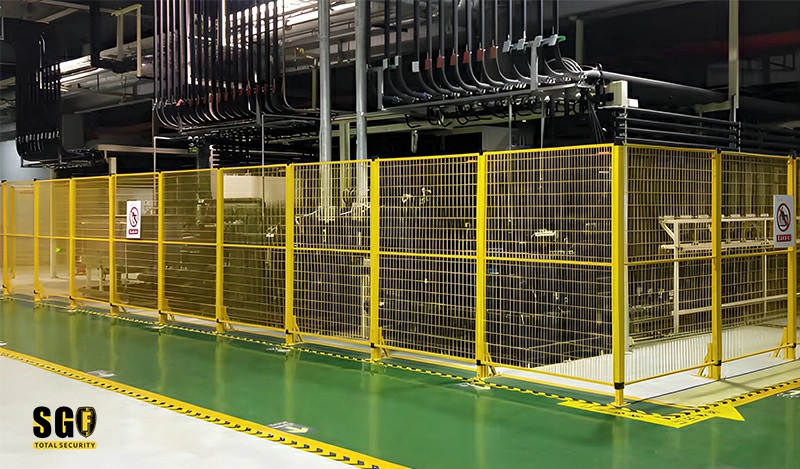
Send your crane lift path and die dimensions for a top-open layout
When the top may stay open, and when it must not
An overhead crane machine cell is a three-dimensional problem. A plan view that shows a clean rectangle says nothing about what can fall into the cell, what can be thrown out of it, or whether a person can reach the hazard from a platform. Those questions are answered before the top is omitted, not after the crane schedule is fixed.
| Entscheidungspunkt | What the layout must state |
|---|---|
| Hazard height and reach | The hazardous movement stays within the zone that the side guarding already protects. Guard height, aperture size and reach distance are calculated to ISO 13857, and the 20×100 mm mesh configuration is checked against the real hazard rather than assumed from a catalogue value. |
| Top mesh is required when | High-level ejection, sparks or swarf, high-level stacker loads, a falling-load path over an operator position, or access from an adjacent mezzanine, platform or ladder makes the open top reachable. In those cases a roof panel or a different enclosure is specified. |
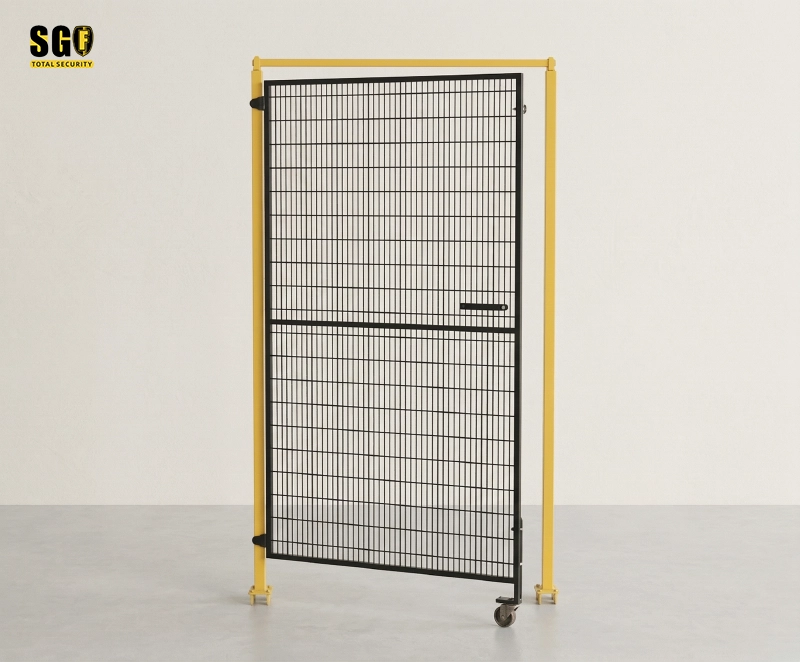
| Door header beam | The header is an alignment member, not a roof. It ties the two gate posts so they stay parallel, which keeps the leaf, latch and interlock actuator in line after repeated opening. It must not intrude into the crane’s vertical envelope. |
| What does not change | Four sides of framed mesh panels, Q235 60×60 mm posts at 2000 or 2200 mm, four M10 expansion anchors per base plate, the agreed bottom clearance, gate cycling checks and the local EHS risk assessment signature. |
How the open-top cell keeps its side boundary intact
Vertical access without a side opening
The crane needs a clear column of air, not a gap in the perimeter. Framed mesh panels with a 20x30x1.5 mm border, 3.0 or 4.0 mm wire and a 20×100 mm aperture are fixed to their posts around all four sides, with M8 fixing rings and bolted base plates. A die or fixture travels down into the cell from above while the side boundary stays closed to a person approaching at floor level. Where a transfer point also exists, conveyor line safety guarding uses a drawn tunnel or light-curtain interface instead of an unguarded slot.
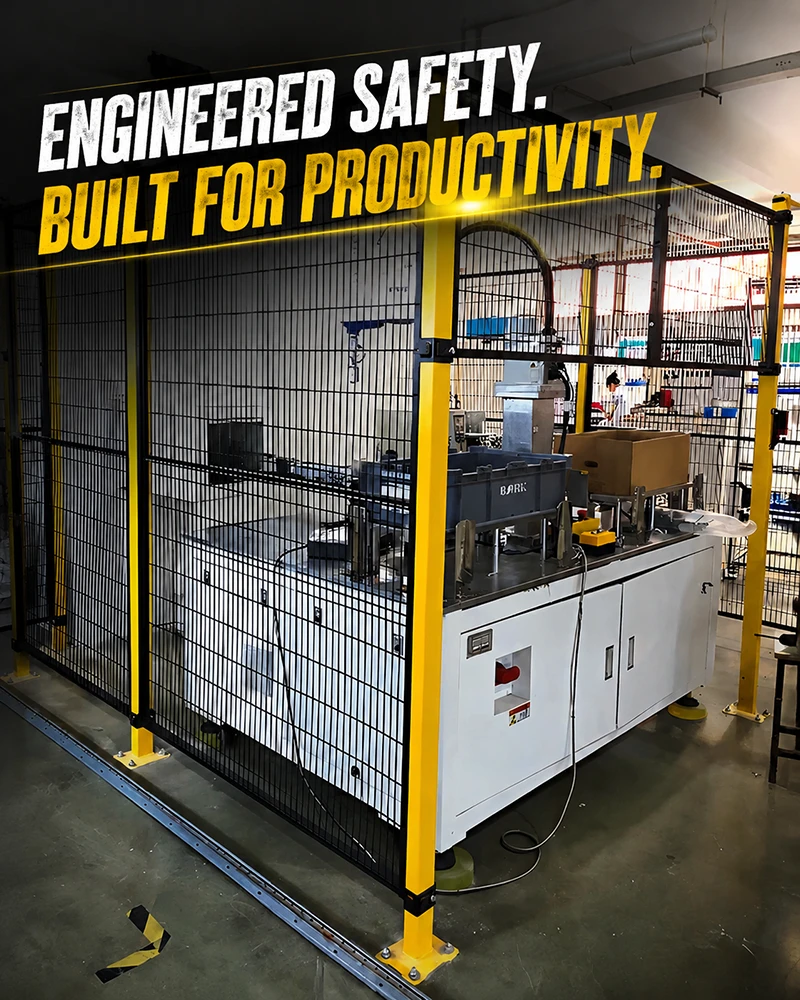
The header beam is an alignment part, not a roof
Removing the top structure changes the load path at the gate. Without a header, two free-standing posts can drift and a single or double leaf begins to sag, the latch misses and the safety interlock reports a fault that maintenance chases as an electrical problem. The header keeps the posts parallel and the leaf centred on its safety lock mounting carrier, prepared for Omron D4NL or Pizzato FS switches. Acceptance records three to five open-close cycles, post verticality, panel flatness and fastener counts, with tolerance agreed in the contract.
Where a top-open layout is the wrong answer
Press shop safety fence and welding shop safety cells with flying debris, robot cell guarding with high-arm ejection risk, and any position under a travelling load are not candidates for an open top. The 1600 J impact figure quoted for the standard configuration does not transfer automatically to custom heights, door widths or a suspended load case, and must be confirmed for the actual build. Guard design remains an ISO 14120 review, the interlock circuit stays with the electrical team, and the system is not intended for pure pedestrian guidance. Local EHS owns the acceptance decision.
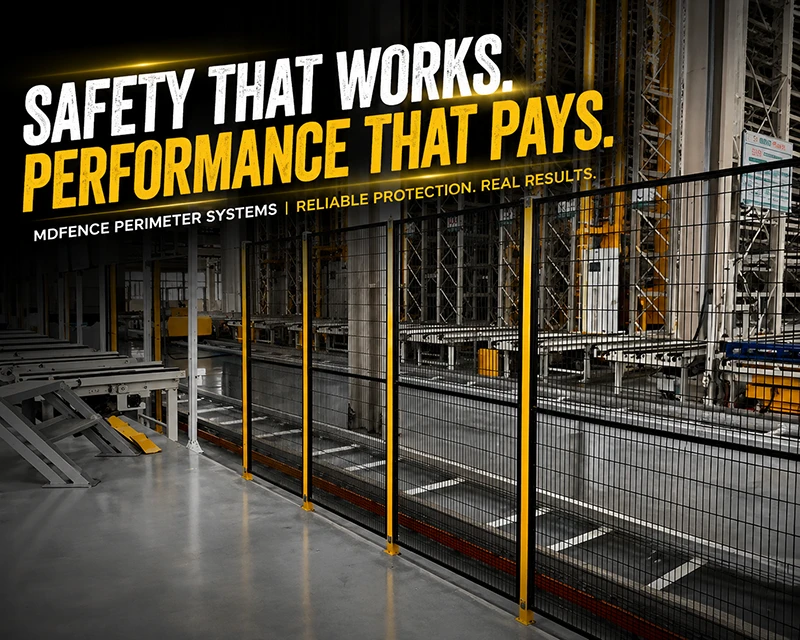
Cells where an open top is worth specifying
- Overhead crane machine cell and die change: heavy tooling is lowered vertically with the side perimeter closed.
- Automotive assembly line safety and mould handling: crane paths are fixed and the risk assessment can define a clear column.
- CNC machine guards for large housings: top loading replaces a wide gate that would otherwise weaken the run.
- Automation system isolation with high-level transfers: a roof panel is added wherever the vertical path carries a load over people.
Top-open guarding for overhead crane work is a machine guarding systems decision with a narrow scope: it solves the conflict between a crane path and a roof, not the wider risk assessment.
The inputs for an open-top guarding drawing
Send the crane lift path and hook envelope, maximum die or fixture dimensions and weight, hazard heights and movement ranges, adjacent platforms or ladders, gate position and swing, floor and anchor conditions and the safety switch model. The returned pack carries a general arrangement marking the open top and header beam, the panel and post BOM, the gate and lock carrier schedule, the risk assessment checklist with the top-closure decision recorded, and the acceptance checks. A roof panel is quoted wherever the assessment calls for one.
Keep the crane path and keep the boundary
Anchor all four sides, hold the gate posts with a header, and let the tool come in from above. The cell stays guarded at floor level without anyone cutting a hole in the roof structure on site.

