DE
DE  EN
EN  RU
RU  PT
PT  JA
JA  ES
ES  IT
IT AGV/AMR path guarding for automated plants
Equipment isolation fence for controlled AGV and AMR traffic
When people work beside AGVs, AMRs, conveyors, and high-speed palletizing robots, an Equipment isolation fence creates a full-height physical boundary with controlled gates, helping separate the restricted operating zone from pedestrian and material-handling routes.
Why AGV/AMR zones need more than a visual barrier
In an automated warehouse, palletizing zone, conveyor line, or robot cell, mixed traffic creates two linked risks: a person can enter the vehicle or robot operating area, and a vehicle can strike equipment or a temporary barrier. Chain-link fence, improvised plastic or wood barriers, and fixed welded steel structures may leave gaps in height, access control, visibility, or future reconfiguration. A project should assess the restricted zone and controlled access points against its applicable machinery and vehicle-safety requirements, including ISO 3691-4 where relevant.
| Konstruktionsanforderung | Alfence response |
|---|---|
| Full-height physical separation | Standard welded wire mesh panel heights of 1000, 1800, and 2000 mm; multiple sections can be combined for a higher boundary requirement. |
| Protected pedestrian and vehicle access | Hinged, folding, telescopic, sliding, and linear/pulley safety gates cover personnel, pallet, forklift, AGV, and AMR passage requirements. |
| Controlled opening and restart prevention | Safety interlock locks, magnetic handles or mechanical key locks can be integrated with safety switches and the site safety system. |
| Fast retrofit and line changes | Modular frame, T-slot aluminum posts, removable panels, bolt-free panel swap, and floor-mounted expansion-bolt fixing support reconfiguration without on-site welding. |
| Clearance and equipment visibility | 20×100 mm mesh can support a layout close to the hazard while maintaining the stated approximately 120 mm safety-distance design target; transparent panel options support visual supervision. |
Structure and gate evidence for a controlled route
Full-height modular guarding around the restricted zone
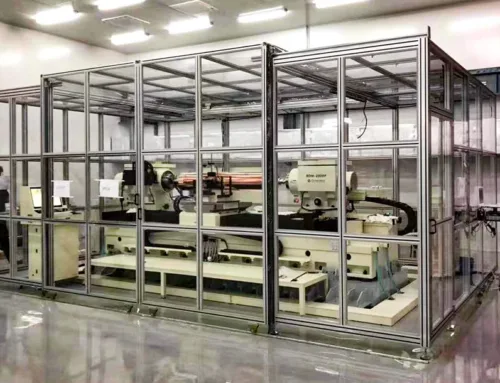
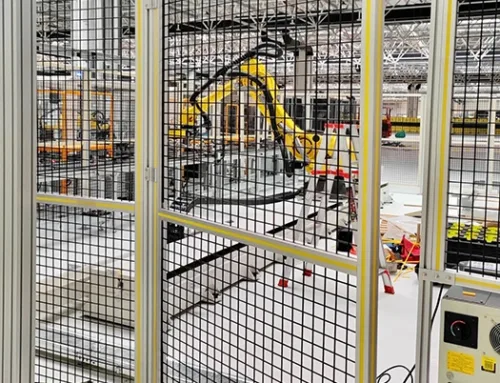
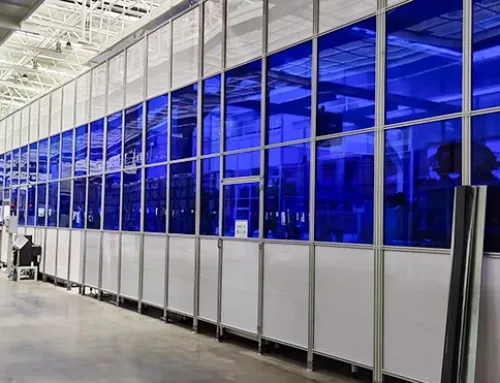
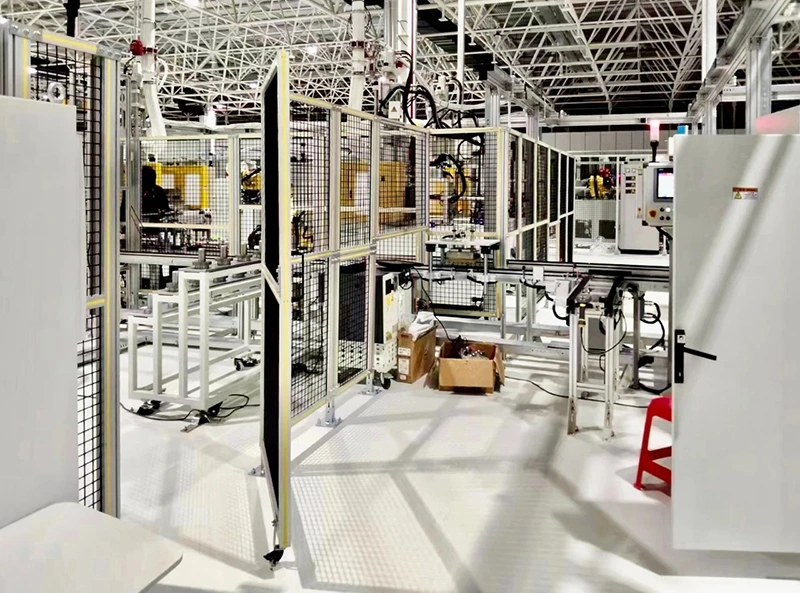
Alfence uses a post-and-panel system with aluminum alloy profiles, T-slot aluminum posts, and welded wire mesh panels. The 1000/1800/2000 mm panel-height range and multi-section arrangement allow the boundary to follow an automated warehouse, AGV path, palletizing zone, or robot cell rather than relying on a low visual partition. The 40×40 or 45×45 mm post options, floor connectors, expansion bolts, and nylon end caps support a defined, floor-mounted perimeter.
Five gate formats for material and personnel flow
Access is selected according to the route, not forced into one door type. A hinged gate supports a single opening up to 1500 mm; folding and telescopic gates suit constrained layouts; conventional sliding gates provide a double opening up to 4300 mm; and a linear or pulley gate can reach a double opening up to 6000 mm. For a forklift, pallet, AGV, or AMR route, the gate can be specified with a safety interlock lock and magnetic handle or mechanical key lock so opening is controlled rather than left as an unmonitored gap.
Interlocked access linked to the safety circuit
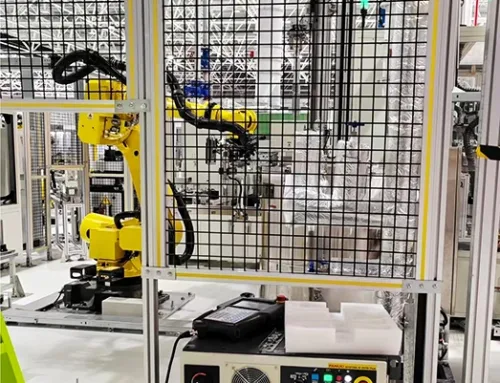
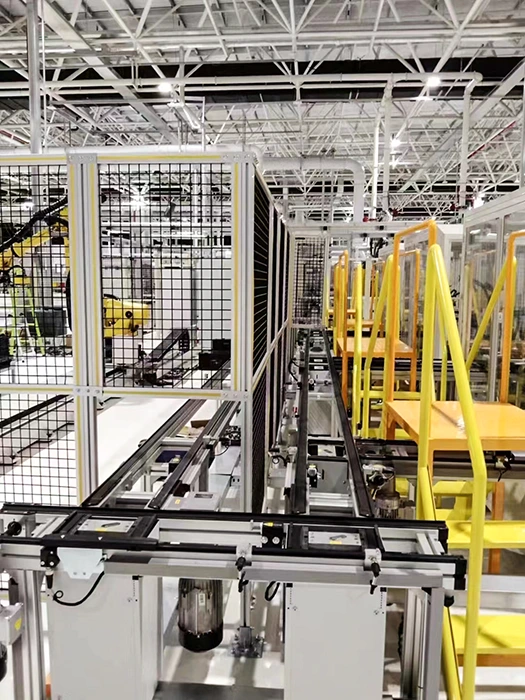
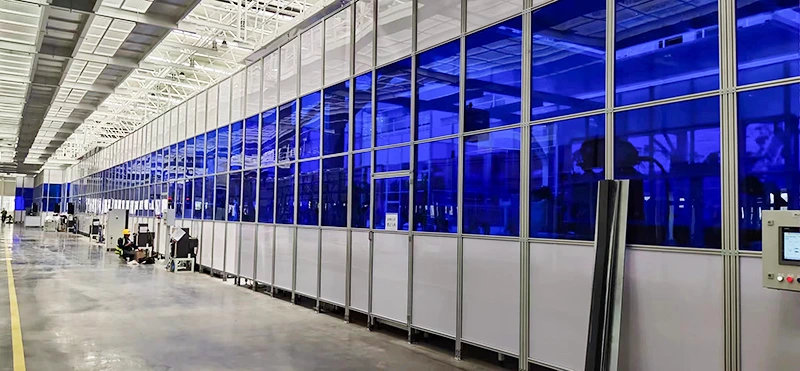
A gate alone is not a control strategy. Alfence can be paired with a safety interlock switch, safety light curtain, and compatible safety-system logic so that a protected operation can be stopped when a gate is opened or a monitored access point is interrupted. The site integrator must validate the safety function, stopping distance, reset logic, and risk assessment. The field evidence below shows aluminum-profile guarding, welded mesh, a controlled automation cell, and an anchored perimeter rather than a temporary barrier.
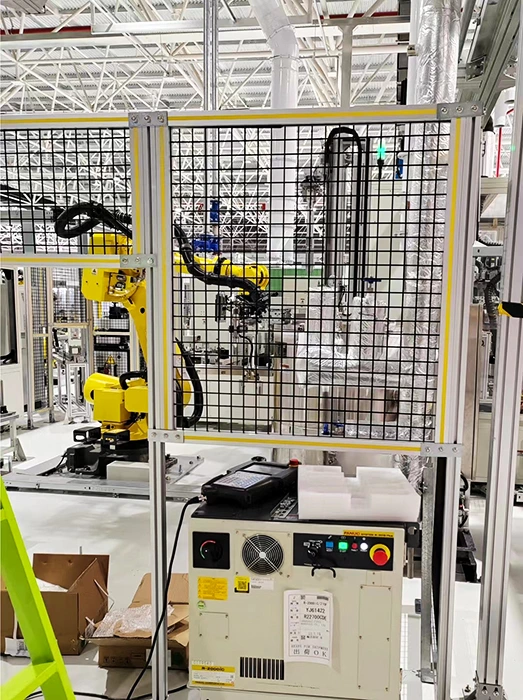
Where this equipment isolation fence fits
- AGV path guarding: Separate vehicle operating lanes from pedestrian aisles and define controlled crossing points.
- AMR and shuttle-car protection: Use a full-height perimeter around storage zones, ASRS interfaces, and transfer points.
- Palletizing and robot-cell guarding: Keep personnel outside high-speed robot motion and provide a monitored service gate.
- Conveyor and material-handling robot guarding: Combine mesh panels, access doors, light curtains, and safety switches around transfer equipment.
- Retrofit guarding: Reconfigure or relocate modular components when an assembly line, warehouse route, or machine layout changes.
For indoor plant installation, the corrosion-resistant, lightweight aluminum profile system supports fast assembly and reusable components. The 20×100 mm welded mesh can help save floor space by allowing a closer-to-hazard layout when the project risk assessment confirms the required EN ISO 13857 distance. Alfence is intended for machine guarding and perimeter guarding, not as a substitute for a fall-protection guardrail or a fully enclosed machine enclosure.
Specify the boundary before specifying the fence
Provide the AGV/AMR route, restricted-zone height requirement, pedestrian crossings, pallet or forklift opening, stopping distance, gate monitoring points, and floor conditions. SGF can then map the modular safety fence, gate format, safety interlock, light curtain, panel material, and fixing method to the application. Confirm the final design against EN ISO 14120, EN ISO 13857, ISO 3691-4 where applicable, and the plant safety circuit requirements.
Build a controlled AGV/AMR boundary with Alfence
Replace improvised separation with a documented Equipment isolation fence layout: full-height modular panels, a gate sized for the actual route, and access monitoring that supports a controlled stop before entry or restart.