DE
DE  EN
EN  RU
RU  PT
PT  JA
JA  ES
ES  IT
IT 
For years, we’ve been conditioned to believe that managing warehouse safety and efficiency is about managing people. We create rules, we hold briefings, we post signs, and we patrol the floor. We operate like diligent security guards, trying to modify the behavior of every individual who walks through our doors.
But as we see in countless manager logs, this approach is a constant, draining, uphill battle. It’s a battle we are destined to lose. Why? Because it’s based on a flawed premise.
The “People Management” Trap is built on three failing pillars:
1. The Yellow Line Fallacy
A painted line on a concrete floor is not a barrier; it is a suggestion. It appeals to a person’s rational mind, assuming they will always see it, comprehend its meaning, and choose to comply. It completely fails to account for the realities of human nature: urgency (a driver in a hurry), distraction (a driver on their phone), or simple confusion (a driver who has never been to your facility before). A suggestion is not a safety system.
2. The “Safety Vest and Briefing” Ritual
We hand a driver a high-visibility vest and give them a 30-second speech about safety. In doing so, we fulfill a procedural requirement, allowing us to check a box on a form. But this creates a dangerous illusion of security. A vest does not contain a force field. It does not stop a 9,000-pound forklift. It doesn’t prevent a person from taking a wrong turn down a busy aisle. It is a passive measure in a dynamic, high-risk environment.
3. The “Guard at the Gate” Dilemma
In an attempt to enforce the rules, we place a human guard at the entrance. While better than a line, this simply outsources the entire systemic problem to a single, fallible human being. A guard can be distracted. They can be overwhelmed when three trucks arrive at once. Their enforcement can be inconsistent, creating friction with drivers. Most critically, from a business perspective, it’s a significant, recurring operational expense (OPEX) that does not scale. You are paying a salary to solve a problem that a secure Maschentrennwand could solve by design.
The Breakthrough: A Lesson from the Airport
Imagine you are at a busy international airport. Thousands of people—stressed, tired, speaking dozens of languages, many visiting for the first time—are navigating a complex process. Yet, almost everyone manages to check in, get through security, and find their gate with remarkable efficiency.
How? They engineer the space.
Think about the journey from the check-in counter to the boarding gate. It is a masterpiece of spatial engineering. Retractable belt barriers and permanent railings create a single, unambiguous path. You are physically guided. You cannot get to security (Step B) until you have completed check-in (Step A). The genius of this model is that it doesn’t try to manage your intentions; it manages your physical body. It makes the correct path the only path.
Applying the “Space Engineering” Mindset to Your Warehouse
The chaos at our loading docks persists because we are still trying to be “behavior police” instead of “process architects.” We need to stop asking, “How can I get drivers to stay out of the work area?” And start asking, “How can I design an entry point where the driver’s needs are met, making entry into the work area unnecessary and physically impossible?”
When you adopt this new mindset, the solution becomes clear. It must be a system that:
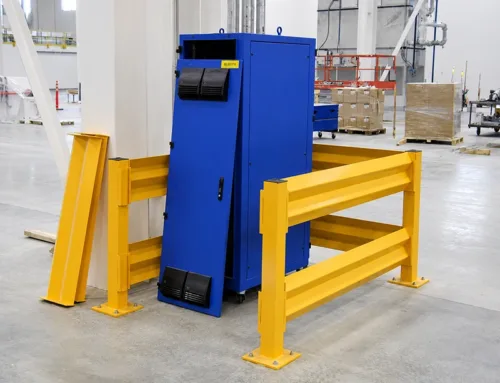
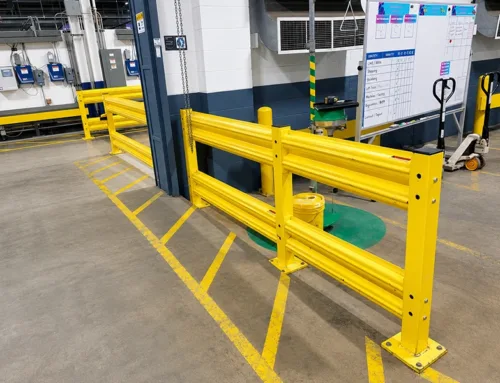
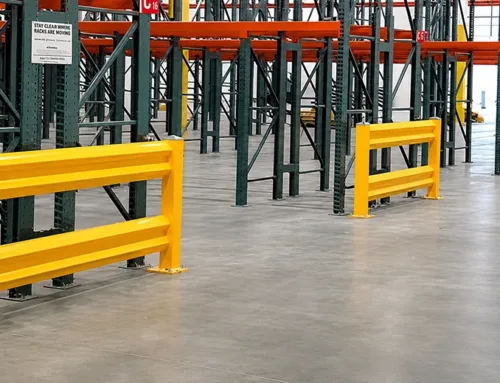
- Establishes an Unambiguous Physical Boundary: Not a suggestion on the floor, but a hard, physical separation—like a wire Maschentrennwand—between the external world and your internal operations.
- Provides a Designated, Efficient Transaction Point: A dedicated window or counter where all necessary interactions can happen safely.
- Creates a Safe, Self-Contained Waiting Area: A clear, professional space where drivers can wait without being exposed to operational hazards.
- Is System-Reliant, Not Human-Reliant: It functions flawlessly 24/7, regardless of who is on duty or how busy it gets.
By shifting our focus from managing people to engineering space, we transform the problem. We move from reactive enforcement to inherent safety. We free our employees from being safety monitors and allow them to focus on value-added work. This isn’t about more rules; it’s about designing a smarter space that makes the right behavior the default behavior.