DE
DE  EN
EN  RU
RU  PT
PT  JA
JA  ES
ES  IT
IT 
Walk onto almost any factory floor with a new robot, and you’ll likely see them: bright yellow or red lines painted on the concrete. They’re a universal symbol for “stay out,” a well-intentioned effort to create a “safe distance” between people and machines. For decades, this has been a common first step in industrial safety.
But in the era of high-speed, high-payload robotics, we have to ask a hard question: Is that line on the floor—a solution that relies 100% on human awareness and compliance—truly enough to protect your team? The answer, according to global safety experts and standards like ISO 10218, is a clear no.
This isn’t about bureaucracy. It’s about a fundamental shift in understanding how modern industrial accidents happen and how they can be robustly prevented. Let’s dig deeper into the philosophy of this critical standard and why it demands a move from passive lines to active, engineered solutions like a proper Maschinenzaun.
The Core Philosophy: Risk Assessment, Not Just Demarcation
The fundamental purpose of ISO 10218 isn’t just to tell people where not to stand. Its goal is to compel a thorough risk assessment that identifies all potential hazards and implements reliable measures to mitigate them. Herein lies the critical difference:
- A Painted Line is an administrative control. It’s a rule whose effectiveness is entirely dependent on every single person seeing, understanding, and obeying it, 100% of the time.
- Eine ISO 10218-Compliant Solution prioritizes engineering controls. These are physical systems designed to control the hazard at its source, removing human error from the equation as much as possible.
Relying on a painted line is like putting up a “Slippery When Wet” sign without mopping the floor. You’ve warned people of the hazard, but you haven’t actually removed it. An engineering control mops the floor.
Three Key Concepts from ISO 10218 Your Painted Line Ignores
To truly calculate the detailed account of your risk, you need to understand the principles that make standards like ISO 10218 so effective. Here are three concepts that reveal the limitations of a simple “safe distance.”
1. “Maximum Space” – The 3D Reality of Your Robot’s Reach
A line on the floor is a two-dimensional boundary. Your robot, however, operates in a three-dimensional world. The standard requires you to consider the robot’s Maximum Space—the total volume of space the robot can reach, including its tooling and the workpiece.
Think about it:
- Can the robot’s arm reach over your painted line while staying within its programmed path?
- If it drops a heavy payload from its highest point, where will that object land? Likely far outside the line.
- In the event of a catastrophic failure, could the arm swing uncontrollably to its absolute physical limits?
The concept of Maximum Space forces you to think like a physicist considering all possible movements, not just a draftsperson. This 3D reality is the true hazard zone you must contain.
2. The Hierarchy of Controls: Why Your Line is at the Bottom
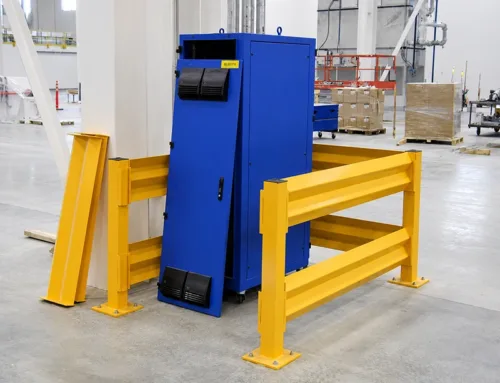
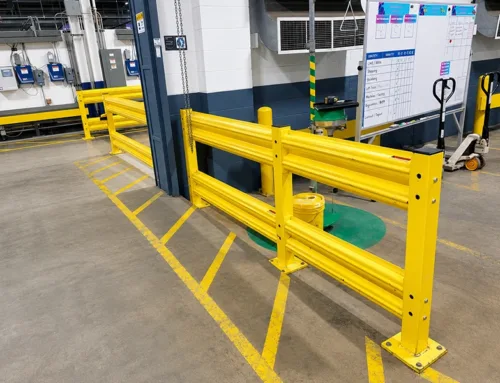
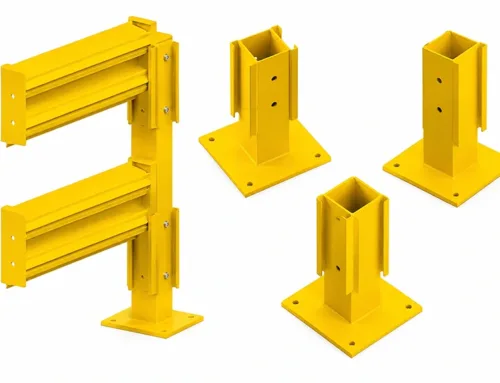
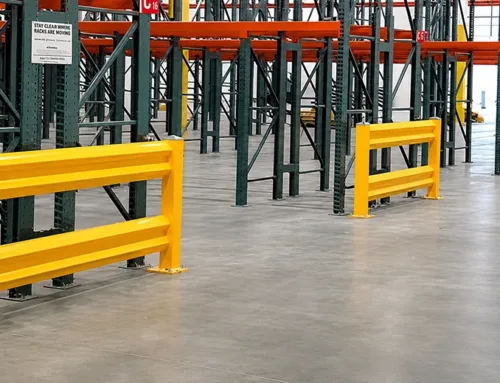
One of the most fundamental principles in all of safety management is the Hierarchy of Controls. It ranks risk reduction methods from most to least effective. A robust physical barrier, like a Maschinenzaun, is an Engineering Control. It is fundamentally more reliable because it doesn’t depend on a person’s decision-making in the moment.
| Control Type | Beschreibung | Effectiveness |
|---|---|---|
| Elimination | Physically remove the hazard. | Most Effective |
| Substitution | Replace the hazard with something less dangerous. | ▼ |
| Engineering Controls | Isolate people from the hazard (e.g., physical guarding, safety interlocks). | ▼ |
| Administrative Controls | Change the way people work (e.g., signs, warning lines, training). | ▼ |
| Personal Protective Equipment (PPE) | Protect the worker with equipment like hard hats or safety glasses. | Least Effective |
3. Performance-Rated Protection: Matching Strength to Risk
Modern standards don’t just say “add a guard.” They operate on the principle of performance levels—meaning your safety measure must be proven to be as robust as the hazard it’s meant to contain. You wouldn’t use a household circuit breaker to protect an industrial motor. Likewise, the principle of performance rating demands that you select a guarding solution, such as a certified Maschinenzaun, with an impact rating that exceeds the calculated kinetic energy of a potential impact. A line on the floor has an impact rating of zero.
From Theory to Your Factory Floor
Understanding these principles is the first step. The next is to apply them. Look at your robotic work cell and ask:
- Does my safety strategy rely primarily on administrative controls like lines and signs?
- Have I truly accounted for the robot’s full 3D “Maximum Space” and potential projectile paths?
- If I have a physical barrier, do I have any data or certification of its performance against the specific impact risks my robot presents?
The Takeaway: Graduate from Awareness to Engineering
A line on the floor isn’t without value; it’s a good starting point for general awareness. But it is not, and never can be, a sufficient primary safety solution for modern robotics. Embracing the principles of ISO 10218 is about adopting a professional, engineering-first mindset. It’s about building a system so robust that it protects your team not just when things go right, but especially when things go wrong.
You are now equipped with the “why” behind robust safety standards. Your next step is to evaluate solutions built on these principles—solutions that offer proven, performance-rated protection, and turn your factory floor from a space of risk into an environment of true, engineered safety.