ES
ES  EN
EN  DE
DE  RU
RU  PT
PT  JA
JA  IT
IT 

Determining the correct safety fence height is more than a compliance checkbox; it’s a critical engineering decision that directly impacts personnel safety and operational uptime. The answer isn’t a single number, but a calculation based on your specific risks. A modular system provides the flexibility to meet both baseline standards and the unique demands of high-risk automation.
Debunking the Myth of a Single “Standard” Height
While many spec sheets list common heights like 1200mm (approx. 4 ft) or 2000mm (approx. 6.5 ft), these are not universal mandates. International safety standards like ISO 14120 and OSHA 1910.212 focus on a core principle: the guard must prevent personnel from reaching over, under, around, or through the barrier to contact the hazard. The required height is therefore a function of the distance from the barrier to the hazardous zone. A fence positioned further from a machine may be shorter, while one closer to the danger zone must be taller to prevent reaching over. This risk-based approach is fundamental to creating a truly safe environment.
The Baseline: Meeting Compliance with Standardized Options
For many applications, standardized heights provide an effective and cost-efficient solution. These common configurations are designed to meet the majority of industrial safety requirements.
- 1200mm (4 ft) Height: Often used for general area demarcation and traffic control, such as creating safe walkways around automated guided vehicle (AGV) paths or separating manual workstations from low-risk machinery. This height serves as a clear visual and physical reminder of boundaries without obstructing overall plant visibility.
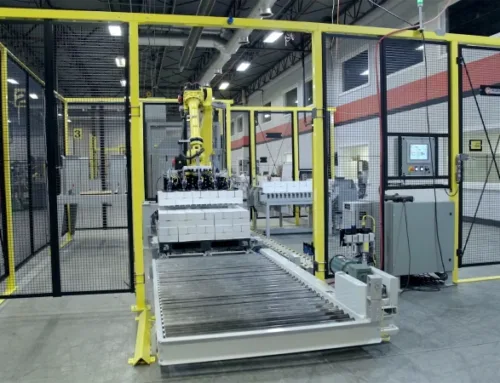
- 2000mm (6.5 ft) Height: This is a more common baseline for Protección de Máquinas and Valla de Seguridad para Robots. It effectively prevents most personnel from reaching over the barrier into active work cells, satisfying the requirements for a wide range of automated processes.
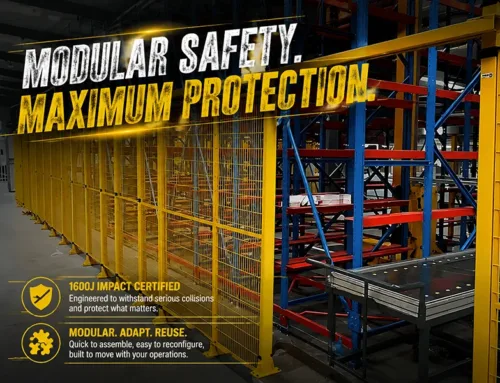
A well-engineered modular system will offer these heights as standard, built with robust materials like Q235 carbon steel posts and fully welded framed panels to ensure they provide genuine protection, not just a visual deterrent.

When Standard Height Isn’t Enough: Assessing High-Risk Scenarios
The most critical safety decisions are made when standard solutions fall short. For system integrators and plant managers dealing with high-energy applications, exceeding standard heights is often a necessity driven by a thorough risk assessment.
High-Energy Ejection and Projectile Risk
In environments like automotive welding stations, CNC machining centers, or any high-speed assembly line, the risk of component failure can lead to high-velocity projectiles. A broken tool bit, a shattered grinding wheel, or a dropped workpiece from a heavy-payload robot can easily clear a 2000mm fence.
This is where custom height solutions become critical. As demonstrated in projects for heavy industrial facilities, fences can be engineered to heights of 2440mm (8 ft) or more. This additional vertical protection is essential to fully contain the work cell and protect personnel in adjacent areas from catastrophic equipment failure.
Stacking and Climbing Hazards
In warehousing and logistics, materials are often stacked near safety barriers. A standard-height fence could inadvertently become a ladder if pallets or containers are placed next to it. Taller fences mitigate this risk by making it significantly more difficult for personnel to use nearby objects to climb over the barrier into a dangerous area, such as an automated storage and retrieval system (ASRS) aisle.
Beyond Height: A Systemic View of Vertical Safety
An effective safety barrier’s performance is not defined by height alone. True safety is achieved when height is combined with superior structural integrity and application-specific components. A tall but weak fence is a dangerous illusion of security.
The Foundation: Structural Integrity
The ability of a fence to withstand force is paramount. The system’s strength begins at the floor with robust anchoring systems, such as 60 x 60mm steel posts with thick wall sections, secured by multiple M10 expansion bolts. This foundation ensures the fence will not fail under impact. The panels themselves must also contribute to the system’s rigidity. Framed panels, where the mesh is fully welded inside a structural tube frame, offer vastly superior Resistencia al impacto compared to frameless mesh, preventing deformation and maintaining the integrity of the safety perimeter.

The Barrier Material: Matching the Panel to the Hazard
The type of panel used is as important as its height. The choice of infill material should be directly tied to the specific risks within the guarded area.
| Panel Type | Primary Application | Key Safety Benefit |
|---|---|---|
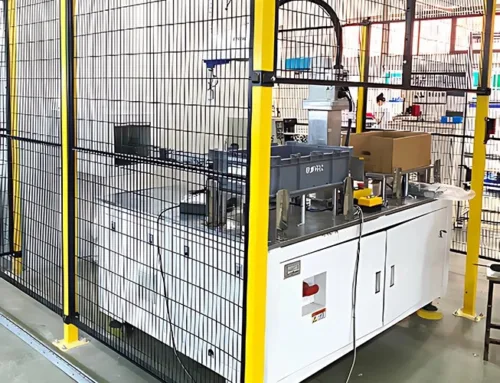
| Steel Wire Mesh | General robot cells, machine guarding, perimeter fencing. | Provides excellent visibility and airflow while preventing physical access. The black powder coating minimizes glare for clearer observation. |
| Polycarbonate / Acrylic | CNC machining, cutting applications, quality inspection stations. | Offers high-impact protection and full transparency, containing liquids like cutting fluid and small debris without sacrificing visibility. |
| Solid Steel Plate | Welding cells, laser cutting, applications requiring total containment. | Completely blocks sparks, flashes, and projectiles. Provides an absolute barrier for high-hazard processes. |
Ultimately, the “standard height” for your safety fencing is the height that a comprehensive risk assessment dictates. It begins with understanding compliance baselines but must evolve to address the specific, real-world hazards of your operation. By choosing a modular, high-strength system, you gain the flexibility to specify not only the right height but also the right materials and structural components to build a safety solution that is both compliant and genuinely effective.
Preguntas Frecuentes
1. Does OSHA specify a single mandatory height for all machine guarding fences?
No, OSHA does not mandate a single height. OSHA’s standard 1910.212 requires that guards be affixed to the machine where possible and secured elsewhere if attachment to the machine is not possible. The key principle is that the guard must prevent any part of an operator’s body from being in the danger zone during operation. The final required height depends on the hazard’s size, location, and the distance of the guard from the hazard.
2. Can I customize the height of my industrial safety fence?
Yes. High-quality modular fencing systems are designed for customization. While standard heights like 2000mm are readily available, systems can be engineered to custom heights, such as 2440mm (8 ft) or more, to contain high-energy processes or meet specific facility requirements. This flexibility is crucial for addressing unique risks identified in your assessment.
3. What is more important for safety: fence height or its impact resistance?
Both are critically important and work together. Height without strength is ineffective. A tall fence that cannot withstand the impact of a malfunctioning robot or a forklift collision fails to provide protection. A robust system, confirmed by certifications like TUV impact testing, ensures that the specified height is backed by the structural integrity needed to contain a hazard.
4. How does the type of door I choose affect my safety fence height requirements?
The door system is an integral part of the barrier. The height of the door panels should match the height of the adjacent fixed panels to maintain a consistent barrier. Furthermore, the door’s design (hinged, sliding, folding) and its integration with safety interlocks are critical. A properly designed door system, often including a top door frame beam, ensures the entire entrance point maintains the structural integrity and safety level of the rest of the fence.
5. Why do some safety fences use black mesh instead of a brighter color?
Black is the preferred color for wire mesh panels due to optical principles. A black surface absorbs more light and produces less glare and reflection than brighter colors like yellow or silver. This makes it easier for the human eye to see through the mesh and clearly observe the machinery and processes inside the cell, enhancing safety through better visibility.