ES
ES  EN
EN  DE
DE  RU
RU  PT
PT  JA
JA  IT
IT 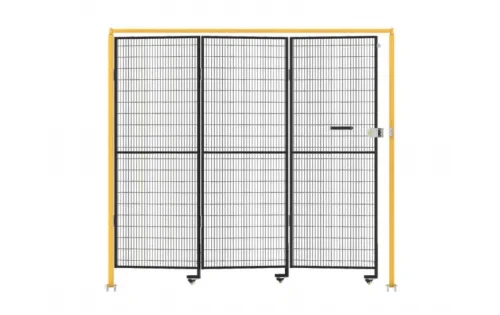

|
In a high-speed automotive assembly line or a robotic welding cell, a forklift collision with a safety guard is a matter of “when,” not “if.” When a panel gets crushed, you cannot afford a 4-hour shutdown for hot work and welding. You need a modular solution that gets your OEE (Overall Equipment Effectiveness) back to green in minutes. |
The “Hot Work” Nightmare vs. The Modular Reality
For System Integrators and Facility Managers in the automotive sector, the old way of fixing a damaged perimeter guard involved a grinder, a welding torch, and a “Hot Work Permit.” In an environment filled with hydraulic oils and sensitive electronics, this often means shutting down adjacent cells, covering robots with fire blankets, and waiting for safety approvals. This process destroys your production Takt time.
The answer to the title is a resounding YES. With the Valla de Seguridad Industrial Mdfence system, replacing a damaged section is a mechanical assembly task, not a construction project.

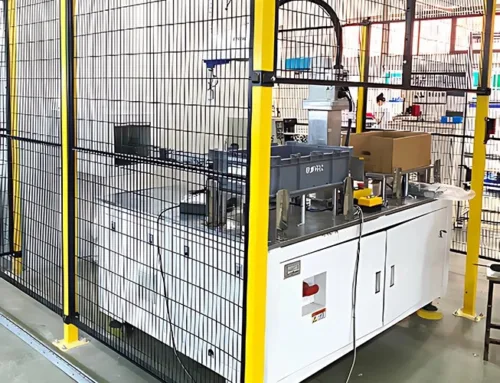
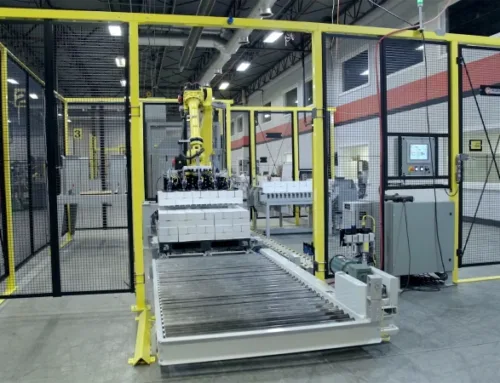
Complex robotic layouts require modular maintenance, not rigid welding.
Anatomy of a 10-Minute Swap: The Framed Mesh Advantage
Unlike “frameless” wire mesh that loses structural integrity when bent, our system uses a 20x30mm steel tube frame (Q235 Carbon Steel). When a forklift fork punctures or buckles a mesh panel, the damage is usually contained to that specific modular unit.
The Replacement Protocol for Maintenance Teams:
- Isolate the Cell: Perform standard Lockout/Tagout (LOTO) procedures on the robot controller.
- Assess the Post: Check if the 60x60mm post is compromised. Thanks to our heavy-duty M10 expansion bolts and welded base plates, the post often survives impacts that destroy the panel.
- Release the Clips: Use a standard Allen key to loosen the connection clips. There is no drilling or cutting required.
- Swap and Restart: Remove the damaged machine guarding fence panel, slot in the spare from your maintenance stock, and retighten. Total MTTR (Mean Time To Repair): less than 15 minutes.

Standardized connection clips allow for rapid panel removal without special tooling.
Protecting the Anchors: Don’t Let the Floor Crumble
In high-traffic logistics corridors where AGVs and forklifts operate alongside the fence, the weakest link is often the concrete floor. If a post is ripped out, re-drilling into cracked concrete is a nightmare.
To mitigate this in your layout design, we recommend integrating our Post Base Protective Covers. These act as a sacrificial buffer for low-level impacts (like pallet jacks), preserving the integrity of the chemical or mechanical anchors. This ensures that when a major impact happens, you are replacing steel parts, not pouring new concrete.

Protective covers shield the anchors from direct impact, simplifying maintenance.
FAQ: Maintenance & Compliance in Automation Cells
Q1: If we replace a mesh panel with a Polycarbonate panel (for welding flash protection), do we need new posts?
No. Our Valla de Seguridad Industrial system is universal. The same clips and posts accommodate mesh, sheet metal, or polycarbonate panels, allowing you to upgrade a cell’s function without rebuilding the structure.
Q2: Does replacing a panel affect our ISO 14120 compliance?
As long as you replace it with an OEM Mdfence panel of the same dimensions and mesh aperture (e.g., 20x100mm for finger safety), your safety distance calculations (ISO 13857) and impact resistance certification remain valid.
Q3: A forklift bent the door frame. Can we replace just the door leaf, or do we need to replace the interlock integration?
You can replace just the door leaf. Our pre-drilled mounting plates for safety switches (Omron/Keyence/Sick) can be transferred to the new frame, provided the alignment is recalibrated during installation.
Q4: Do you keep stock of standard panels for “Just-in-Time” delivery?
Yes. We understand that downtime costs in automotive assembly are calculated in thousands of dollars per minute. We maintain stock of standard 2000mm height components for rapid dispatch.
Q5: What tools does my maintenance team need for a panel swap?
A standard set of metric Allen keys (hex wrenches) and a 17mm/19mm wrench for the anchor bolts (if checking tightness). No welding equipment, grinders, or paint touch-up kits are required.