ES
ES  EN
EN  DE
DE  RU
RU  PT
PT  JA
JA  IT
IT 

When engineering dedicated manufacturing lines or complex robotics layouts, relying solely on optical area scanners leaves your high-speed mechanical assembly machines vulnerable. Laser scanners can trigger a Safety Torque Off (STO), but they cannot stop a 220 lbs ejected workpiece from a CNC milling center or prevent a rogue forklift from crushing a 6-axis robot. You need a physical barrier that guarantees absolute isolation, integrates seamlessly with your PLC, and minimizes your footprint.
The Illusion of Optical Safety in High-Speed Assembly
In automotive automation and precision machining, system integrators often debate between optical area scanners and physical Sistemas de Protección de Máquinas. The “Before” scenario is a common headache: An integrator installs area scanners around an automatic high-speed manufacturing line to save space. However, during a high-speed turning operation, a tool breaks. The optical field detects the flying debris and commands the machine to stop, but inertia dictates otherwise. The shrapnel flies straight through the invisible laser field, damaging ancillary equipment or, worse, striking an operator.
Furthermore, area scanners in welding stations are notorious for “nuisance trips.” Welding sparks, heavy dust, or even a worker leaning too close can trigger false stops, plummeting your Overall Equipment Effectiveness (OEE).

The Logic: Why Physical Fencing is Irreplaceable
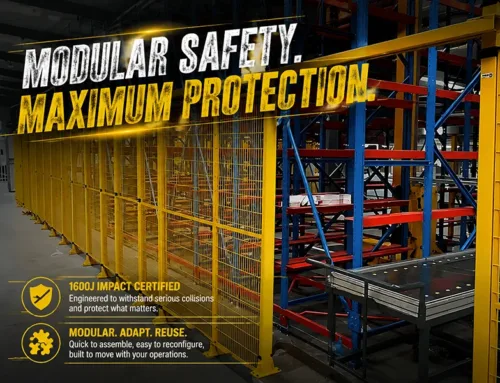
This is where the structural integrity of Vigilancia Perimetral Industrial becomes non-negotiable. Mdfence is engineered specifically for these harsh realities. Unlike flimsy wire mesh, our framed panels utilize a 20x30x1.5mm seamless steel tube frame with fully flattened weld points.
The Physics of Protection: Our Q235 carbon steel system is TUV certified to withstand 1600 Joules of impact. In practical terms, it acts as an energy-absorbing crumple zone that can halt a 220 lbs mass moving at 12.4 mph. Instead of brittle fracture, the steel undergoes plastic deformation, keeping the hazard contained.
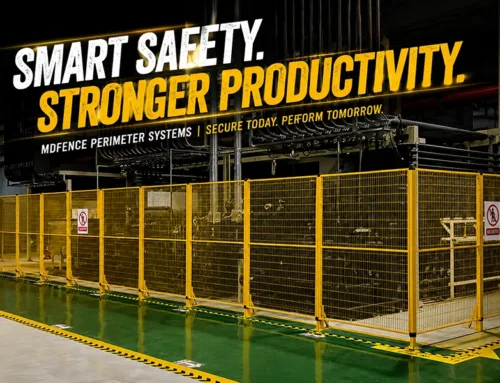
Reclaiming Floor Space: Area scanners require massive safety distances (often exceeding 30 to 70 inches) to account for human approach speeds before the machine fully halts. Mdfence’s 20x100mm mesh design is “finger-safe” according to ISO 13857 standards. This allows you to install the Valla de seguridad industrial just 4.7 inches (120mm) away from the hazard zone, instantly reclaiming premium square footage for additional robotic work cells or material handling pathways.

Seamless Integration with Control Equipment
For system integrators, a fence is useless if it cannot communicate with the PLC. In the past, engineers had to perform “hot work” on-site—drilling and welding custom brackets onto painted posts to mount safety interlocks, ruining the powder coating and risking corrosion.
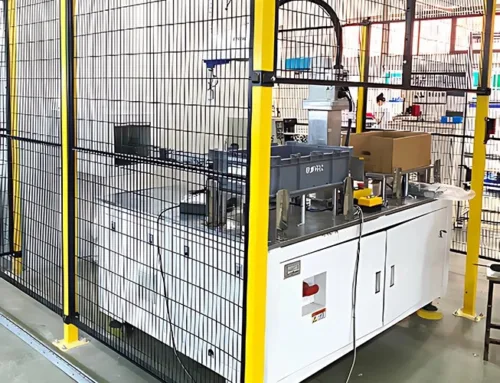
Mdfence transforms the physical barrier into an active node in your control system. We provide pre-engineered installation carriers (such as the KKCK-LCK-B-D4NL-SET) designed explicitly for industry-standard electro-optical elements and safety switches like Omron D4NL or Pizzato. When an operator opens the access door to a robotics layout, the mechanical separation forces the STO, physically and logically isolating the cell.
The “After”: Uninterrupted OEE and Rapid Reconfiguration
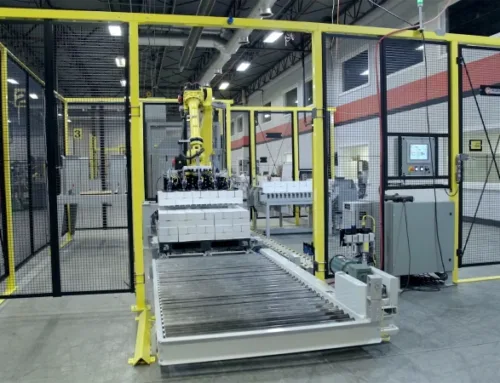
By replacing or supplementing area scanners with Sistemas de Vallado de Seguridad para Robots, the daily operational headaches vanish. Your CNC centers and high-speed assembly lines are no longer plagued by false stops caused by environmental interference.

When your “build to print” project requires a layout change, the modular design shines. Utilizing simple M8 flange bolts and fixing rings, your maintenance team can dismantle and reconfigure the entire perimeter without a single spark or drop of welding slag, ensuring 100% asset reusability and minimizing Mean Time To Repair (MTTR).
Technology Comparison Matrix
| Feature / Capability | Optical Area Scanners | Mdfence Physical Guarding |
|---|---|---|
| Resistencia al impacto | Zero. Cannot stop ejected parts or forklifts. | 1600 Joules (TUV Certified). |
| Required Safety Distance | Large (Depends on approach speed, often > 40 inches). | As close as 4.7 inches (120mm) due to 20x100mm mesh. |
| Environmental Sensitivity | High. Prone to nuisance trips from dust, sparks, and light. | None. Operates flawlessly in heavy machining environments. |
| Control System Integration | Direct logic integration. | Pre-engineered brackets for Omron/Pizzato interlocks. |
Frequently Asked Questions in Automation Integration
1. Can Mdfence be integrated with our existing PLC and Safety Light Curtains?
Yes. The modular structure is designed to act as a physical carrier for control equipment. We provide specialized 80x80mm posts with internal routing for light curtains, and pre-drilled mounting plates for standard safety interlocks, ensuring a seamless connection to your emergency stop circuits.
2. How does the 20x100mm mesh help with our robotics layout space constraints?
According to ISO 13857, the reach distance is dictated by the opening size. Standard 50x50mm mesh requires you to place the fence up to 33.5 inches away from the hazard. Our 20x100mm “finger-safe” mesh restricts penetration, allowing you to install the barrier just 4.7 inches (120mm) from the moving mechanical assemblies, saving significant floor space.
3. We have forklifts operating near the CNC turning centers. Will this fence survive a collision?
The system is constructed from high-tensile Q235 carbon steel and anchored with M10 expansion bolts. It is TUV certified to withstand a 1600 Joule impact. In the event of a severe forklift collision, the steel will deform plastically to absorb the kinetic energy rather than shattering, protecting your high-speed assembly machines.
4. Does the installation require hot work permits on the factory floor?
No. Mdfence is a 100% cold-assembly system. Panels connect to posts using metal fixing rings and M8 flange bolts. This eliminates the need for on-site welding, preventing sparks, fumes, and the need for fire watches, which is critical when installing around sensitive electro-optical elements.
5. What happens if our dedicated manufacturing line needs to be expanded next year?
The “design for automation” modularity means the system has a near 100% asset reuse rate. You can easily unbolt the panels, move the posts, and reconfigure the perimeter to accommodate new conveyors or robot stations without discarding any of the original materials.