ES
ES  EN
EN  DE
DE  RU
RU  PT
PT  JA
JA  IT
IT

|
Nuisance tripping and misaligned interlock switches are the silent killers of OEE in automotive robotic cells. When you are integrating high-speed assembly lines or CNC machining centers, relying on flimsy wire mesh and onsite drilling for safety switches leads to sagging doors, broken Safety Torque Off (STO) circuits, and costly downtime. You need a pre-engineered physical barrier that seamlessly handshakes with your PLC logic without the integration headache. |
The Hidden Cost of “DIY” Interlock Integration on the Plant Floor
In the world of robotics integration, the physical Protección de Máquinas is often treated as an afterthought compared to the servo motors and vision systems. System integrators frequently purchase cheap, frameless wire mesh. The nightmare begins during the installation phase: technicians are forced to use hand drills on painted steel posts to mount heavy-duty safety interlocks (like Omron D4NL or Pizzato switches).
This “DIY” approach creates metal shavings that threaten nearby servo drives, destroys the powder coating, and invites rust. Worse, because frameless doors lack structural rigidity, they sag under their own weight after just a few months of operators entering the cell for LOTO (Lockout/Tagout) procedures. The actuator key misaligns with the switch body, the PLC registers a safety fault, and your multi-million-dollar automated welding station grinds to a halt. Every minute of this nuisance tripping bleeds cycle time and skyrockets your MTTR (Mean Time To Repair).
The Mdfence Logic: Engineered for Seamless Safety Torque Off (STO)
To eliminate these integration bottlenecks, an Valla de Seguridad Industrial system must be designed as an active component of the machine safety circuit, not just a passive cage.
Rigid Framed Panels Eliminate Door Sag
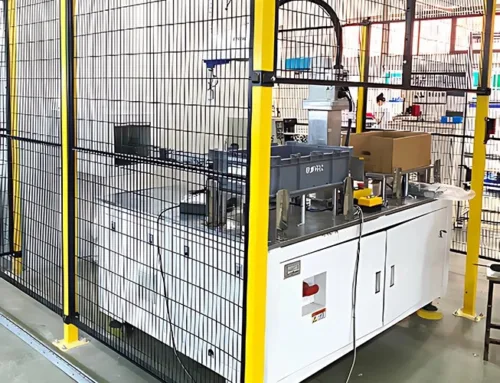
Unlike standard fencing, the Mdfence system utilizes a 0.78″ x 1.18″ (20x30mm) continuous tubular steel frame for every door panel. This out-of-plane stiffness guarantees that even a 59-inch (1500mm) wide hinged door will not sag over time. The structural integrity ensures that the interlock actuator key hits the switch dead-center every single time an operator closes the door, maintaining a closed STO circuit and preventing arbitrary machine stops.
Pre-Engineered Safety Interlock Carriers
We engineered the guesswork out of the installation. Mdfence provides standardized lock carriers (such as the KKCK-LCK-B-D4NL-SET) specifically pre-drilled and tapped for industry-standard third-party interlocks.

As shown above, the L-shaped safety switch mounting accessories bolt directly onto the 2.36″ x 2.36″ (60x60mm) Q235 carbon steel posts using modular fixing rings. There is zero onsite drilling, zero hot work, and zero exposed metal. Your integration team can mount the electrical accessories in minutes, ensuring full compliance with ISO 14120 and OSHA machine guarding standards.
Door Configurations for Dynamic Manufacturing Layouts
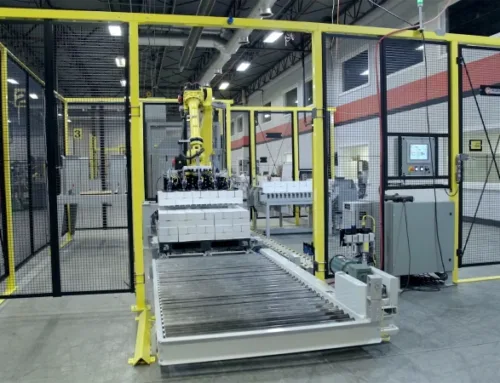
Automotive layouts and CNC machining centers are notoriously tight on floor space. A standard swing door might clash with an AGV path or a conveyor line. To accommodate high-speed mechanical assembly machines, your Valla de Seguridad para Robots needs adaptable access points.

For areas requiring forklift access to load heavy engine blocks or tooling, double sliding doors (up to 169 inches / 4300mm wide) are the optimal solution. Mounted on heavy-duty bearing rails, these doors slide smoothly without consuming valuable aisle space. When integrated with a robust safety interlock, the PLC instantly halts the robotic cell the moment the slide bolt is disengaged, ensuring absolute operator safety without compromising material handling efficiency.
Frequently Asked Questions (FAQs)
| Can I mount my own Omron or Pizzato safety interlocks on this fence? | Yes. We provide pre-engineered Safety Interlock Carriers (e.g., KKCK-LCK-B-D4NL-SET) that match the exact hole patterns of standard Omron and Pizzato switches. This allows for plug-and-play integration with your PLC without onsite drilling. |
| Will the hinged doors sag over time and cause nuisance tripping? | No. Our doors are constructed with a 20x30mm tubular steel frame, fully welded to the mesh. This rigid structure prevents the sagging common in frameless wire mesh, ensuring the interlock actuator remains perfectly aligned with the switch body. |
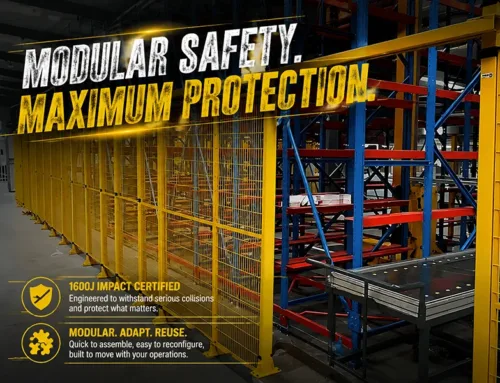
| How does this fencing withstand a robot crash or ejected CNC parts? | The system is built from high-tensile Q235 carbon steel and is TUV certified to withstand impacts up to 1600 Joules (approx. 1180 ft-lbs). The impact energy is safely dissipated through the modular clips and down to the floor anchors. |
| Does the installation require hot work permits on the assembly line? | Absolutely not. The entire system is modular and assembles using M8 flange bolts and fixing rings. It is a 100% cold assembly process, meaning no welding spatter, no grinding dust, and no need to halt nearby automation equipment during installation. |
| Is the mesh gap compliant with ISO 13857 for finger safety? | Yes. Our standard mesh spacing is 0.78″ x 3.93″ (20x100mm). This narrow gap prevents operators from reaching through the fence, allowing you to install the barrier as close as 4.7 inches (120mm) to the hazard zone, saving valuable factory floor space. |