ES
ES  EN
EN  DE
DE  RU
RU  PT
PT  JA
JA  IT
IT

|
Struggling to get your new turnkey robotic welding cell past the plant’s EHS audit? You are not alone. Navigating OSHA 1910.212 requirements for machine guarding often leaves automation system integrators trapped between rigid compliance and the need for high-speed material flow. Let’s break down exactly what OSHA demands for your automated production lines, and how to engineer a foolproof physical perimeter without sacrificing your Overall Equipment Effectiveness (OEE) or dealing with the nightmare of on-site hot work. |
Understanding OSHA 1910.212 for Automated Production Lines
Under OSHA standard 1910.212, any machine part, function, or process that may cause injury must be safeguarded. For a modern facility running CNC machining centers or 6-axis industrial robots, this means protecting operators from the point of operation, ingoing nip points, rotating parts, and flying chips or sparks. A compliant Machine Guarding System must be a permanent part of the machine layout, prevent workers from reaching around, under, through, or over the barrier, and must not create new hazards (like sharp edges or shear points).
The Integrator’s Nightmare: Sagging Mesh and Nuisance Trips (Before)
Picture this: You just finished commissioning a high-speed mechanical assembly machine. To save costs, the procurement team ordered cheap, frameless wire mesh from a local fabrication shop. During the test run, a worker leans against the fence, and the mesh permanently deforms. Worse, the standard 2×2 inch (50x50mm) mesh fails the ISO 13857 reach-through test. The EHS manager pulls out their safety gauge and forces you to push the entire perimeter back by 33 inches (850mm). Suddenly, your AGV (Automated Guided Vehicle) aisle is too narrow, creating a massive logistical bottleneck.
Then comes the integration phase. Your electrical team needs to mount Omron D4NL safety interlocks to tie the doors into the PLC’s safety circuit. Because the cheap fence has no pre-engineered mounting plates, your guys are out there with hand drills, punching holes into painted posts on the facility floor. Metal shavings fly everywhere, paint chips off, and within three months, those drill holes become rust traps. Due to the weak door frame, the hinges sag over time, the safety switch misaligns, and the robot randomly halts production. Every minute of that Mean Time To Repair (MTTR) eats directly into your profit margin.
The Engineering Logic: Built for the Factory Floor (Why It Works)
To eliminate these integration headaches, Valla de Seguridad Industrial must be engineered as a precision mechanical component, not just a static wall. The Mdfence system is built on an uncompromising structural foundation designed specifically for heavy industrial environments.

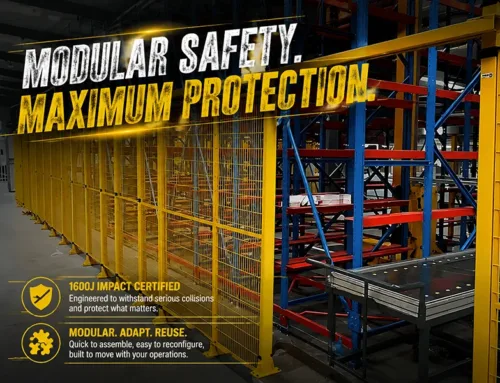
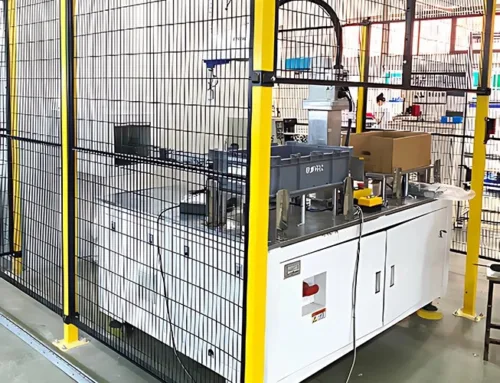
Structural Integrity: Instead of flimsy wire, every panel utilizes a 0.78″ x 1.18″ (20x30mm) Q235 carbon steel tubular frame. The 0.12″ to 0.15″ (3.0-4.0mm) wire is flat-welded to the frame, eliminating sharp burrs that could snag uniforms or scratch operators. When anchored to the concrete via 2.36″ x 2.36″ (60x60mm) posts, the system achieves a TUV-certified impact resistance of 1600 Joules. If a 220 lbs (100kg) workpiece is ejected from a lathe at 12.4 mph (20 km/h), the Q235 steel absorbs the kinetic energy through plastic deformation, containing the flying debris without shattering.
Finger-Safe Dimensions: We utilize a narrow 0.78″ x 3.93″ (20x100mm) slotted mesh design. According to ISO 13857, this restricts penetration to just the fingertips. This simple physics application allows you to legally install the fence a mere 4.7 inches (120mm) away from the hazard zone.
Reclaiming Space and Maximizing OEE (After)
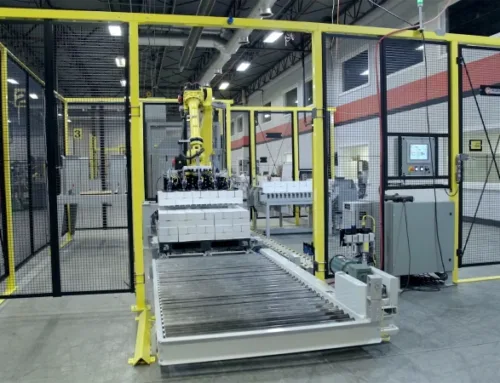
By upgrading to a modular Robot Safety Fencing System, the transformation on the plant floor is immediate. Reclaiming those 33 inches around every robotic cell instantly widens your forklift and AGV pathways, optimizing material handling routes.

When it comes to access, our double hinged doors are equipped with caster wheels and top frame beams. This guarantees the door geometry remains perfectly square over thousands of cycles. Your pre-engineered lock carriers (compatible with Omron or Pizzato) align flawlessly every single shift. No more nuisance trips. No more phantom machine faults. Furthermore, the 100% bolt-on assembly means zero hot work on site. You can reconfigure a CNC cell over the weekend using nothing but a hex wrench, keeping your capital assets completely reusable.
Accommodating Heavy Material Handling
In automotive assembly and heavy metalworking, moving pallets of raw materials in and out of the danger zone requires massive clearance. Standard doors simply don’t cut it when a forklift needs to drop a tooling jig into the cell.

For areas with limited swing space but high-width requirements, double sliding doors on high-grade bearing rails provide up to 14.1 feet (4300mm) of unobstructed access. This allows forklifts to maneuver safely without clipping the perimeter guarding, while the integrated safety interlocks ensure the machinery remains in a safe Torque-Off state until the doors are securely closed and the LOTO (Lockout/Tagout) process is cleared.
Hardware Integration for Active Safety
A physical barrier is only half the OSHA equation; the other half is logic control. Your fence must seamlessly integrate with the machine’s safety circuit.

With standardized installation steps for hinges, door stops, handles, and lock carriers, our systems bridge the gap between mechanical guarding and electrical safety. The rigid Q235 steel posts provide a vibration-free mounting surface for your electrical accessories, ensuring that your automated high-speed manufacturing lines comply with ANSI/RIA R15.06 without bogging down your installation crew.
Frequently Asked Questions (FAQs)
1. How far does a machine guarding fence need to be installed from a 6-axis industrial robot?
Per ISO 13857, the safe distance depends on the mesh opening size. Our 20x100mm slotted mesh restricts access to fingertips only, allowing the fence to be legally installed as close as 4.7 inches (120mm) from the hazard, saving valuable floor space compared to standard 50x50mm mesh.
2. Can we mount our required Omron D4NL safety interlocks directly to the fence?
Yes. We provide pre-engineered lock carriers (e.g., KKCK-LCK-B-D4NL-SET) designed specifically for industry-standard switches like Omron and Pizzato. This eliminates the need for on-site drilling and ensures perfect alignment for your PLC safety circuits.
3. Does installing your perimeter guarding require a hot work permit?
No. The entire system is 100% modular and utilizes a cold-assembly bolt-on design. You can assemble, modify, or expand the fencing around your CNC machining centers using standard hand tools without generating welding sparks or smoke.
4. What happens if a forklift or an AGV accidentally bumps the fence panels?
Our system features a TUV-certified impact resistance of 1600 Joules. The fully welded Q235 carbon steel tubular frames and heavy-duty floor anchors will absorb the kinetic energy through plastic deformation, preventing the barrier from collapsing into the robotic cell.
5. How do we load heavy engine blocks into the robotic cell if the fence is in the way?
For overhead crane operations, we utilize a top-open layout. If material is fed via conveyors, we engineer custom tunnel guards that comply with OSHA reach-through standards, allowing the product to pass while strictly keeping personnel out.