ES
ES  EN
EN  DE
DE  RU
RU  PT
PT  JA
JA  IT
IT 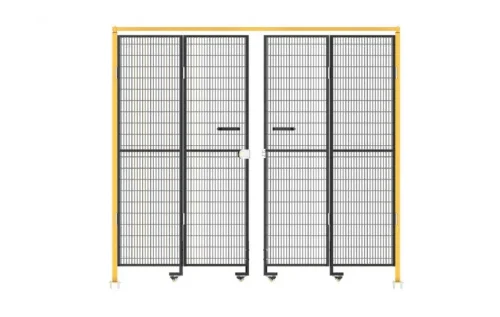
 |
Your custom automation system is a masterpiece of engineering. But will it be held up at the client’s site by a non-compliant, locally-fabricated safety cage? The risk of failed EHS audits, costly on-site modifications, and delayed payments for your export machinery is real. |
The Export Integrator’s Nightmare: When “Local Sourcing” Fails at the Goal Line
As a system integrator, you deliver precision. Your robotic cells, assembly lines, and turnkey solutions are specified down to the last millimeter. Yet, a common “cost-saving” measure often introduces the biggest risk: specifying “locally fabricated” safety fencing at the client’s international facility. The idea seems sound until your installation team is 5,000 miles from home, facing a “cage” built by a local workshop that threatens to derail the entire project. The welds are poor, the mesh size is a clear violation of ISO standards, and the only tool you have to fix it is an angle grinder and a can of spray paint. This isn’t just an inconvenience; it’s a direct threat to your project timeline, budget, and reputation.
Why Traditional Fencing Creates Unpredictable Risks for Export Machinery
The “weld-it-on-site” approach introduces three critical points of failure for any high-value machinery export project:
- Compliance Roulette: Local fabricators, however skilled, are rarely experts in global machine safety standards like ISO 14120 or ANSI/RIA R15.06. They might use a 50x50mm mesh, which seems strong, but it allows fingers and hands to get too close to the hazard. This forces an enormous safety distance (up to 850mm), wasting the client’s valuable floor space and guaranteeing a failed EHS audit.
- The Hidden Costs of “Hot Work”: On-site welding is a Pandora’s box of hidden costs and delays. It requires special “hot work” permits, forces the client to shut down adjacent production, and creates fire hazards. The resulting fumes, grinding dust, and messy, hand-painted finish are unacceptable in any modern manufacturing facility, especially those in the automotive or electronics supply chain.
- Logistical & Financial Burdens: If you choose to pre-fabricate and ship, the costs are equally punishing. Bulky, pre-welded fence sections are a logistical nightmare. They consume vast amounts of expensive container space, are highly susceptible to damage during transit, and offer zero flexibility if the client’s floor plan has a last-minute change.
A Modular, Compliant System: De-Risking Your Global Deployments
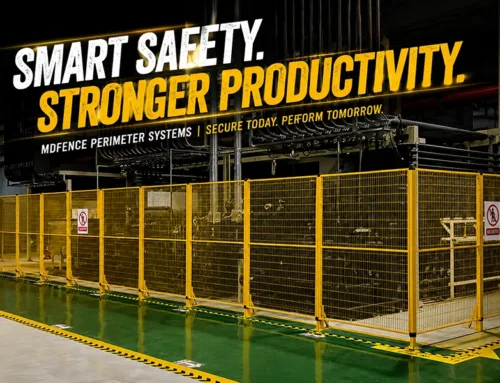
The solution is to treat Protección de Máquinas not as a commodity but as an engineered system—one that is designed for global compliance and logistical efficiency from the ground up. The Mdfence system is built on this principle, transforming safety fencing from a project risk into a competitive advantage.
Engineered for “Cold Assembly” and Rapid Deployment
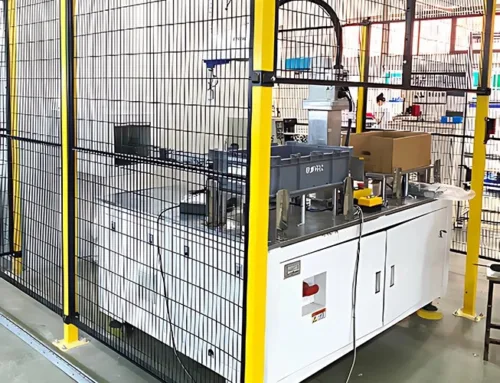
Our entire system is designed for “cold assembly.” Every component, from the robust Q235 carbon steel posts to the framed mesh panels, connects with high-strength bolts. This completely eliminates the need for on-site welding, grinding, or painting. A two-person team equipped with only basic hand tools can install over 150 feet (approx. 50 meters) in a single day. This means your installation is predictable, fast, clean, and repeatable, whether your project is in Ohio, Shanghai, or Munich.

Built-in Compliance That Saves Space and Passes Audits
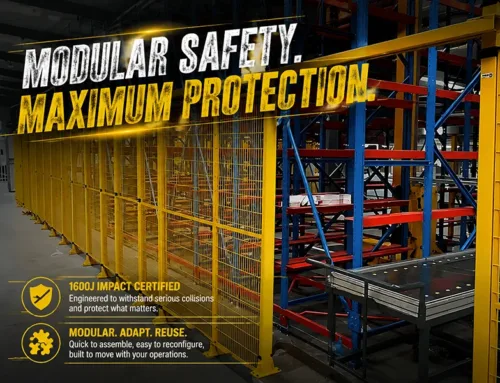
We’ve engineered compliance into the very DNA of our product. Our standard 20x100mm mesh aperture is a critical feature. According to ISO 13857, this “finger-safe” design allows the barrier to be placed as close as 120mm (4.7 inches) from the hazard. Compared to the 850mm required for larger mesh, this can save nearly 8 square feet of floor space for every 10 feet of fencing—a massive benefit in a compact, high-value production cell. Furthermore, our system is certified to withstand 1600 Joules of impact, ensuring it provides real protection against ejected parts or equipment collisions.
Seamless Integration with Your Control System
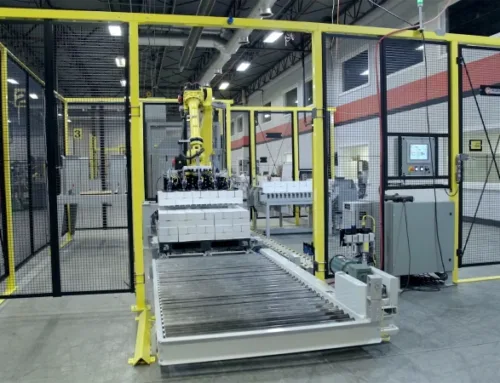
A modern Valla de Seguridad para Robots system is an active part of the machine’s safety circuit. We understand that you can’t waste hours on-site fabricating custom brackets for safety interlocks. That’s why we offer a range of pre-engineered mounting plates and lock carriers designed specifically for industry-standard switches from Omron, Pizzato, Schmersal, and others. This “plug-and-play” approach ensures your mechanical barrier integrates flawlessly with the PLC’s safety logic, saving invaluable engineering and commissioning time.

The Payoff: Predictable Costs, Faster Commissioning, and Zero-Hassle Handovers
Imagine your next international deployment. The complete Valla de Seguridad Industrial system for a complex multi-robot cell arrives on a single, neatly packed pallet, slashing your shipping costs. Your team assembles the entire perimeter in hours, not days. The pre-drilled holes for the Omron D4NL safety switch line up perfectly. When the end-customer’s EHS manager inspects the installation, they see the ISO-compliant mesh, the robust Q235 steel construction, and the professional, clean finish. They sign off on the first pass. Your project is commissioned on schedule, and the final invoice gets paid without delay. That is the predictability that an engineered fencing system delivers.
Frequently Asked Questions for System Integrators
1. Can you provide 3D CAD models (e.g., STP files) for our layout design?
Absolutely. We provide a complete library of 3D models for all our standard components. This allows your engineering team to integrate our fencing system directly into your master CAD layout, ensuring a perfect fit, identifying any potential interference, and generating an accurate Bill of Materials (BOM) from the start.
2. How does your system accommodate conveyors or other material pass-throughs?
We offer customized tunnel guards and cutouts that are designed to meet ISO 13857 standards for pass-through openings. We can modify our standard framed panels to create precise openings for your conveyors, ensuring that materials can pass through while preventing personnel access to the hazardous area.
3. What is the lead time for a standard system? We have an urgent project.
We maintain a significant inventory of our standard components (yellow posts, black mesh panels, and common door sizes). For urgent requirements, we can often ship standard configurations within a few business days, helping you meet tight project deadlines.
4. Our end-customer is in a humid, coastal environment. What is the corrosion resistance of your powder coating?
Our system uses a high-adhesion electrostatic powder coating over a properly prepared Q235 carbon steel substrate. This finish passes the ISO 9227 neutral salt spray test, providing excellent resistance to corrosion from humidity, industrial oils, and common solvents, ensuring long-term durability and appearance.
5. We need a very wide access point (e.g., 3 meters / 10 feet) for forklift or equipment access. What are our options?
We offer several solutions for wide openings. Our double-leaf hinged doors can span up to 3000mm (approx. 10 ft). For areas where swing space is limited, our sliding door systems are an ideal choice. And for very large or uniquely constrained spaces, we can provide multi-panel folding door systems that offer the maximum possible clear opening.