ES
ES  EN
EN  DE
DE  RU
RU  PT
PT  JA
JA  IT
IT

|
In the high-speed world of automotive assembly and robotic integration, a “cage” isn’t just a barrier—it’s part of the machine’s control logic. If your safety fencing delays the commissioning phase because it can’t integrate with third-party interlocks, or if a forklift nudge knocks a panel out of alignment causing sensor trips, your cycle time suffers. We engineer guarding that keeps your PLCs happy and your operators safe. |
Bridging the Gap Between Physical Barriers and Digital Safety Logic
In modern smart factories—specifically within automotive body shops (BIW) and tiered supplier assembly lines—the definition of safety has evolved. It is no longer enough to simply bolt down a steel grid. The physical guarding must function as a seamless extension of the automation system.
For System Integrators (SIs) and Plant Managers, the friction point often lies in the “Last 100 Feet” of the project: the integration of Valla de seguridad para máquinas with the electronic safety circuit. Standard fencing often forces installers to improvise on-site, drilling and tapping posts to fit specific safety switches, which compromises the powder coating and delays the FAT (Factory Acceptance Test).
Solving the Interlock Integration Headache
A robust safety fence must accommodate the “brain” of the safety system—the interlocks. Whether you are specifying Omron D4NL, Sick, or Pizzato switches, the mounting interface is critical. A common failure mode in robotic cells is the misalignment of the door key due to weak door frames or improvised mounting brackets.
Our solution eliminates this variable. Mdfence systems are designed with specialized Safety Interlock Carriers. These aren’t just holes drilled in a post; they are engineered mounting plates (like the KKCK-LCK series) designed to accept industry-standard interlocks without on-site fabrication. This turns the fence from a passive barrier into an active component of the machine’s E-stop circuit.

Figure 1: Specialized mounting accessories for safety switches ensure seamless integration with PLC logic.
Modular Layouts for Complex Robotic Cells
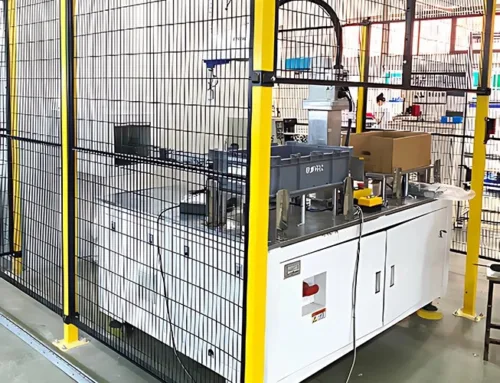
Automotive production floors are rarely perfect rectangles. You are often navigating around existing building columns, overhead cable trays, and AGV paths. A rigid “one-size-fits-all” panel system often leads to dangerous gaps or costly custom fabrication that halts installation.
To maintain Valla de Seguridad Industrial compliance (ISO 14120), the distance between the hazard and the guard is calculated based on reach-over and reach-through risks. Our modular design allows for precise configuration. We utilize a combination of standard panel widths and adjustable connection kits to navigate complex geometries—like a 45-degree turn around a rotary table or a tight enclosure for a CNC tending robot—without compromising the structural integrity required to stop ejected parts.

Figure 2: Complex layouts with multiple entry points and angled turns require a modular system that adapts to the floor plan, not the other way around.
Optimizing Access: Sliding vs. Hinged in Tight Spaces
In a smart factory, floor space is premium real estate. A large hinged door swinging out into a forklift aisle creates a new collision hazard. Furthermore, for cells requiring frequent material ingress/egress (like palletizing stations), the door mechanism must be robust enough to handle thousands of cycles.
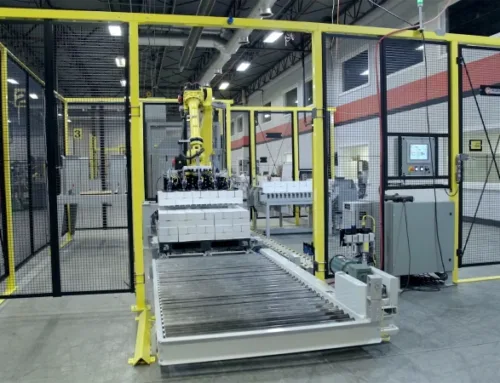
For high-traffic areas or constrained spaces, we recommend Valla de Seguridad para Robots equipped with sliding door systems. Our top-track sliding doors eliminate trip hazards on the floor (crucial for pallet jacks and AGVs) and use heavy-duty bearing rails to ensure smooth operation. For extremely wide openings—such as those needed for exchanging large injection molds—our folding door systems provide maximum clearance without the footprint of a massive sliding gate.

Figure 3: Single sliding door systems maximize aisle space while providing secure access to the automated cell.
Structural Integrity: The “Framed” Advantage
In an industrial environment, the fence serves two purposes: preventing entry and containing hazards. If a robotic arm throws a workpiece or a tool fails at high RPM, the guarding is the last line of defense. Flimsy wire mesh spot-welded directly to posts often fails under high-energy impact.
Mdfence utilizes Framed Panels. The steel mesh is welded into a 20x30mm tubular steel frame, which is then secured to 60x60mm Q235 Carbon Steel posts. This “frame-within-a-frame” architecture significantly increases rigidity and impact resistance. It ensures that even if a forklift bumps the perimeter, the fence absorbs the energy without deforming to the point where safety switches misalign or panels pop out.

Figure 4: Framed panel construction provides superior resistance to impact compared to frameless mesh designs.
Streamlined Installation for Tight Commissioning Schedules
We understand that by the time the safety fencing is being installed, the project is likely already under time pressure. Welding on the factory floor is often prohibited due to fire risks or requires time-consuming hot work permits.
Our system is 100% mechanical assembly. Using our specialized upper and lower fixation rings, panels snap into place and are secured with standard metric fasteners. This allows for rapid deployment and, crucially, easy disassembly if the production line needs to be reconfigured for a new car model or product variant.

Figure 5: The mechanical fixation system allows for rapid assembly without welding, accelerating project completion.
Frequently Asked Questions: Automation Safety
1. Can your fencing system integrate with our existing Omron or Allen-Bradley safety interlocks?
Yes. We view the fence as a carrier for your safety logic. We offer pre-engineered mounting kits (interlock carriers) compatible with major safety switch brands like Omron, Sick, and Pizzato. This ensures the switch and key align perfectly without requiring your team to fabricate brackets on site.
2. How do we determine the correct distance between the fence and the robot?
The safety distance is calculated based on ISO 13857 standards, factoring in the reach-through capability of the mesh opening and the stopping time of the machine. Our standard 20x100mm or 50x50mm mesh meets most requirements for preventing hand/finger intrusion, allowing the fence to be placed closer to the hazard to save floor space.
3. We have AGVs entering the cell. Do you have automated door options?
While our core offering is manual doors, our sliding and hanging door systems are designed with low-friction bearings that can be easily retrofitted with pneumatic or electric actuators by your system integrator to allow for automated AGV entry/exit.
4. Is the system durable enough for a welding environment?
Absolutely. For welding cells, we can replace standard wire mesh with sheet metal or polycarbonate (PC) panels to block UV arc flash and welding spatter. The Q235 carbon steel structure is powder-coated (RAL 1023/9005), providing excellent corrosion resistance against industrial fumes.
5. What happens if a forklift damages a post?
Because Mdfence is modular, you don’t need to cut out and re-weld a section. You can simply unbolt the damaged post or panel and replace it with a spare. This minimizes maintenance downtime and keeps your safety validation intact.