ES
ES  EN
EN  DE
DE  RU
RU  PT
PT  JA
JA  IT
IT 

|
When you are integrating a high-speed 6-axis robot arm, the “work envelope” isn’t just a line on a CAD drawing—it’s a high-risk zone. A standard wire mesh partition isn’t enough when you need to calculate stopping times and safety distances according to ISO 10218. You need a perimeter that integrates seamlessly with your safety PLC logic and withstands high-energy impacts without compromising the cell’s footprint. |
The Reality of Guarding Multi-Axis Robot Cells
In the world of automated assembly and system integration, the physical barrier is often the last piece of the puzzle, yet it causes the most headaches during commissioning. Whether you are deploying a FANUC spot welding cell or an ABB material handling unit, the challenge remains the same: How do you secure the kinetic energy of the robot while maintaining accessibility for teaching and maintenance?
Generic fencing often fails in two areas: rigidity under impact and integration with safety interlocks. A flimsy fence triggers false E-stops due to vibration, and a lack of proper mounting plates forces your electrical team to fabricate brackets on-site, delaying the FAT (Factory Acceptance Test). Our Valla de seguridad para máquinas is engineered specifically to solve these integrator-level problems.

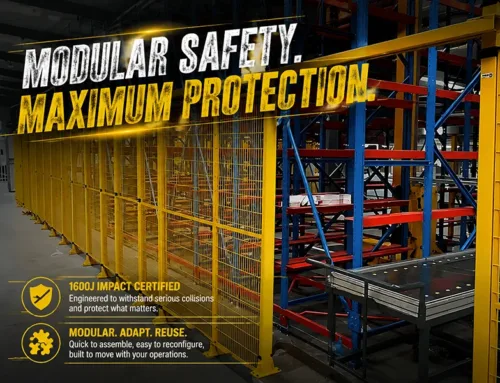
Figure 1: High-rigidity framed panels essential for robot impact containment.
Structural Integrity: Beyond the Visual Barrier
A multi-axis robot doesn’t just pose a pinch-point hazard; there is a risk of flung workpieces or manipulator collision. The Mdfence system utilizes Q235 Carbon Steel with a framed panel design (20x30mm frame). Unlike “frameless” mesh that can deform easily, our Valla de Seguridad para Robots creates a rigid structural cage.
The TUV-certified impact resistance ensures that if a robotic arm over-travels or a heavy automotive part is ejected, the barrier holds. This structural rigidity is also critical for maintaining the precise alignment required for safety light curtains and door sensors. A wobbly fence means misaligned sensors, leading to nuisance tripping and downtime on the production line.
Seamless Integration with Safety Interlocks
For system integrators, the “pain” is often in the details. Mounting a complex solenoid interlock (like an Omron D4NL or Pizzato FS series) to a round post or a thin wire mesh is a nightmare. It usually involves makeshift brackets that look unprofessional and can loosen over time.
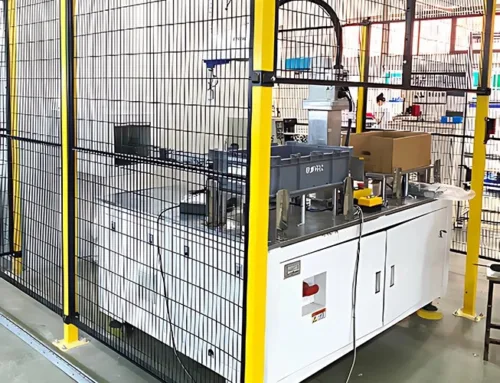
We treat the fence as an active part of the safety circuit, not just steel. We provide pre-engineered Safety Interlock Carriers (e.g., KKCK-LCK-B-D4NL-SET). These are specialized mounting plates designed to fit specific industry-standard switches perfectly. This allows your electrical technicians to mount the interlock and the actuator key quickly, ensuring the door serves as a reliable E-stop trigger for the robot controller.

Figure 2: Dedicated mounting solutions for safety interlocks and mechanical locks.
Optimizing Floor Space with Smart Access
In automotive assembly lines, floor space is premium real estate. A large swing door (hinged door) might block an AGV path or interfere with an operator station when opened. For these scenarios, our Vigilancia Perimetral Industrial system offers robust sliding door options.
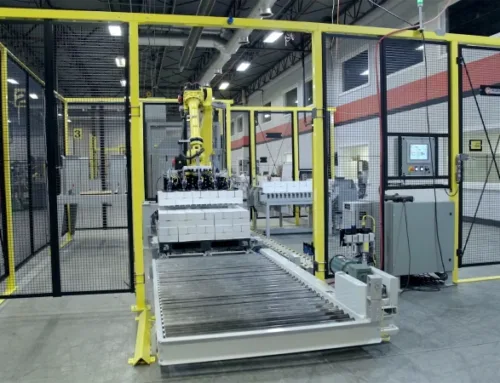
Our sliding doors utilize a top-track system with bearing rails, ensuring smooth operation even for wide openings (up to 4300mm for double doors). This allows you to bring in a forklift for heavy die changes or robot maintenance without requiring a massive clearance radius for the door swing.

Figure 3: Double sliding doors facilitate large equipment access in tight robot cells.
Conclusion: A Turnkey Safety Asset
Don’t let the perimeter guarding be the bottleneck of your automation project. By choosing Mdfence, you are selecting a system that understands the rigors of robotics integration. From the Q235 steel construction to the specific interlock compatibility, we help you meet safety standards while keeping your project timeline on track.
Preguntas Frecuentes
1. Can your fencing integrate with Omron or Keyence safety interlocks?
Yes, we provide specialized “Safety Interlock Carrier” kits (e.g., KKCK-LCK-B-D4NL-SET) designed to mount third-party switches like Omron, Pizzato, and Keyence directly to our doors and posts without on-site fabrication.
2. What is the standard height for robot cell guarding?
Our standard post height is 2000mm (approx 6.5 ft), which is industry standard for preventing reaching over into the hazard zone. However, we can customize heights up to 2440mm (8 ft) for high-risk robot applications.
3. How do you handle robot “over-travel” risks?
Our system is built with Q235 carbon steel and framed panels that are fully welded. This construction is TUV certified for high impact resistance, designed to contain parts or machinery in the event of a control failure.
4. Can I get a custom layout for a complex automated line?
Absolutely. As shown in our case studies with automation integrators, we can work from your CAD drawings to produce a kit that fits specific footprints, including 45-degree angles and cutouts for conveyors.
5. Does the fencing interfere with light curtains?
No. The rigidity of our 60x60mm posts ensures that the structure does not vibrate or sway, providing a stable mounting surface adjacent to light curtains or area scanners to prevent false trips.