ES
ES  EN
EN  DE
DE  RU
RU  PT
PT  JA
JA  IT
IT Machine guarding · safety device integration
Interlock Switch Mounting Without Drilling: Why Alfence T-Slot Posts End Phantom Stops
A robot cell, a hinged guarding door and an interlock switch are only as reliable as the alignment between the door and the switch tongue. When that switch bracket is bolted to a powder-coated steel post, every retrofit drills through the coating, drops swarf inside the cell and leaves a bare-metal seed for corrosion. Alfence replaces that detail with a T-slot aluminum post that carries interlocks, e-stops and conduit inside the profile groove.
The failure usually surfaces as an unexplained Safe Torque Off at shift start: the door has settled, the tongue no longer sits square in the switch, and the PLC reports a guard fault instead of a mechanical one. Fixing it by re-drilling the post adds a second hole, a second bare edge and a second rust line — and the door keeps sagging.
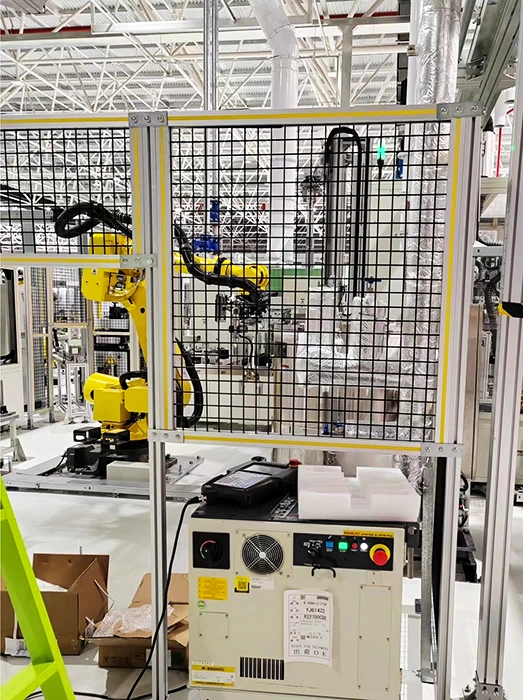
T-slot post and safety hardware: what the retrofit actually installs
On welded steel guarding, the switch bracket, the e-stop box and the cable conduit are all drilled into the post. The drilling damages the coating, the chips land on machine ways or inside a control cabinet, and the bare hole starts to bleed rust within a season. Under a heavy hinged door the post and hinge plate also work loose, which is the mechanical origin of most intermittent guard faults: the tongue loses its toleranced position and the safety circuit drops out while the machine is healthy.
| Element | Alfence reference |
|---|---|
| Guarding post | 40×40 mm or 45×45 mm aluminum profile, 0–2200 mm; 4040B ≈1.8 kg/m, 4040P ≈2.0 kg/m |
| Sensor / e-stop / conduit mounting | T-slot groove in the profile; brackets lock in the slot, no drilling of the post face |
| Panel | 20×100 mm welded wire mesh; standard frame 20×20 mm with 3 mm wire; reinforced frame 20×30 mm with 3.5 mm wire |
| Panel options | Wire mesh, PC, solid sheet or acrylic transparent panel; plastic panel heat resistance ≈≤60 °C |
| Surface build-up | Shot blasting, then powder coating cured at 185 °C for 15 min; profile extruded at ≈480 °C, ≈3000 t press |
| Hinged safety door | Single leaf up to 1500 mm, double leaf up to 3000 mm; folding 2100 / 4500 mm; telescopic 1500 / 3000 mm |
| Sliding / linear door | Double-leaf sliding reference 4300 mm; linear or caster door up to 4000 / 6000 mm |
| Handle position | 1050 mm from floor, or 1100 mm from the top rail; magnetic handle available |
| Interlock hardware | Safety lock (bolt type or universal type, both with safety switch); Schmersal AJM150, 1500 N holding force, matched to 40×40 profile |
| Light curtain | 150–1800 mm length reference, operating range -10 °C to +60 °C |
| Floor fixing | Foot connector / base plate with expansion bolt; M8 reference hole ≈10 mm |
Three details that remove the intermittent guard fault
No drilling, no swarf, no rust line on the post
The slot in a 40×40 mm or 45×45 mm aluminum post is a mounting surface in its own right. Interlock brackets, e-stop enclosures, junction boxes and cable conduit all clamp into that groove, so the powder-coated face is never penetrated, no chips fall into an open machine, and the coating that resists corrosion in a coolant or washdown area stays intact. Where a sensor still needs a drilled interface, M8 hardware with an ≈10 mm reference hole keeps the intervention predictable rather than improvised on site.
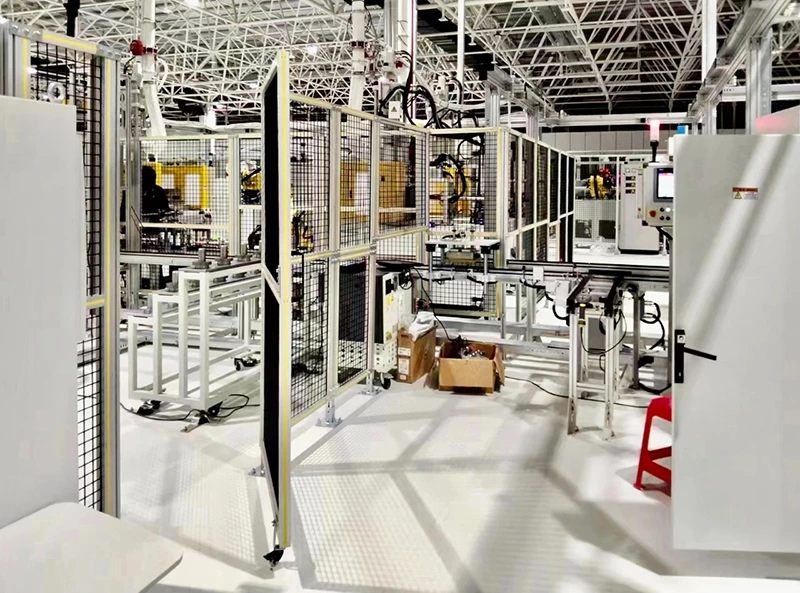
Door hardware that keeps the interlock tongue in place
A guard fault caused by a sagging leaf is a mechanical problem, not an electrical one. Alfence hinged doors are sized within the modular system — single leaf up to 1500 mm, double leaf up to 3000 mm — with folding, telescopic and linear or caster door options where a sliding leaf suits the aisle. Handles sit at a repeatable 1050 mm from the floor, and the frame accepts a Schmersal AJM150 with 1500 N holding force on the 40×40 profile. Because the leaf, hinge point and lock plate belong to the same profile family, the tongue returns to the same position after every open and close.
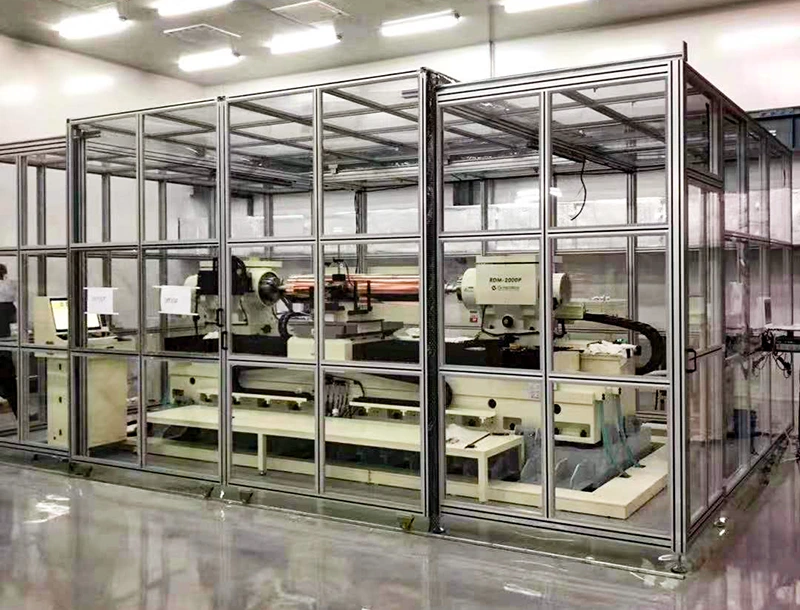
Interlock, e-stop and cable routing planned as one perimeter
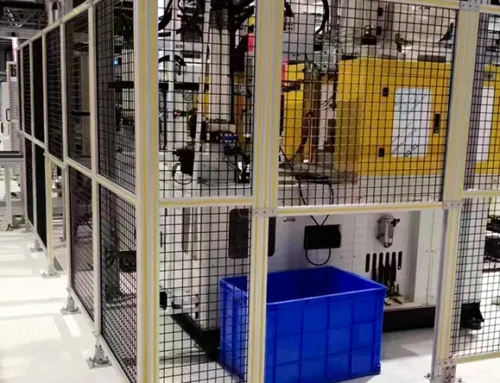
Transparent PC or acrylic panels and mesh panels can be mixed in the same run, so a light curtain (150–1800 mm reference, -10 °C to +60 °C) and a safe-lock door can sit side by side on one continuous boundary. Conduit runs inside the perimeter framework instead of across the machine, which matters on a long production line where several access points share one safety circuit.
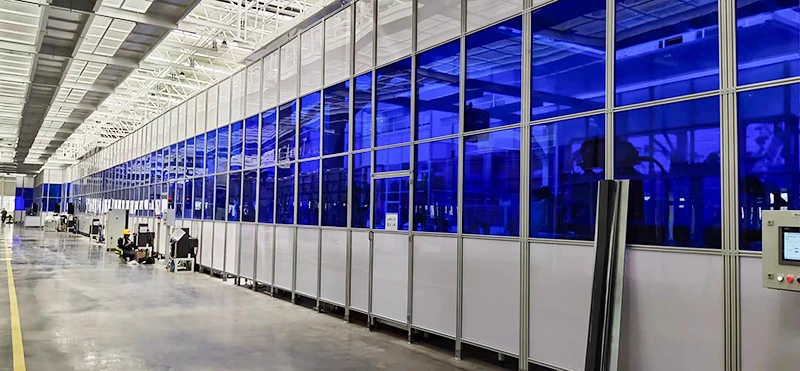
Where this mounting principle pays for itself
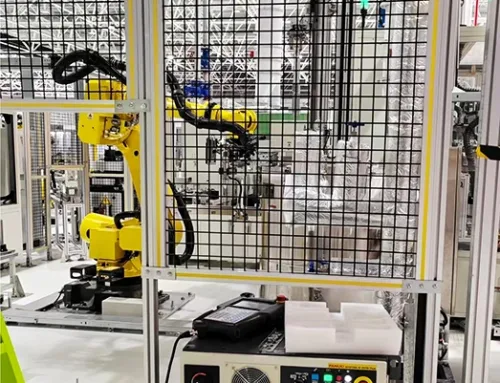
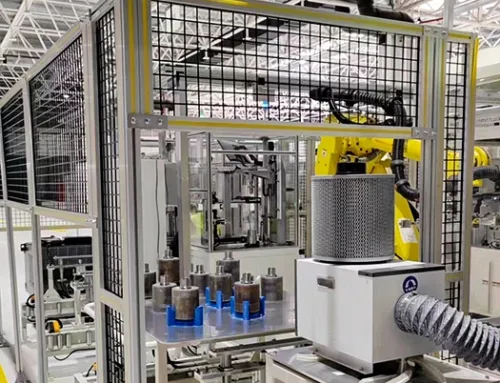
- Robot cell guarding and robot safety fence projects — the interlock and the light curtain mount on the same post line, so no bracket is welded on after the cell is built.
- Welding cell guarding — solid PC or acrylic panels handle arc exposure while the switch and e-stop stay outside the spatter zone, in the slot rather than on a drilled plate.
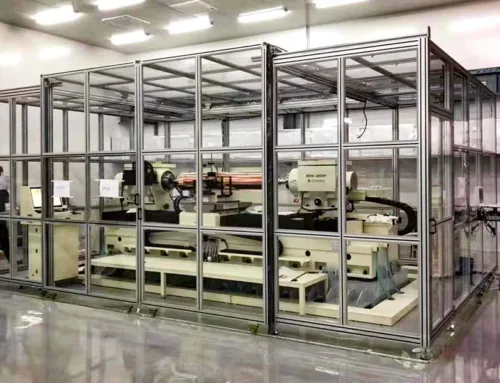
- CNC machine guarding and machine tool enclosures — coolant and chips no longer reach a bare drilled hole; the aluminum profile carries the door interlock.
- Packaging line and palletizer guarding — multiple interlocked access doors along one run, each aligned by the same frame geometry.
- Conveyor guarding, AGV path guarding and shuttle car protection — 20×100 mm mesh keeps visual contact with the aisle while the safety circuit stays enclosed.
- ASRS and automated warehouse guarding — long straight runs with repeated access points, where a single drill-and-rewire cycle per door would otherwise dominate the shutdown.
- Cleanroom guarding and corrosion-sensitive indoor areas — extruded, shot-blasted and powder-coated profiles suit rooms where bare steel and drilling debris are not acceptable.
- Retrofit guarding and relocatable guarding — posts and panels can be unbolted, re-positioned and re-used when the line changes, with the interlock hardware re-fitted into the same slot.
Every one of these layouts still has to be verified against the machine’s own risk assessment and the applicable guarding standards, including EN ISO 14120 for the physical barrier, EN ISO 13857 for safety distances and EN ISO 14119 for interlocking devices. The profile family makes the hardware easy to install and easy to move; it does not replace the engineering review that decides where the door, the switch and the light curtain belong.
Retrofit documentation we can prepare for your project
Send us the cell layout, the existing door leaf sizes and the interlock model you specify. We will map the post positions, the door types — hinged, folding, telescopic, sliding or linear — and the switch and light-curtain mounting points onto a T-slot post schedule, with mesh or transparent panel zones marked, so the installation team knows before the shutdown where every bracket locks in and no drilling is required.
Replace drilled steel posts with a T-slot mounting surface
If an interlock bracket is still being bolted through a painted post, the next phantom stop is already scheduled. Share your guarding layout and we will come back with the Alfence post, panel and door configuration that keeps the safety circuit aligned and the coating intact.