ES
 EN
 DE
 RU
 PT
 JA
 IT
CONVEYOR TUNNEL GUARD / CONVEYOR LINE SAFETY GUARDING
A hole cut for a belt is not a transfer opening, it is an EHS nonconformity waiting to be found
Belt conveyors and sortation lines have to pass through the perimeter, and the usual site fix is a grinder and a generous rectangular hole. At acceptance the EHS reviewer measures the gap, decides a person can climb through it, and the line loses its commissioning slot to rework. A conveyor tunnel guard treats the transfer opening as a guarded passage sized to ISO 13857: the aperture and the reachable distance to the hazard are calculated together, infill panels close the space above, below and beside the belt, and the framed mesh panels are prefabricated in the factory so the site only bolts modules together. One conveyor integrator’s project cleared the end customer’s acceptance on the first pass with a prefabricated tunnel guard and standard hole positions.
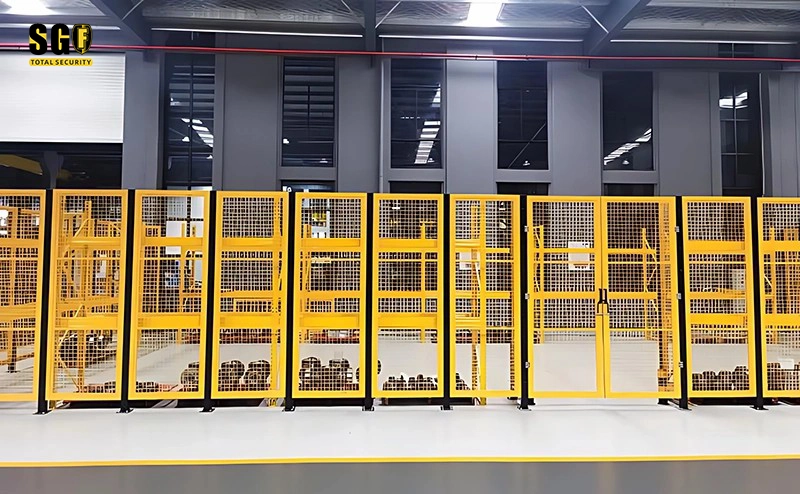
Send your belt width and transfer height for a tunnel guard drawing
The aperture is only half of the ISO 13857 check
A cut opening is judged by what a person can reach from outside it, not by the size of the product passing through. If the belt is short and the nip point sits just behind the panel, even a modest gap can fail. The tunnel adds reachable distance, so its length becomes part of the safety distance calculation rather than a cosmetic detail.
| Verificar | What is measured and recorded |
|---|---|
| Locate the hazard | Mark the nip points, drive rollers, moving belts and any ejected-product risk inside the cell. The reference point is the nearest dangerous part, not the machine frame. |
| Measure the reach path | Trace the shortest path from the outer face of the opening to that hazard, including the full tunnel length and the angle of approach. Aperture size and distance are then checked together against the ISO 13857 tables for upper and lower limb access. |
| Close the surrounding gaps | Above the belt, below the return run and to both sides of the conveyor frame, the same aperture rule applies. A 150 mm bottom clearance seen in project documents is not automatically acceptable; it is re-checked against the floor and the reach path. |
| Resolve a failed check | Extend the tunnel, reduce the clear opening to the product envelope plus running tolerance, or add an internal baffle. The answer is on the drawing, not a wider cut on site. |
Why a prefabricated tunnel guard survives acceptance
Above, below and beside the belt are separate panels
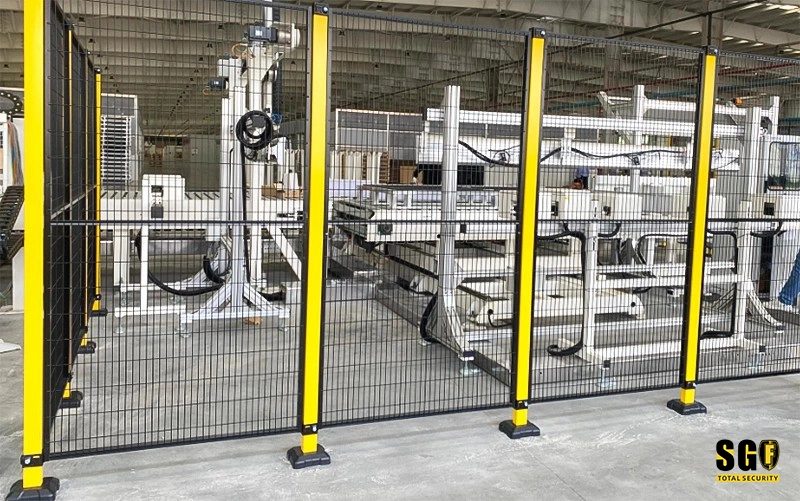
The transfer opening is built as a set of framed mesh panels with a 20x30x1.5 mm tube border, 3.0 or 4.0 mm wire and a 20×100 mm aperture, fixed to Q235 posts with M8 fixing rings and four M10 expansion anchors per base plate. Upper and lower infills are made to the measured belt height and return clearance, and narrow side infills close the gap to the conveyor frame using the same aperture rule. Every piece is manufactured with its hole positions and part code, so conveyor line safety guarding arrives as a bolt-together assembly instead of a cut-and-weld repair.
Cutting a framed panel destroys the evidence
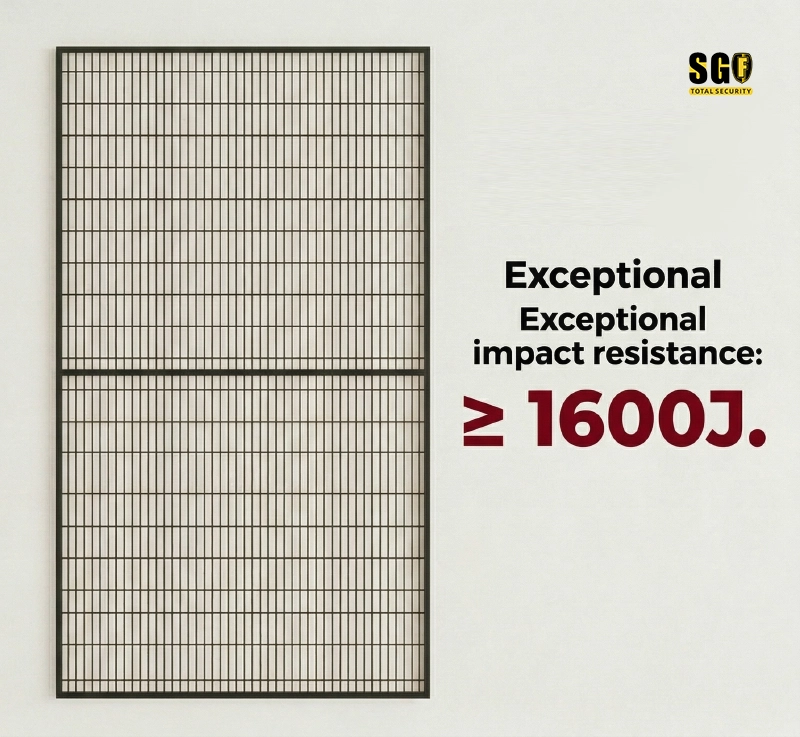
A grinder opens the tube border, exposes bare steel, breaks the electrostatic powder coating and removes the flatness and burr-free weld condition recorded for that unit. It also changes the aperture locally, which is exactly what the EHS reviewer measures. A modular safety barrier keeps the panel intact: the tunnel dimensions go into the general arrangement drawing, the fence layout BOM lists each upper, lower and side infill, and the crate carries matching part codes. That is the practical reason a prefabricated tunnel guard and standard hole positions passed an end customer acceptance on the first pass in one conveyor integrator project; it is a single project record, not a claim about every plant.
Where the light curtain and the emergency stop take over
A tunnel guard is physical guarding: it prevents access by geometry. A light curtain is presence detection at the material opening and needs muting or blanking logic so product can pass without stopping the line; an emergency stop is a deliberately triggered stop command, not a guard. Both feed the safety circuit designed by the integrator, along with any safety interlock devices on the access gate and the safety lock mounting carrier prepared for Omron D4NL or Pizzato FS switches. Our scope is the machine guarding fence panels, the standard hole positions and the installation datum; the safety circuit, safety rating, PLC logic and validation belong to the electrical team and the local risk assessment under ISO 14120.
Lines where a drawn tunnel is worth the drawing time
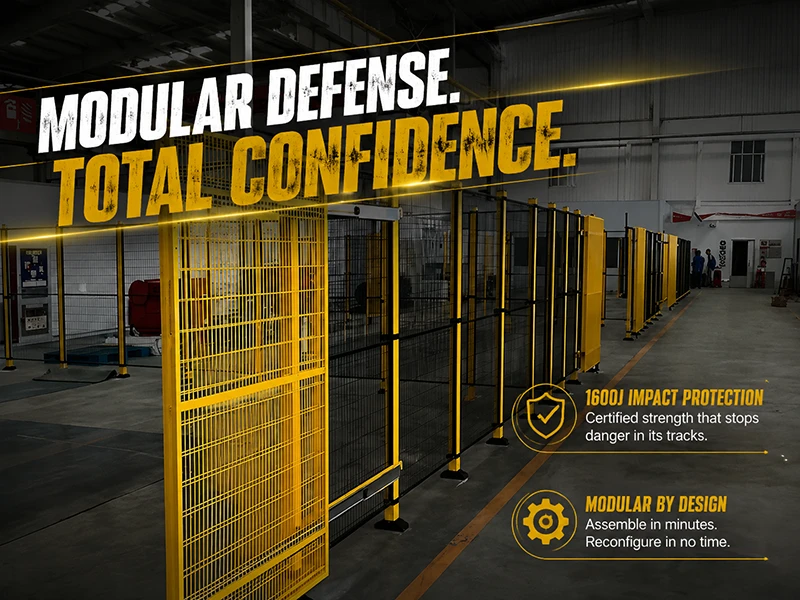
- Conveyor line safety guarding and sortation transfers: the product envelope is fixed, so the opening can be sized to it plus running tolerance.
- Automated material handling safety and palletizer safety guarding: infeed and outfeed openings are listed on the same drawing as the gate schedule.
- Machine perimeter guarding around a shared cell: the reach path is measured to the nearest nip point, not to the fence line.
- Flexible manufacturing and later line changes: coded infill panels can be replaced when the belt height changes.
A physical guarding solution that closes every gap around a transfer opening lets commissioning proceed on the EHS decision, not on a second fabrication visit.
The inputs for a tunnel guard drawing
Send the belt width and height, product envelope and running tolerance, conveyor frame position, transfer height above finished floor, hazard locations inside the cell, floor and anchor conditions, gate positions and the light curtain or safety switch model chosen by the integrator. The returned pack carries the general arrangement with the opening and reach path dimensioned, the upper, lower and side infill schedule, the panel and post BOM with part codes, the fastener and packaging list and the acceptance checklist. The local EHS engineer signs the ISO 13857 calculation and the risk assessment.
Let the product through, not the person
Size the opening to the load, add the tunnel length to the reach calculation, and close every surrounding gap with a manufactured panel. Acceptance then has one drawing to review instead of a site modification to reject.