ES
ES  EN
EN  DE
DE  RU
RU  PT
PT  JA
JA  IT
IT Industrial Safety Fence for ZeroLabor robot cells
Industrial Safety Fence for robot-cell interlock retrofits
When technicians must enter a fenced robot cell for maintenance or insulation refill, the gate must talk to the central control system without delays. Mdfence is built as an Industrial Safety Fence platform with pre-set hardware carriers for electronic interlocks, so the safety gate can trigger shutdown cleanly instead of forcing a field-made workaround.
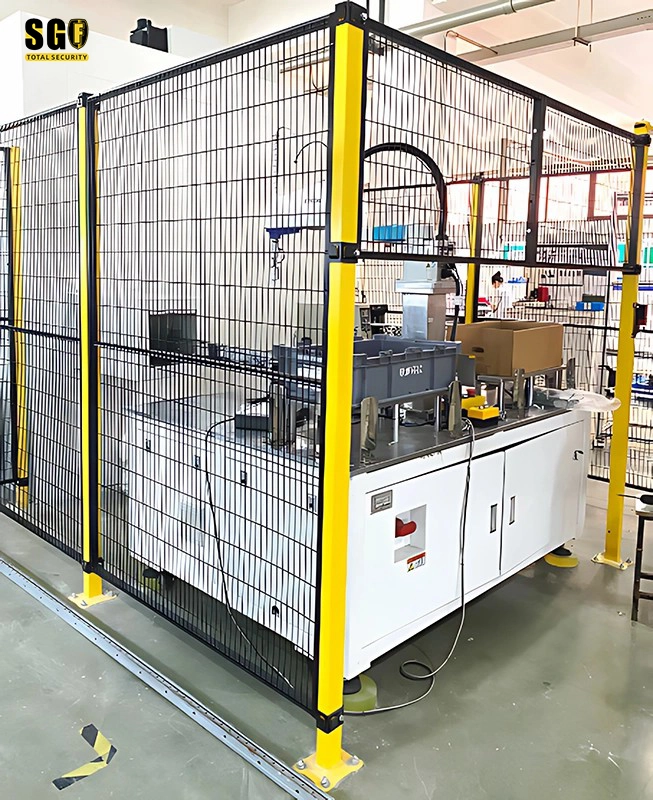
Why the integration problem starts on the shop floor
In a high-automation cell, the pain is rarely the fence panel itself. The real issue is repeated adjustment work: the safety gate must align with the controller, the interlock switch must fit the door, and every change must still support a stable stop signal. If the fence arrives without a proper mounting path, electricians end up drilling, cutting, and reworking panels on site. That slows commissioning and creates inconsistent interlock quality.
| Necesidad del cliente | Respuesta de Mdfence |
|---|---|
| Fast connection to the robot control loop | Pre-set lock carrier makes electronic interlock installation straightforward |
| Less field modification | Standardized fence structure reduces drilling and cutting on site |
| Stable shutdown behavior | Gate and interlock can be aligned as a repeatable system, not a one-off fix |
| Cleaner commissioning | Electricians can work from a predictable mounting layout |
Why Mdfence fits electronic interlock work
1. The fence is built as an integration platform, not just a barrier
Mdfence is designed around a standard lock carrier, which is the key reason it suits electronic safety switches. Instead of leaving the contractor to fabricate a switch point after delivery, the fence gives the electrical team a consistent place to install the interlock hardware. This is the difference between a physical barrier and a commissioning-ready Industrial Safety Fence.
2. The structure supports repeatable installation
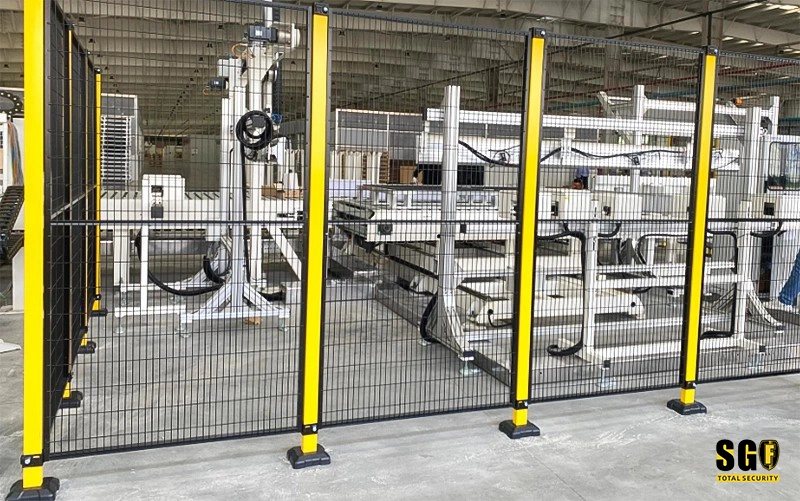
The product evidence matters here. The detail board shows the weld seam, coating, and base plate together, which is exactly what a plant team wants before they commit to a multi-cell retrofit. The installation diagram shows base plate positioning, drilling, expansion bolts, and retaining ring assembly, making the assembly sequence easy to follow when the gate must line up with interlock hardware.
3. The panel layout gives engineers a clean mounting reference
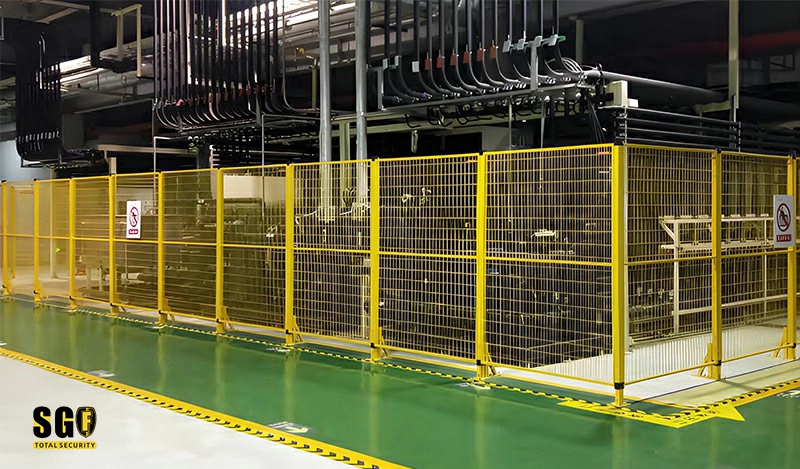
The technical front view clarifies the relation between post, mesh panel, and fixing clamp. That is useful because interlock work depends on geometry: the door side, post side, and hardware side all need a consistent reference. For plants that run ZeroLabor-style robot cells, this reduces rework when the gate must open for maintenance and immediately return the cell to a safe stopped state.
Where this solves the problem best
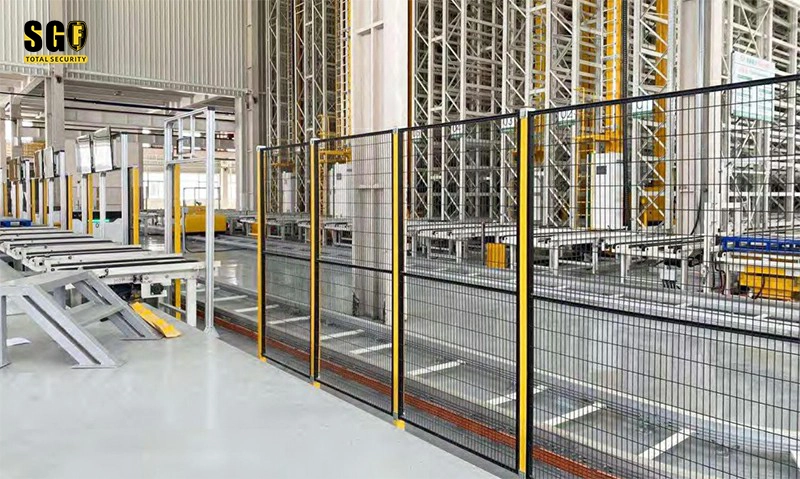
- Robot cells that need routine technician access without breaking the safety chain.
- Automation lines where the interlock must be connected to a central stop logic.
- Retrofit projects where electrical teams want a pre-engineered mounting path instead of field drilling.
- Plants that need a stable fence layout for repeat maintenance and controlled shutdown.
For these scenarios, the result is simple: faster integration, less site work, and a more stable safety interlock system. Mdfence helps the gate behave like part of the control architecture, not a separate accessory.
Cómo se ve el resultado final
A technician opens the gate, the interlock talks to the controller, and the cell stops as intended. When the work is done, the same standardized fence hardware helps the system return to service with less adjustment and fewer repeat calls. That is the practical value of an Industrial Safety Fence designed for integration first.
Plan your next interlock-ready fence layout
If your team needs a fence that matches electronic safety switches without field improvisation, Mdfence gives you a cleaner path from layout to commissioning.