ES
ES  EN
EN  DE
DE  RU
RU  PT
PT  JA
JA  IT
IT 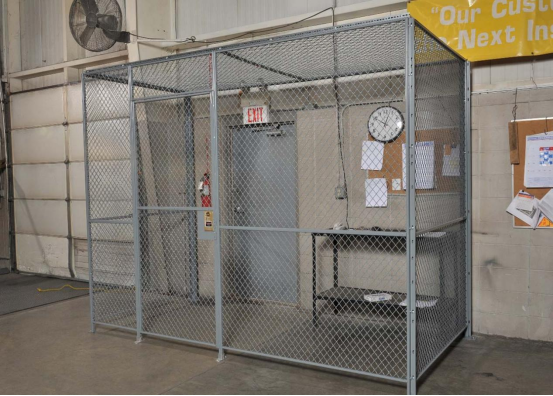
This is a look at the small, daily inefficiencies that add up to a massive operational drain. If you manage a busy warehouse, this might sound familiar. We often try to solve systemic safety and efficiency issues with rules and signs, but the real solution may lie in physical barriers like mesh partition panels that create clear, safe zones.
2:15 PM PST
The afternoon rush. The air is thick with the hum of the ventilation fans and the high-pitched whine of a forklift in reverse. From my office window, I have a clear view of Bay 3. My best forklift operator, John, is executing a perfect high-level retrieval—a delicate, two-ton dance he’s mastered over the years.
Just as the pallet clears the racking, a truck driver, a new guy, wanders away from his cab. He’s holding a bill of lading like a lost map. He steps just past the faded yellow line on the floor, looks around, and spots John, the closest person in uniform. He walks towards the forklift.
My hand instinctively reaches for the intercom button to yell, but I stop myself. It’s too late.
John sees him. He has to. Per protocol, he halts the descent, stabilizes the load mid-air, and sounds a short, polite beep from his horn. The driver waves the paper. John gestures for him to wait, safely completes the drop, powers down the lift, and dismounts.
The whole exchange takes four minutes. The driver just needed to know where the shipping office was. Four minutes. Trivial, right?
No. That’s the lie we tell ourselves.
Let’s do the real math. It was four minutes for the driver. For John, it was a complete operational reset. The mental cost of breaking focus during a high-stack maneuver. The procedural cost of powering down and restarting. The physical cost of a delayed put-away, which now creates a small bottleneck in the main aisle. That four-minute question didn’t cost four minutes of productivity. It cost ten.
This happened twelve times today with different drivers and different employees. That’s 120 minutes. Two full hours of my team’s most valuable resource—focused, uninterrupted time—gone. Vanished into thin air because of a simple question that shouldn’t have been asked in a high-traffic zone.
3:30 PM PST
A new kind of chaos. A driver for one of our key suppliers, someone who should know better, is on a mission. His paperwork is missing a signature from receiving. But the receiving clerk is at the other end of the facility.
So, the “scavenger hunt” begins.
I watch him on the CCTV feed. First, he asks a packer, who points him vaguely down Aisle 7. He walks down Aisle 7, a zone strictly for authorized personnel, dodging two pallet jacks along the way. At the end of the aisle, he finds a floor supervisor. The supervisor doesn’t have the authority to sign, so he gets on his radio. The call goes out for the receiving clerk, who is now interrupted while unloading another truck.
Let’s calculate this cost:
- The Driver: 8 minutes spent walking through a hazardous area.
- The Packer: 1 minute of lost focus and productivity.
- The Supervisor: 3 minutes of his time spent coordinating.
- The Receiving Clerk: 5 minutes to stop his current task, walk over, sign, and return.
Total cost: 17 minutes of collective time, involving four different people, to solve a problem that was created by one person being in the wrong place. The risk factor is even harder to quantify. What is the cost of a non-safety-trained individual walking unescorted through a live warehouse? It’s a liability I don’t even want to think about. This isn’t just inefficient; it’s a game of Russian Roulette we’re playing every single day.
4:45 PM PST
I’m at my desk, trying to work on next quarter’s inventory slotting plan. This is the “deep work” that can actually save the company money. But I can’t focus. My brain is still on the floor.
Every unexpected shout, every long blast of a horn, makes me look up. My mind is constantly running a background process, a low-level anxiety program scanning for the next interruption, the next near-miss.
This is perhaps the greatest hidden cost of all: the manager’s mental overhead.
My job should be to architect a more efficient system, to train my people, to strategize. Instead, I spend at least half my day as a highly-paid security guard and firefighter. My most valuable contributions are being stolen by the constant, nagging need to manage the chaos at my own front door.
We’ve tried everything. Bolder yellow lines. Bigger signs (in three languages). Stern warnings in our morning briefings. We’ve made our people responsible for policing the area. But we’re trying to solve a systemic problem with behavioral suggestions. It’s like trying to fix a leaky pipe by shouting at the water.
The Epiphany
As I close out the day, I add it all up. The small interruptions, the scavenger hunts, the congestion delays. I can tangibly account for over three hours of lost operational time. That’s nearly half a full-time employee’s salary, wasted. Every. Single. Day.
And it strikes me. The problem isn’t the drivers. They’re just people trying to do their job in an environment that is confusing and poorly designed for them. The problem isn’t my staff. They are doing their best to work around the chaos.
The problem is the system itself. Or rather, the lack of one.
My focus has been wrong. I’ve been trying to control the unpredictable actions of dozens of different people every day. It’s an impossible, exhausting battle.
Maybe the question isn’t, “How do I get people to follow the rules?”
Maybe the real question is, “How do I design a space where following the rules is the only option?” By using physical structures like mesh partition panels, I could create safe walkways and secure areas, making the safe and efficient action the most obvious one.
I don’t have the final answer yet. But for the first time, I feel like I’m finally asking the right question.