EN
EN  DE
DE  RU
RU  PT
PT  JA
JA  ES
ES  IT
IT Industrial Perimeter Guarding
Industrial Perimeter Guarding for Fast Cold-Work Machine Cell Installation | Mdfence
Industrial Perimeter Guarding only works in B2B projects when it can be installed fast, accepted cleanly, and reconfigured later without hot work. Mdfence is built for that reality: modular steel panels, clamp-based joints, and a cold-work assembly method that shortens delivery time while keeping machine cells controlled.
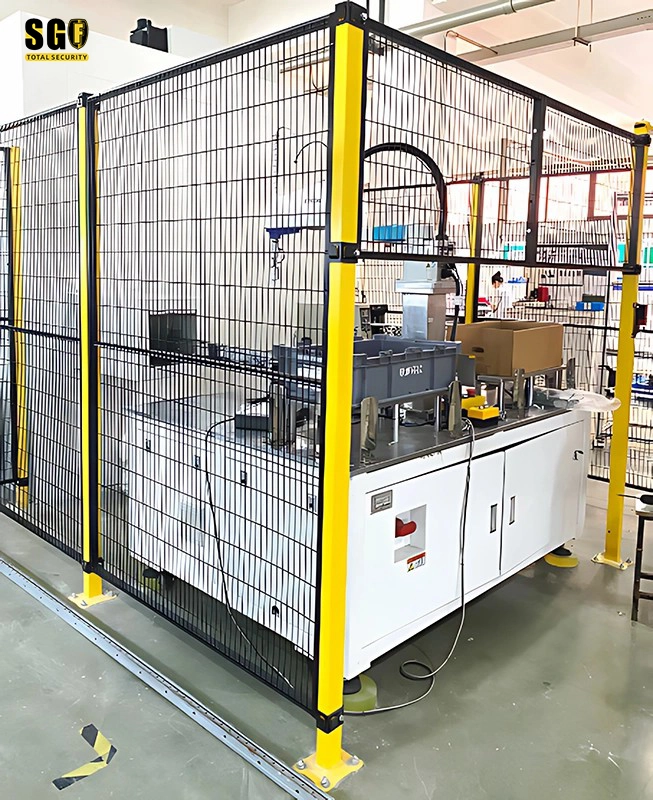
What buyers need when the project clock is tight
Most mid-market buyers are not trying to buy the cheapest fence. They are trying to avoid delays, rework, and site complaints. If a guarding system needs welding on site, special fabrication, or endless adjustment to fit a changed layout, the project starts losing value before the line even runs. Industrial Perimeter Guarding must therefore solve three things at once: fast installation, predictable acceptance, and future layout flexibility.
| Project requirement | Mdfence response |
|---|---|
| No hot work on site | 100% modular cold-work assembly with clamp-style rings and hex-screw connections |
| Fast handover | Typical assembly speed improves by 40% to 70% versus welded barrier methods |
| Layout changes | Panelized structure can be re-opened, moved, and reassembled for line changes |
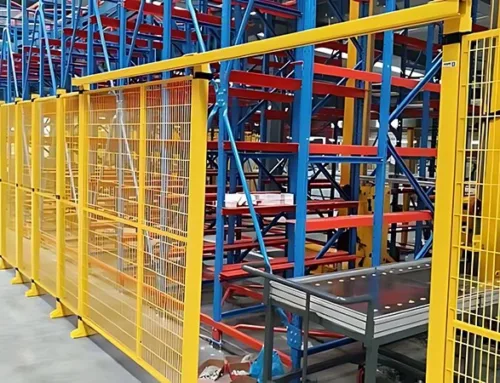
| Clear safety boundary | Yellow posts and black mesh create strong visual warning for operators and visitors |
| Site acceptance | Pre-engineered base plates, door points, and accessory-ready interfaces support clean commissioning |
Why Mdfence fits fast-installation guarding projects
1. Cold-work assembly removes the slowest step
Mdfence is designed so the installer can complete the fence with clamp-style retaining rings and inner-hex screws instead of field welding. That matters when the customer does not have a dedicated welding engineer, or when the site rule set makes hot work expensive to approve. In practice, this turns Industrial Perimeter Guarding from a fabrication task into an assembly task.
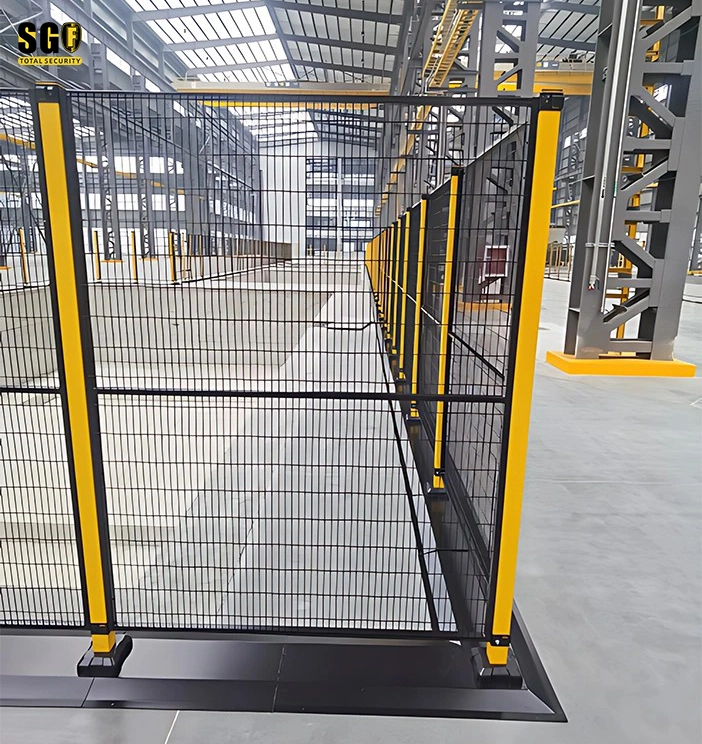
2. The structure is made for real industrial use, not temporary partitioning
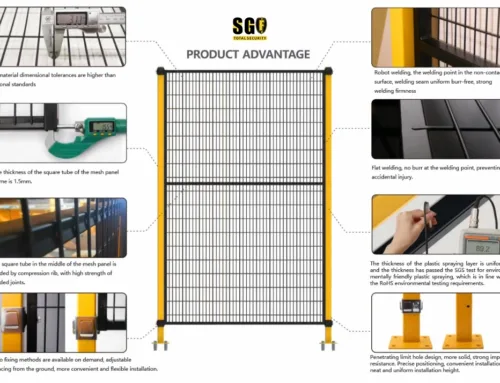
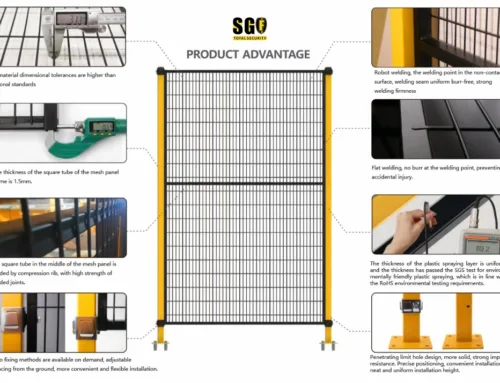
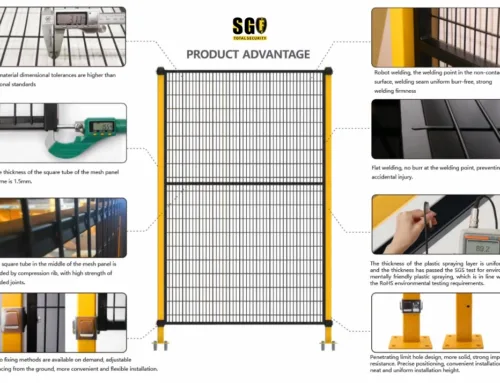
The product brief points to a Q235 carbon steel system with common 60×60 mm posts, 20×30 mm reinforced panel frames, and 20×100 mm machine-guard mesh using 3.0 mm or 4.0 mm wire. That combination gives buyers a proper machine-cell barrier rather than a light-duty visual separator. The result is a fence that stays stiff at gates, corners, and long straight runs.
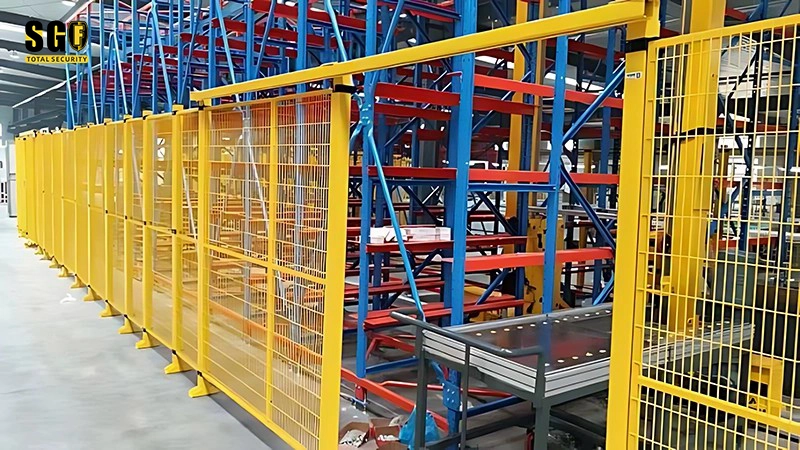
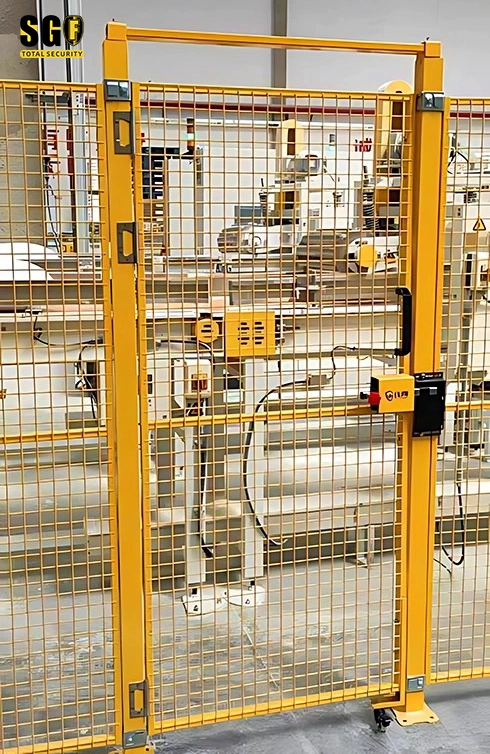
3. The detail proof is visible in the gate and fixing points
Fast installation still has to pass inspection. That is why the system is built around base plates, drilling points, fixing clamps, and accessory-ready gate hardware. The product also uses the familiar yellow-post and black-mesh language that makes hazards easy to read in a crowded plant. This is the kind of guarding that helps EHS teams, integrators, and plant managers speak the same language during commissioning.
Where the fastest value shows up
- Robot cells that need a clean perimeter without site welding
- CNC, welding, and assembly zones with frequent line changes
- Conveyor and transfer areas that must stay protected during commissioning
- Warehouse aisles where guarding must respect narrow circulation paths
- Projects where the buyer needs a fence that can be reordered, extended, or relocated later
The practical result is simple: the buyer gets a safer cell faster, the integrator spends less time on call-back support, and the plant avoids the hidden cost of a welded solution that becomes hard to change after the first production revision.
Spec snapshot for procurement and engineering teams
Typical Mdfence project options include powder-coated steel panels, safety-yellow posts with black mesh, common heights around 2000 mm or 2200 mm, and door interfaces that can be prepared for locks or interlock devices. For Industrial Perimeter Guarding projects, the important point is not a single number; it is the way the system combines structure, access control, and fast assembly into one delivery method.
Final result
When a customer needs Industrial Perimeter Guarding but cannot afford a slow welded install, Mdfence gives them a modular cold-work path. That means faster deployment, lower guidance burden, cleaner handover, and a barrier that can grow with the line instead of locking the line into yesterday’s layout.