IT
IT  EN
EN  DE
DE  RU
RU  PT
PT  JA
JA  ES
ES 
|
For Production and Facility Managers, perimeter guarding is more than a compliance box—it’s the first line of defense for critical assets. This article moves beyond standard safety talk to focus on structural integrity. We detail how the material specification and welding process of your recinzione di sicurezza industriale directly determine its resilience, long-term maintenance costs, and ability to prevent costly production stops in high-traffic, high-risk industrial environments. |
The Unseen Cost of Low-Impact Fencing
In facilities operating high-value equipment—from advanced CNC centers to automated warehousing systems—an unplanned shutdown can cost thousands of British pounds per hour. Often, the cause of the downtime isn’t machine failure, but a damaged perimeter barrier. A flimsy guard railing, easily bent by a pallet jack or a glancing blow from an automated guided vehicle (AGV), can trip a safety light curtain or impede a sliding door, forcing an immediate, unscheduled stop.
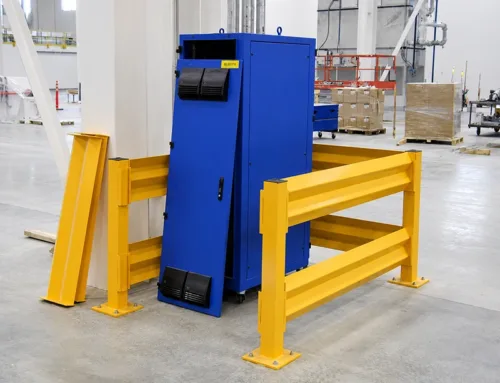
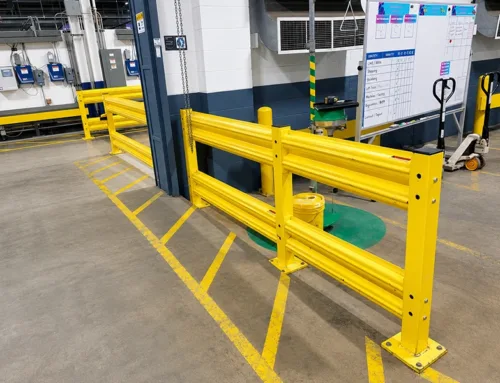
The core value of premium Recinto di protezione per macchine is its certified impact resistance. Systems built with high-strength Q235 carbon steel and robust 60x60mm posts are engineered to absorb accidental impacts without structural failure. This resilience keeps the production boundary secure and functional, preventing accidental shutdowns and safeguarding the high-precision machinery within.
Structural Integrity: Where Manufacturing Quality Pays Off
The Power of Fully-Welded Framed Panels
The true strength of a modular panel lies not just in the steel wire gauge, but in how it connects to the frame. Many systems rely on simple clips or partial welds. However, the use of fully-welded framed panels—where the mesh wires are flattened and completely welded to the interior of the steel tube frame—creates a rigid, single-piece structure.
Questo Recinzione di sicurezza industriale design ensures that energy from an impact is distributed evenly across the frame, not localized to a single clip or weld point that could fail. This superior stiffness, often verified by independent TUV safety certifications, provides a critical margin of protection for staff and equipment that flimsy alternatives cannot match. For operations managers, this detail means fewer maintenance callouts and zero compromise on physical barrier effectiveness.
Protecting Your Investment from Corrosion and Wear
The long-term visual appearance and structural longevity of the fencing system depend entirely on the surface treatment. In manufacturing environments where humidity, coolant splashes, or frequent cleaning are common, standard paint finishes degrade quickly, leading to rust and a compromised professional image.
High-quality systems use a powder coating process compliant with international standards (such as GB/T9286-1998 for coating adhesion) and validated by salt spray corrosion tests (ISO9227). This durable, resilient finish prevents corrosion from weakening the Q235 carbon steel structure over years of heavy use. A visually clean, intact barrier system also reinforces safety compliance and good housekeeping across the facility.
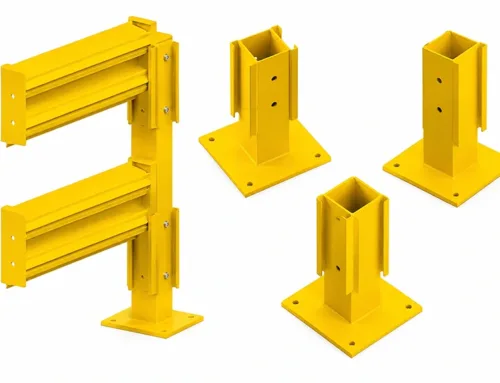
Image: Post base protective covers ensure a clean environment, prevent trip hazards, and protect floor-anchoring expansion bolts from damage.
Operational Value: The Flexibility of Future Layouts
Facility layouts are rarely static. As production lines change, new robots are introduced, or workflows are optimized, the perimeter guarding must adapt. A truly modular system, with standardized posts and panels, allows maintenance teams to quickly reconfigure, expand, or move large sections of the barrier with minimal tools.
This flexibility ensures that your initial capital expenditure remains a valuable asset, rather than disposable scrap. Whether you need an extra wide access point for an overhead crane or a new 45-degree angle to accommodate a new conveyor, the system components should be designed for non-destructive reassembly. This protects your investment and drastically reduces the engineering time required for facility updates.
Domande frequenti (FAQ)
Why is TUV certification important for industrial safety fencing?
TUV certification provides independent, verifiable proof that the physical barrier meets specific structural requirements, particularly concerning impact resistance. For facility managers, this means the fencing has been tested and confirmed to protect expensive machinery (like Sistemi di recinzione di sicurezza per robot) from accidental collisions and internal equipment failures.
What is the benefit of Q235 carbon steel compared to typical mild steel?
Q235 carbon steel is a high-grade structural steel known for its excellent strength and toughness. When used in safety barriers, it ensures the posts and frames maintain their rigidity and dimensional stability under stress, which is crucial for preventing fence deformation that could obstruct doors or compromise safety integrity.
How do the various door systems (sliding, folding, hinged) support facility operations?
The range of modular door systems is designed to address operational constraints. Sliding doors are ideal for wide openings with limited swing space; folding doors maximize opening width in extremely tight areas; and hinged doors are standard for personnel access. Choosing the right door ensures efficient material flow and personnel access without creating new safety hazards.
Does the powder coating require special maintenance?
The industrial-grade powder coating is highly durable and compliant with stringent adhesion and corrosion standards. It requires only standard cleaning, offering superior resistance to chemical damage and rust compared to liquid paint, minimizing long-term maintenance needs and keeping the barrier looking professional for years.
Are special tools required for installation or modification?
Modular fencing systems are designed for rapid, non-destructive assembly. They utilize standardized, easy-to-use fasteners that typically require only basic hand tools like hex wrenches and a hammer drill for floor anchoring. This allows in-house maintenance teams to quickly install or modify the system without needing specialized welding or cutting equipment.